Your rep has a call in two hours. The buyer asked for a proposal “by end of day.” Someone grabs an old deck, swaps the logo, pastes in last quarter’s pricing, adds three slides about the company, exports a PDF, and sends it off. Nobody on the buyer side can quickly find the scope. The CFO hunts for the commercial terms. The implementation lead wants to know who owns what. The champion likes the idea but can’t circulate the document internally because it reads like a brochure, not a decision tool.
That’s how decent deals stall.
Proposals are seldom lost because of a forgotten section title. Instead, they are lost because the document makes the buyer do too much work. A proposal should help people approve a purchase, align stakeholders, and reduce perceived risk. It should move cleanly from the problem to the recommended approach to execution proof.
A practical framework already exists. Asana’s project proposal guidance describes a useful four-step workflow: define the problem and success criteria, translate them into SMART objectives and deliverables, specify the approach with roles and milestones, and close with a resource and budget plan. That’s the backbone. The difference in B2B sales is how you package it for real buying committees and how you make it easier to review, share, and act on.
Introduction
Teams asking how to structure a proposal usually think they need a cleaner template. What they usually need is a different operating model.
A proposal that wins isn’t a long-form pitch about your company. It’s a decision document built so a buyer can say yes, send it to finance, forward it to legal, and hand it to the implementation team without rewriting your work. If your proposal can’t survive internal forwarding, it’s weak no matter how polished it looks.
The useful shift is simple. Stop thinking in pages. Start thinking in decisions. Every section should answer one buyer question: What problem are we solving? Why this approach? What exactly are we buying? How will it roll out? What will it cost? What happens next?
Practical rule: If a stakeholder has to search for the core commercial or delivery details, the proposal is under-structured.
That’s why the four-part workflow works so well in sales. First define the problem and success criteria. Then turn that into objectives and deliverables. Then show the approach, roles, and milestones. Then show the resources and budget. It keeps the document moving in the same order buyers evaluate risk.
The rest is execution. Strong proposals align to the buyer’s priorities, tell a concise story, prove feasibility with clear scope and timelines, and remove friction at the signature stage. The modern upgrade is making that structure interactive so the document stays current and useful after you send it.
Aligning Your Proposal with Purpose and Audience
The biggest proposal mistake happens before the first sentence gets written. Teams draft from their standard outline instead of the buyer’s real decision process.
A high-performing proposal should be structured as a decision document, not a narrative, and the strongest outline starts by extracting every explicit and implicit requirement from the opportunity while placing value proposition, pricing, and key benefits up front. That advice matches what strong sales teams do in practice. They build the proposal backward from how the account will evaluate it.

Start with the buyer’s scoring logic
Even when the buyer doesn’t share a formal rubric, one still exists. Finance wants cost control and clarity. Operations wants adoption and timeline realism. Security wants compliance answers. The executive sponsor wants confidence that the investment solves the stated problem without creating a new one.
That means your discovery notes need to answer questions like these:
- What business problem triggered this purchase? Name the operational pain, not just the requested feature.
- What does success look like for this account? If the buyer can’t define success, your proposal should help them define it.
- Who signs, who influences, and who blocks? These are different roles, and your structure should reflect them.
- What has to be true internally for approval to happen? Procurement, implementation readiness, legal terms, and stakeholder consensus all matter.
A lot of account teams now organize this input in one place before drafting. For teams handling multiple stakeholders, account executive workflows often benefit from having research, call notes, and proposal inputs connected rather than scattered across email threads and slide comments.
Buyers rarely reject a proposal because it had too little branding. They reject it because it didn’t answer the questions their internal reviewers actually asked.
Map section ownership before you draft
A lack of clear ownership often causes proposals to slow down. Sales owns the executive summary. Solutions engineering owns technical approach. Finance owns pricing approval. Legal owns terms. If nobody assigns ownership early, the proposal turns into a stitched document with duplicated points and missing details.
A simple internal map works better than endless revision cycles:
- Decision section. Executive summary and recommendation. Usually owned by the seller or deal lead.
- Delivery section. Scope, implementation model, dependencies, milestones. Usually shared with presales or delivery.
- Commercial section. Pricing, assumptions, option logic, terms. Usually shared with finance and leadership.
- Proof section. Customer references, evidence, credentials, supporting materials. Usually gathered by enablement or the account team.
The key trade-off is speed versus specificity. A generic proposal goes out faster, but it makes the buyer do the customization mentally. A customized proposal takes more effort, but it shortens the buyer’s path to internal alignment. In competitive deals, that trade-off usually favors specificity.
Crafting the Core Proposal Narrative
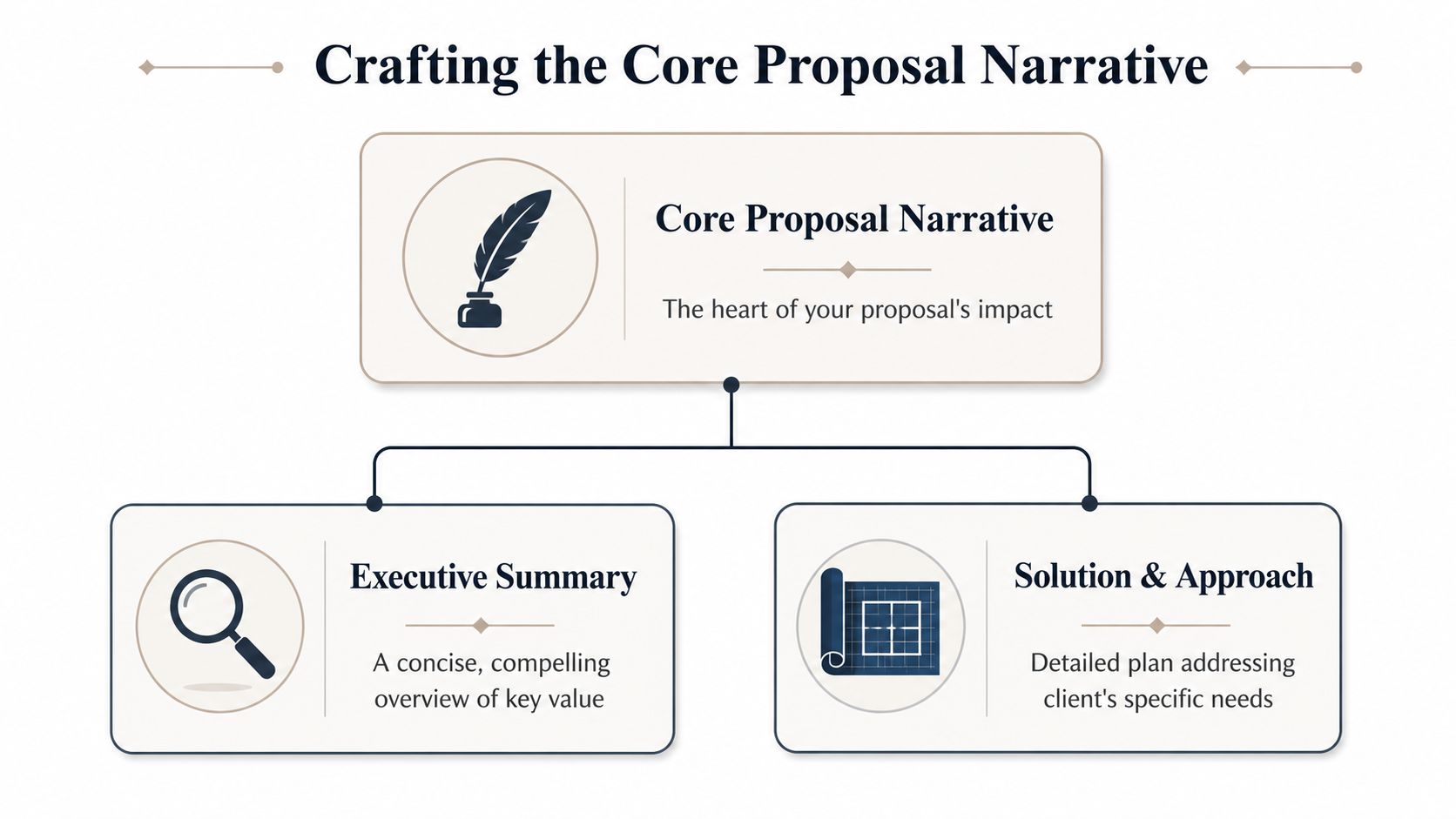
Most buyers decide whether a proposal is worth serious attention in the first page or two. That’s why the heart of the document isn’t the company overview. It’s the combination of the executive summary and the solution narrative.
Write the executive summary for the executive who won’t read everything
A weak executive summary says what your company does. A strong one says what the buyer is trying to achieve, what stands in the way, what you recommend, and what happens if they approve the plan.
The easiest way to write it is to answer five points in order:
- Current situation. What the buyer is dealing with right now.
- Desired outcome. What they want to change.
- Recommended approach. Your solution in plain language.
- Expected working model. How the engagement will run.
- Commercial snapshot. The investment and next decision.
This should read like a mini-proposal. If a CRO, CFO, or VP only reads that page, they should still understand the recommendation.
Keep the summary short enough to scan, but concrete enough to circulate internally without a translator.
What doesn’t work is opening with your founding story, product architecture, or a generic “about us” section. Those belong later, and only if they support the purchase decision.
Build the solution story around defended choices
The middle of the proposal is where many teams lose discipline. They dump features, services, or workstreams into the document and assume detail equals credibility. It doesn’t.
The University of Sheffield’s proposal guidance makes a point that applies directly to B2B sales: a strong proposal moves from problem framing to method justification to feasibility evidence, and the methods section should defend choices rather than present a list. That’s exactly right for commercial proposals too. Buyers don’t just want to know what you’ll do. They want to know why this approach is the right fit for their situation.
Structure the solution section around choice and consequence:
Problem and constraint
State the operational reality. Maybe the buyer has fragmented systems, a slow reporting cycle, adoption risk, or a deadline tied to budget or leadership pressure. If you skip the constraint, your proposal sounds detached from the deal.
Recommended approach
Describe the solution in buyer language. Focus on the workflow, implementation model, or delivery sequence. Keep jargon under control. If your presales team would use a whiteboard to explain it live, write it that way.
Why this route
In this section, defend your choices. Explain why you’re recommending phased rollout instead of a big-bang launch. Detail why a shared governance model fits the account. Clarify why certain deliverables come first. Demonstrate judgment.
Feasibility
Buyers need evidence that your plan can be executed. That means naming assumptions, responsibilities, dependencies, and any conditions that affect delivery. A good narrative lowers anxiety. A vague one raises it.
A practical pattern looks like this:
- For executives: lead with business impact and risk reduction.
- For operators: add milestones, responsibilities, and handoff points.
- For technical reviewers: clarify integration or implementation assumptions.
- For procurement: make the commercial structure easy to parse.
That’s how to structure a proposal without turning it into a wall of prose. You’re not writing to impress. You’re writing so each stakeholder can find the part that lets them approve the deal.
Providing Evidence with Scope, Timelines, and Pricing
The proposal stops being persuasive and starts becoming credible when you show exactly what will happen, when it will happen, and what the buyer is paying for. Many competitive deals are won this way, not because one vendor writes prettier sentences, but because one vendor makes the purchase easier to evaluate.
Guidance published in PMC on presenting a research proposal shows how serious evaluators think. Credible proposals are built for review and include operational detail, such as design choices, prespecified outcomes, analysis plans, and timelines. In B2B sales, the exact fields differ, but the standard is the same. Reviewers want enough structure to judge feasibility, compliance, and impact.
Turn promises into reviewable proof
The first proof layer is scope. If the deliverables are loose, the buyer gets nervous and your team inherits future conflict. Good scope language says what is included, what is excluded, what the client must provide, and what counts as completion.
The second proof layer is timeline. A timeline shouldn’t just show dates. It should show sequencing. Buyers need to understand what happens first, what depends on approval, and where their team is required to participate.
The third proof layer is pricing. Strong pricing sections don’t hide the number until the end, but they also don’t throw a bare figure on the page with no logic. They frame the investment in relation to the work, option set, and assumptions.
Three practical moves help here:
- Define the scope in buyer terms. Use deliverables, approvals, workshops, rollout phases, or support windows. Don’t rely on broad labels like “implementation support.”
- Show the timeline as a working plan. Include milestones, owner handoffs, and known dependencies, not just a calendar view.
- Explain pricing logic. Show what drives cost, what changes it, and what assumptions sit under it.
If you need supporting proof, place it next to the claim it supports. Don’t bury all evidence in an appendix. A short note on assumptions, a customer example described qualitatively, or a responsibility matrix often does more work than another page of marketing copy.
For teams refining how they present proof and commercial context, a review of sales enablement tools for proposal and content workflows can help clarify what should live in the proposal versus what should remain in internal systems.
A buyer can tolerate a higher price more easily than a fuzzy scope.
Proposal structure checklist
| Component | Purpose | Key Question to Answer |
|---|---|---|
| Executive summary | Establish the decision quickly | Why should we approve this? |
| Problem statement | Confirm the business need | What issue are we solving? |
| Objectives and deliverables | Translate goals into concrete outputs | What will we get? |
| Methodology or approach | Show how the work will be done | Why this approach? |
| Scope boundaries | Prevent confusion and future disputes | What is included or excluded? |
| Timeline and milestones | Demonstrate execution readiness | When does each step happen? |
| Pricing and assumptions | Make the investment reviewable | What are we paying for and under what terms? |
| Qualifications or proof | Reduce delivery risk | Why trust this team to execute? |
| Next steps | Convert interest into action | What do we do now? |
One more point matters in larger or more regulated deals. If outside parties are involved, proposals often fail in the operational layer, not the storytelling layer. Roles, dependencies, and document ownership need to be settled before submission, especially when budgets, scopes of work, or compliance documents come from different contributors.
Transforming Your Proposal into an Interactive Deck
Static PDFs still have a place. Some buyers need them for procurement files, legal review, or offline circulation. But static proposals create constant friction in live deals. Pricing changes. Scope evolves. Product screenshots age. Account context improves after each call. Then someone has to rebuild slides, resend files, and explain which version is current.
That’s why more revenue teams are shifting from document-first proposals to interactive, web-native proposals that behave more like working sales assets than frozen attachments.
Move from static file to working sales asset
The structure doesn’t change. You still need the same proposal spine: summary, problem, solution, scope, timeline, pricing, proof, and next steps. What changes is how you deliver and maintain it.
A modern setup can pull in CRM notes, spreadsheet-based pricing, discovery inputs, and product visuals into a single deck that sales, presales, and leadership can update without rebuilding from scratch. Tools such as PowerPoint, Google Slides, and web-native platforms all play a role here depending on the buyer and the internal workflow. In cases where teams want browser-based sharing, live data connections, interactive widgets, and export options, presentation template workflows can support a more maintainable proposal process. Encelade is one example of a platform built for that model, with web-native decks, live data support, interactive widgets, and exports to PDF or PPTX.
The practical advantage isn’t visual flair. It’s control.
- Live numbers stay current. If pricing or package assumptions change in the source sheet, the proposal can reflect that without manual copy-paste.
- Interactive elements explain faster. A Gantt, embedded model, or clickable product flow can replace paragraphs of explanation.
- One shared link reduces version confusion. Buyers forward one source instead of juggling attachments.
- Engagement signals help follow-up. Sales teams can see which sections got attention and where interest dropped.
Build for interaction and internal forwarding
An interactive proposal should still be easy to skim. Don’t turn it into a product demo with no commercial discipline. The same buyer questions still need clear answers.
A good interactive structure often looks like this:
- Opening view. A concise summary with recommendation and commercial snapshot.
- Expandable detail. Tabs, accordions, or linked slides for scope, implementation, security, or technical notes.
- Live commercial section. Pricing tables connected to current assumptions.
- Embedded proof. Product visuals, timelines, workflows, or models that buyers can inspect.
- Action layer. Approval steps, contacts, and a clear path to kickoff.
The trade-off is discipline. Interactive proposals are powerful, but they can become cluttered if every stakeholder adds another widget or branch. Keep the core path linear. Put detail behind interaction, not in front of the decision.
Interactive doesn’t mean complicated. It means the buyer can get the right level of detail without losing the main thread.
Closing the Deal with Clear Next Steps
A proposal can be well argued, sharply priced, and still fail because the ending is soft. Buyers shouldn’t have to guess what happens after they agree.
Give the buyer one clear path forward
The final section should remove ambiguity. State the next action, who owns it, and what follows once they take it. If there are several possible actions, rank them. Don’t give five equal-weight options and hope they choose one.
A clean close usually includes:
- Primary approval action. Sign, approve, or confirm in writing.
- Immediate follow-up step. Book kickoff, schedule commercial review, or align implementation owners.
- Named contacts. Show who handles commercial, technical, and delivery questions.
- Terms visibility. Put the main terms where they can be found without making the section feel like a legal trap.
This section should sound confident, not pushy. The buyer already has enough complexity to manage internally. Your job is to make the path forward feel organized.
A practical closing line often does more work than a long wrap-up. Something like: approve this proposal, confirm your preferred start window, and we’ll schedule the kickoff with the agreed stakeholders. It’s clear, low friction, and tied to action.
The same rule applies here as everywhere else in the document. If the buyer has to interpret what you mean, you’ve left work on their side of the table.
If your team is still building proposals from old slides, pasted spreadsheets, and versioned PDFs, Encelade is one option for turning proposal inputs into interactive, web-native decks with live data, collaboration, and export support. It fits teams that want proposals to function as working decision documents instead of static attachments.