
A rep is five minutes from a buyer call, asks for the latest deck, finds three versions, and still has no clear next step after the meeting. That is the sales enablement problem. Content is part of it, but the bigger issue is execution across the whole deal cycle, from prep and presentation to follow-up, coaching, and measurement.
That is why the category keeps expanding. The line between content tools and training tools has largely disappeared, and current buying guides now treat content, readiness, in-deal execution, and analytics as one system rather than four purchases (Federico Presicci). The money is following that shift. Mutiny's 2026 buyer's guide puts the sales enablement platform market at $5.23 billion in 2024 and projects $12.78 billion by 2030, and reports that organizations with a dedicated enablement function see a 49% win rate on forecasted deals against 42.5% for teams without one.
The practical question is not which platform has the longest feature list. It is which type of tool fixes the bottleneck your team has right now. Before you shortlist anything, name the bottleneck out loud. In practice it is almost always one of four:
- Content discoverability — the assets exist, but reps cannot find the current version fast enough.
- Rep readiness — reps are trained but still execute inconsistently in live conversations.
- Buyer collaboration — deals stall after the meeting because nobody packaged the decision for the buying group.
- Deal visibility — leadership cannot see which content or behavior actually moved pipeline.
Each of those has a different answer, and the shortlist changes completely depending on which one you pick. That is also why integration quality matters more than feature depth for most buyers: most B2B sales teams run two to four of these tools in combination rather than replacing their stack with one suite (Mutiny). Analytics and CRM integration have moved from nice-to-have to baseline expectations in the same period (Atlassian).
The best sales enablement tools improve rep behavior in live deals. They help sales find the right asset faster, present it in a way buyers can follow, and give managers visibility into what moved the deal forward. Buying a repository will not fix poor follow-up, inconsistent demos, or coaching based on opinion. Choosing the right category of tool can.
Table of Contents
- 1. Encelade
- 2. Seismic
- 3. Highspot
- 4. Showpad
- 5. Mindtickle
- 6. Bigtincan
- 7. Allego
- 8. SalesHood
- 9. Mediafly
- 10. Guru
- Top 10 sales enablement tools compared
- Final thoughts: buy for the layer you need
1. Encelade
Encelade is the most interesting option here if your bottleneck isn't storing content. It's building customer-facing materials fast enough, keeping them current, and making them persuasive enough to move deals forward. That's a different problem, and most traditional sales enablement tools only solve part of it.
Encelade is a web-native presentation platform built for sales, marketing, and revenue teams. It turns research, CRM notes, spreadsheets, and docs into interactive, on-brand decks. Instead of static slides, it uses widgets, live data connections, browser-based sharing, and native 3D support to make the presentation itself part of the sales motion. If you're evaluating the category more broadly, the longer argument for interactive presentation software is worth reading alongside this.
Why it works in real sales cycles
The biggest operational win is speed. Teams can generate decks in minutes instead of spending hours rebuilding the same account narrative for every prospect. One-prompt restyling also matters more than it sounds. Revenue teams waste a lot of time fixing brand drift across decks, especially when AEs, SEs, and marketing all touch the same material.
The second win is accuracy. Live connections to Google Sheets, Notion, HubSpot, Salesforce, Stripe, Google Analytics, and Amplitude mean charts and stat blocks pull from the source rather than a screenshot someone took last quarter. Refresh is a deliberate action, not a background job, which is usually what you want before a customer meeting. If your pricing model, usage data, benchmark slides, or rollout plan change often, that removes one of the most common failure points in late-stage deals.
Practical rule: If reps keep exporting stale screenshots into decks, you don't have a content problem. You have a live-data problem.
Encelade also supports 50+ interactive widgets, device mockups, Gantt views, code blocks, maps, globes, and native 3D files including .glb and .gltf, plus Spline scenes that stay rotatable in the browser. That's useful when your sales process depends on showing a product workflow, implementation plan, architecture, or physical product detail instead of talking through bullet points. The practical techniques are covered in Encelade's guide to making interactive slides.
For teams building a modern stack, the API angle is the differentiator. Encelade offers a Presentation API and MCP tooling, so teams can generate decks programmatically or through agents. If you want account plans, QBRs, solution proposals, or personalized demos generated from CRM and product data, this is the kind of platform that fits an API-first motion. Teams looking at the wider operational picture should also weigh AI workflow automation as a separate layer rather than expecting an enablement suite to cover it. For practical ways to get better output from AI-generated decks, see Encelade's guide to AI presentation generator tips.
Best fit and trade-offs
Encelade is strongest for teams that need customer-facing output, not just internal enablement administration.
- Best for fast-moving revenue teams: Sales, presales, and marketing can create account-specific decks quickly.
- Best for live metrics: Connected sources cut the manual updating that produces wrong numbers in front of buyers.
- Best for web delivery: Shareable links cut down version drift and give engagement analytics like views and time-on-slide.
Pricing is unusually transparent for this category: a free Starter plan, then Builder at $15/mo, Pro at $49/mo, and Team at $99/mo, with 20% off if you pay annually, and custom Enterprise terms above that. In a list where most vendors are quote-only, that alone shortens evaluation.
The trade-offs are real.
- Credit-based usage requires planning: Larger teams or high-volume generation may need Team or Enterprise plans.
- Web-native experiences don't translate perfectly to static exports: PDF and PPTX are available on every plan, but live widgets and native 3D are strongest in the browser.
- Some broader connector scenarios are still evolving: Generic REST and direct database sources aren't wired up yet, so check your specific systems before assuming day-one coverage.
If your team wins by sending polished, customized, interactive follow-up material fast, Encelade solves a problem most enablement suites still treat as an afterthought.
2. Seismic

Seismic is one of the broadest enterprise sales enablement tools on the market. It brings together content automation, training, coaching, analytics, and buyer engagement, including digital sales room capabilities. If your GTM team spans sales, marketing, customer success, and partner functions, Seismic is built for that level of complexity.
Its appeal is scale. Seismic is often the choice when organizations want one platform that can serve multiple roles without stitching together a pile of separate tools.
Why large teams buy Seismic
Seismic is strong when content operations are messy. Marketing can centralize and automate content distribution, sales can personalize what gets sent, and ops leaders can track what's being used across the funnel. For large organizations, that alone can justify the platform because asset sprawl is expensive even when nobody sees the cost directly.
It's also a serious option for companies that want learning and readiness tied to field execution, not parked in a separate LMS. That combination is why Seismic keeps winning in financial services and life sciences, where the binding constraint is usually approval and audit trail rather than creative quality.
Seismic's weakness is the same thing that makes it powerful. It can be heavy. Smaller teams often don't need an Enablement Cloud. They need one or two sharp tools with clean integration into workflow.
- Strong fit for complex GTM organizations: Sales, marketing, and enablement can operate from one governed system.
- Strong content automation: Good for regulated or high-volume asset environments.
- Less ideal for lean teams: Implementation and change management can be more than a small org needs.
If your sales motion is complex, cross-functional, and global, Seismic makes sense. If your main problem is rep productivity in a single region, it may be more platform than you need.
3. Highspot
Highspot is for teams that want one of the most mature enterprise approaches to enablement. It combines content management, training, coaching, guidance, and analytics in one system, and it's especially attractive when Salesforce is central to your operating model.
What stands out in practice is governance. Highspot is good when marketing needs confidence that reps are using the right versions, enablement needs structured programs, and leadership wants reporting that maps activity back to business outcomes. That's a very common enterprise requirement, and plenty of cheaper tools fall apart there.
Where Highspot earns its keep
Highspot works best when the problem is consistency at scale. If you have multiple regions, business units, or product lines, you need more than a folder system. You need permissions, recommendations, lifecycle control, and reporting that lets you see whether the field adopted what you launched.
Highspot is also the most explicit vendor here about how enablement should be judged. Its own 2026 guidance argues that if enablement doesn't tie back to revenue growth, retention, or market expansion, it's busywork. That is a useful standard to hold every vendor on this list to, including Highspot. Neutral analysis from Dock's review of sales enablement software points the same direction: the tools that earn their keep are embedded in rep workflow with CRM and call-recording integrations rather than sitting apart as dressed-up content libraries.
The mistake I see most often is buying an enterprise enablement platform and staffing it like a file cabinet. Highspot only pays off when someone owns governance, rollout, and adoption.
The trade-offs are overhead and opacity. Highspot isn't a lightweight pick for small teams that just need searchable knowledge or better decks, and pricing is quote-based, so budgeting requires a sales conversation before you can compare it against anything else. It usually needs an admin owner, an enablement process, and executive buy-in. If you have that, it can become the operating layer for content and readiness. If you don't, it can become an expensive system reps only half use.
4. Showpad
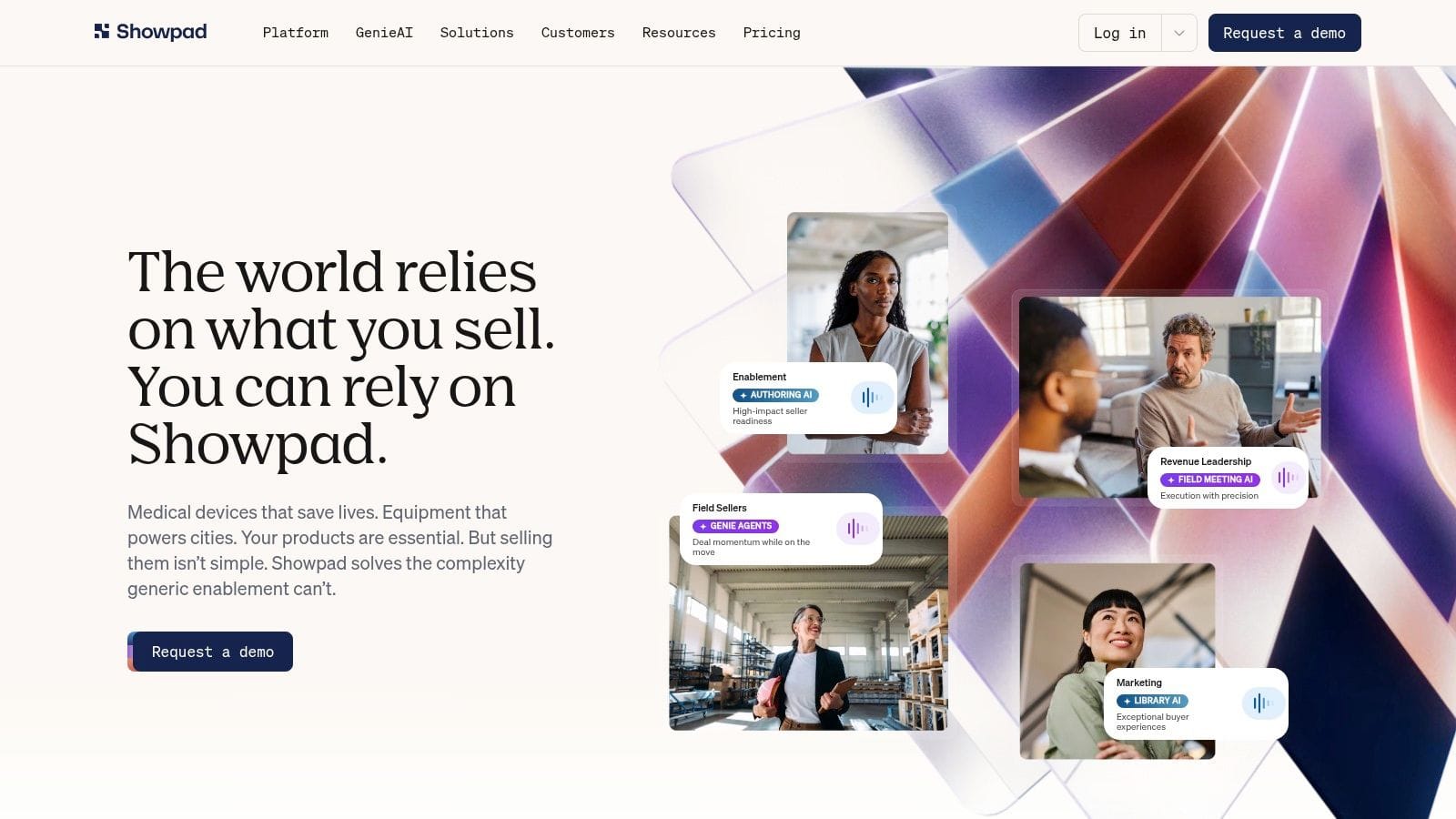
Showpad sits in a useful middle ground. It's broad enough to support content, coaching, learning, and buyer engagement, but it often feels more approachable than the heaviest enterprise suites. For many teams, that balance is the point.
Showpad is especially practical when both sales and marketing need a shared operating environment. Marketers get content control and visibility. Sellers get a cleaner experience for finding and sharing what they need. That balance matters because adoption usually fails when one side loves the platform and the other tolerates it.
What Showpad does well
Showpad's open API and 150+ native integrations make it a good fit for teams that don't want to rebuild their whole stack around one vendor. If you already have CRM, call intelligence, LMS, or engagement systems in place, Showpad is easier to position as a connective layer instead of a total replacement play.
There's also a real buyer-experience angle here. Shared Spaces give deals a persistent room rather than a thread of attachments, and Roleplay AI lets reps rehearse against simulated objections before they practice on a live buyer. Showpad's 3D and AR asset support is a genuine differentiator for manufacturing, medtech, and life sciences teams that need to show a physical product a rep cannot carry into the room.
Buyers rarely complain that you didn't send enough assets. They stall because nobody packaged the decision clearly for the next internal conversation.
The trade-off is modular complexity. Once you start layering in advanced governance, certifications, buyer rooms, and integrations, someone still needs to run the program, and public pricing isn't published. Showpad is easier to live with than some large platforms, but it still rewards disciplined enablement ownership.
5. Mindtickle
A rep finishes onboarding, passes the quiz, and still freezes on the third objection in a live call. That is the problem Mindtickle is built to solve.
I'd put Mindtickle in the Readiness category, not the Content category. If your main issue is seller execution, poor discovery, inconsistent messaging, weak objection handling, or uneven coaching from frontline managers, Mindtickle is usually a better fit than a platform centered on asset management. Its core product reflects that priority. Assessments, role-play, readiness dashboards, coaching workflows, and conversation intelligence sit at the center of the system rather than off to the side.
Where Mindtickle stands out
Mindtickle is strongest for teams that need evidence that training changed behavior in the field. Completion rates do not tell a revenue leader much. Readiness scores, certification frameworks, and manager visibility get closer to the core question: can the rep apply the message in a customer conversation and repeat that performance across deals?
That matters because enablement only earns budget when it improves execution. In practice, Mindtickle helps teams connect training to observable actions such as talk tracks used correctly, objections handled with more consistency, and coaching delivered against a common rubric instead of manager preference.
The company also moved into buyer enablement by acquiring Enable Us in 2023, which added digital sales rooms to a product that had been squarely internal. It's a real capability, but readiness is still the identity, and I'd buy it for that.
The trade-off is operational overhead. Mindtickle performs best when someone owns competencies, scorecards, certification logic, and manager accountability. Teams that want an API-first enablement stack should weigh that carefully. Mindtickle can play an important role if readiness is the gap, but it is not the system I would choose as the primary content or presentation layer. It works best as the part of the stack responsible for making sure reps can execute.
6. Bigtincan
Bigtincan is a strong fit for field-heavy organizations. If reps spend time on the road, in stores, in clinics, at distributor locations, or in environments where connectivity is inconsistent, mobile-first design and offline access stop being nice extras and start becoming core requirements.
That focus gives Bigtincan a different flavor from platforms built mainly for inside sales teams. It's still broad, with content, training, coaching, and analytics, but it's particularly useful where the rep isn't sitting at a laptop all day.
Why field teams choose it
Bigtincan makes sense when compliance and distribution control matter. Regulated industries, channel-heavy organizations, and frontline teams need governed access to the right content without a lot of manual intervention. Mobile delivery, permissions, and centralized management matter more there than flashy dashboards.
It also helps when a single seller handles both direct conversations and partner support. One platform across both motions is easier to govern than separate systems with different content rules.
The best enablement platform for a field team is often the one reps can still use in a parking lot, a hospital corridor, or a customer site with weak signal.
The trade-off is setup complexity. Broad enterprise platforms for mobile and governance use cases usually need deliberate rollout planning. If your team is mostly desk-based and you don't have field requirements, other tools may get you to value faster.
7. Allego
Allego stands out for teams that care about learning, coaching, and reinforcement but don't want those functions disconnected from content and buyer engagement. It blends structured learning, certifications, conversation intelligence, content management, and digital sales rooms into one platform.
In practice, Allego is often appealing to organizations trying to consolidate. If you've accumulated separate tools for onboarding, call review, video coaching, and content sharing, Allego makes a credible case for bringing those workflows together. That pitch tracks the way the category itself has been redefined: Salesforce now describes enablement software as covering the full seller workflow, not a content library with training bolted on.
Where Allego fits best
Its strongest use case is reinforcement. Training only matters if managers can coach against it and reps can apply it in real conversations. Allego is designed around that loop. That's more useful than pushing another set of static modules into a field team that already ignores half the LMS.
It can also help channel and partner programs where consistency is hard to maintain. Shared learning paths, certifications, and content distribution are easier to manage when they sit in one environment.
The trade-off is breadth. Broad platforms can become overkill if you only need one function, and consolidation projects tend to phase in over quarters rather than weeks. If your real issue is presentation quality, answer retrieval, or a single coaching use case, buying a consolidation platform may introduce more admin burden than value.
8. SalesHood
SalesHood is the pragmatic pick on this list. Where the big suites ask you to design your enablement program and then configure it, SalesHood ships with the program already shaped: playbooks, course templates, peer learning, assessments, and manager scorecards.
That opinionation is the product. A team of 30 reps that needs onboarding to work next quarter is better served by a template someone else already pressure-tested than by a platform flexible enough to build anything and therefore requiring someone to build everything.
Fast time to value
SalesHood works best when the bottleneck is ramp speed and program adoption rather than content governance. Onboarding paths, guided selling, and deal collaboration cover the common cases, and manager scorecards give frontline leaders something to run one-on-ones against without adding administrative noise.
The trade-off is ceiling. SalesHood is narrower than Seismic, Highspot, or Allego, and teams with deep buyer-engagement or content-orchestration requirements will hit its edges. Pricing skews SMB and mid-market, which is the right end of the market for it. If you have an enablement team of one and a rollout deadline, that constraint is a feature.
9. Mediafly
Mediafly is a good option when the buyer experience itself is a competitive lever. It combines content activation, interactive presentation workflows, enablement processes, and revenue intelligence. That mix is useful for teams that want stronger alignment between what marketing builds and what sales uses in live deals.
Some enablement tools are strongest internally. Mediafly leans harder into the customer-facing side of the motion. That matters when your team sells through business cases, ROI narratives, and stakeholder communication, not just product demos.
Built for quantified selling
The specific thing Mediafly does that most of this list does not is value selling. Its ROI and TCO calculators let a rep build a defensible financial case inside the deal instead of emailing a spreadsheet after the fact. If you sell into analytical buying committees where a CFO signs, that is a different conversation than a feature comparison, and it is worth paying for.
It also appeals to teams that want enablement and intelligence in the same environment. When sellers can see how materials get used and leaders can connect that usage to pipeline outcomes, content decisions get sharper over time.
The trade-off is that value frameworks are not self-installing. Somebody has to agree what your product is worth, in what units, against which baseline, before a calculator means anything. Mediafly can be a strong fit, but it's best for teams ready to standardize how they present value across the funnel.
10. Guru
Guru is not a full sales enablement suite, and that is exactly why it earns a place here. A rep is live in Slack, Gmail, or Salesforce, needs the current pricing exception, competitor response, or security answer, and does not have time to hunt through folders or ask three people for confirmation.
A lot of enablement problems are really retrieval problems. Content may exist. Training may already be done. But if the answer is hard to find in the moment, reps either guess, use an outdated version, or interrupt someone else. Guru reduces that failure mode with verified knowledge cards, browser access, audit trails, and integrations across the tools sales teams use every day. It also exposes knowledge over MCP, which matters if you want agents pulling governed answers rather than improvising.
Its best fit is clear in a modern stack. Guru is not the main presentation layer, and it is not the system I would choose for readiness, coaching, or buyer engagement. It is the knowledge component. For teams building enablement by core function instead of buying one large suite, that distinction matters.
- Best for answer retrieval at the point of need: Strong fit for SDRs, AEs, support, and CS teams that need accurate answers during live conversations.
- Strong adoption model: Integrations and browser access reduce context switching, which usually matters more than adding another destination platform.
- Limited as a full enablement system: Teams still need other tools for coaching, buyer-facing presentations, readiness, and external engagement.
Top 10 sales enablement tools compared
| Product | Core features | UX & quality | Value / pricing | Target audience | Unique selling points |
|---|---|---|---|---|---|
| Encelade 🏆 | AI-driven web-native decks; 50+ widgets; native 3D; live Sheets/CRM data connections; Presentation API & MCP | ★★★★☆, fast creation, engagement analytics | 💰 Free Starter; Builder $15/mo; Pro $49/mo; Team $99/mo (20% off billed annually); Enterprise custom | 👥 Sales, marketing & revenue teams | ✨ One-prompt bulk restyling; native 3D & Spline; live-updating numbers; link-based delivery |
| Seismic | Content automation, learning/coaching, digital sales rooms, analytics | ★★★★, proven at large scale | 💰 Quote-only; premium enterprise TCO | 👥 Large GTM orgs & regulated industries | ✨ Broadest enterprise footprint; advanced personalization & automation |
| Highspot | Content mgmt, training, guidance, analytics; CRM integrations | ★★★★, enterprise-grade governance & reporting | 💰 Quote-only; mid-market to enterprise | 👥 Enterprise sales & enablement teams | ✨ Deep Salesforce alignment; strong executive reporting |
| Showpad | Content organization, readiness, Shared Spaces, 3D/AR assets, 150+ integrations | ★★★★, balanced UX for sellers & marketers | 💰 Quote-only; tiered feature access | 👥 Field sellers; manufacturing, medtech, life sciences | ✨ Roleplay AI; 3D/AR asset support; open API and SDK |
| Mindtickle | Readiness dashboards, AI role-play, coaching, conversation intelligence | ★★★★, deep readiness & scoring | 💰 Quote-only; enterprise-level TCO | 👥 Onboarding & sales-readiness teams | ✨ Assessment-driven training and manager visibility |
| Bigtincan | Content hub, mobile-first/offline, SalesAI insights, coaching | ★★★, mobile/offline & governance focused | 💰 Quote-only; enterprise editions | 👥 Field, retail & regulated sales teams | ✨ Robust offline/mobile capabilities and governance |
| Allego | Structured learning, AI coaching, convo intelligence, digital sales rooms | ★★★★, strong learning & coaching UX | 💰 Quote-only; scoped for scale | 👥 Enterprises consolidating LMS & content tools | ✨ Video selling + consolidation positioning for multiple tools |
| SalesHood | Onboarding paths, playbooks, peer learning, assessments, manager scorecards | ★★★★, opinionated and quick to roll out | 💰 Quote-based; SMB → mid-market focus | 👥 Teams prioritizing ramp speed & program adoption | ✨ Prebuilt program templates for fast time-to-value |
| Mediafly | Interactive presentations, revenue intelligence, buyer experiences, analytics | ★★★★, strong buyer-experience tooling | 💰 Quote-only; requires scoping | 👥 Complex B2B teams selling to analytical committees | ✨ ROI/TCO calculators and value-based selling workflows |
| Guru | Knowledge agents, semantic search, verification, browser/app extensions | ★★★, fast time-to-value in workflows | 💰 Transparent tiers; per-seat options | 👥 Sellers needing in-workflow answers (Slack/CRM/browser) | ✨ Verification workflows; in-flow delivery; MCP access |
Final thoughts: buy for the layer you need
A lot of bad tool decisions start the same way. A revenue team realizes reps are missing content, managers want better coaching, and leadership wants cleaner reporting. Then the buying process turns into a feature checklist, and the team ends up purchasing a platform that scores well in a demo but does not fix the actual bottleneck.
The better approach is to buy for the job that needs to get done first.
That is the useful lens for this category. Content platforms solve control and distribution problems. Readiness platforms solve behavior and coaching problems. Knowledge tools solve answer retrieval problems. Presentation and buyer-facing tools solve a different issue entirely: reps need to turn messy deal context into clear, current, persuasive follow-up without rebuilding everything by hand.
That distinction matters because sales enablement is no longer one system. It is a stack. In practice, the teams that get value fastest usually separate four layers: CRM as the system of record, readiness for coaching and execution, knowledge for in-workflow answers, and a buyer-facing layer for proposals, presentations, and post-meeting follow-up.
I have seen teams waste months trying to force one platform to cover all four. The trade-off is predictable. Breadth looks efficient during procurement, but it often creates weak adoption because each user group gets a partial fit instead of a strong one.
A few selection rules hold up in real deployments:
- Choose content-centric tools such as Seismic, Highspot, Showpad, or Bigtincan when version control, governance, and distribution are the main problem.
- Choose readiness tools such as Mindtickle, Allego, or SalesHood when managers need a repeatable way to coach, assess, and improve rep behavior.
- Choose a knowledge tool such as Guru when sellers lose time hunting for answers across Slack, docs, CRM, and browsers.
- Choose presentation and buyer-facing tools such as Encelade and Mediafly when the quality and speed of follow-up directly affect conversion.
Whichever layer you start with, run it as a pilot before you scale. Define one success metric up front, give it a small group of reps, and measure adoption honestly. If the platform doesn't change how those reps work in the first phase, more rollout budget will not fix it later.
The next shift is architectural, not just functional. Buyers want tools that fit into workflow, connect cleanly to CRM and content sources, and reduce manual production work. That is why the API-first model deserves more attention in enablement than it usually gets.
An API-first stack gives ops teams more control over how content is generated, updated, and delivered across the sales process. It also reduces one of the most expensive hidden costs in enablement: manual rework by reps and marketers every time messaging, pricing, or product details change.
For teams building for 2026, that makes Encelade a specific kind of fit, not a generic one. It is strongest when reps need to turn CRM notes, research, spreadsheets, and internal docs into buyer-ready presentations quickly, while keeping outputs current and on brand. That solves a real problem. It cuts deck rebuild time, improves follow-up quality, and gives revenue teams a buyer-facing layer that belongs inside the enablement stack instead of sitting off to the side.
If your team keeps losing hours to outdated decks, one-off presentation work, or static follow-ups that fail to move deals forward, Encelade is worth a close look as the buyer-facing layer of your enablement stack. If you'd like to talk through your workflow first, book 30 minutes here.