
You probably have a project in motion right now that should be easy to approve. The need is real. The team feels the pain. The solution makes sense. Then the proposal hits a steering committee, and the conversation drifts into side questions, missing assumptions, and competing priorities. Good ideas rarely die because they were bad. They die because the case for action wasn’t built in a way decision-makers could trust.
That’s why a strong business case template matters. Not as paperwork. Not as a slide deck someone exports the night before review. As a tool that helps people decide, with enough clarity that funding, staffing, and timing become easier to defend.
Most guides stop at a static Word file or a PowerPoint outline. That’s useful up to a point. But teams now make decisions in environments where pipeline shifts, cost assumptions move, and implementation risk changes as new information comes in. A better business case doesn’t just summarize a proposal once. It helps stakeholders evaluate it continuously.
Beyond a Document: A Tool for Decision-Making
A business case template is often treated like a compliance task. Fill in the boxes. Add some numbers. Put a recommendation on the last page. That approach produces documents, but it rarely produces approval.
A better view is simpler. Your business case is the argument for why this initiative deserves attention before other initiatives. It has to explain the problem, the available choices, the downside of delay, and the practical shape of execution. If it can’t do that, the committee will do the thinking for you, and they’ll usually do it against the clock.
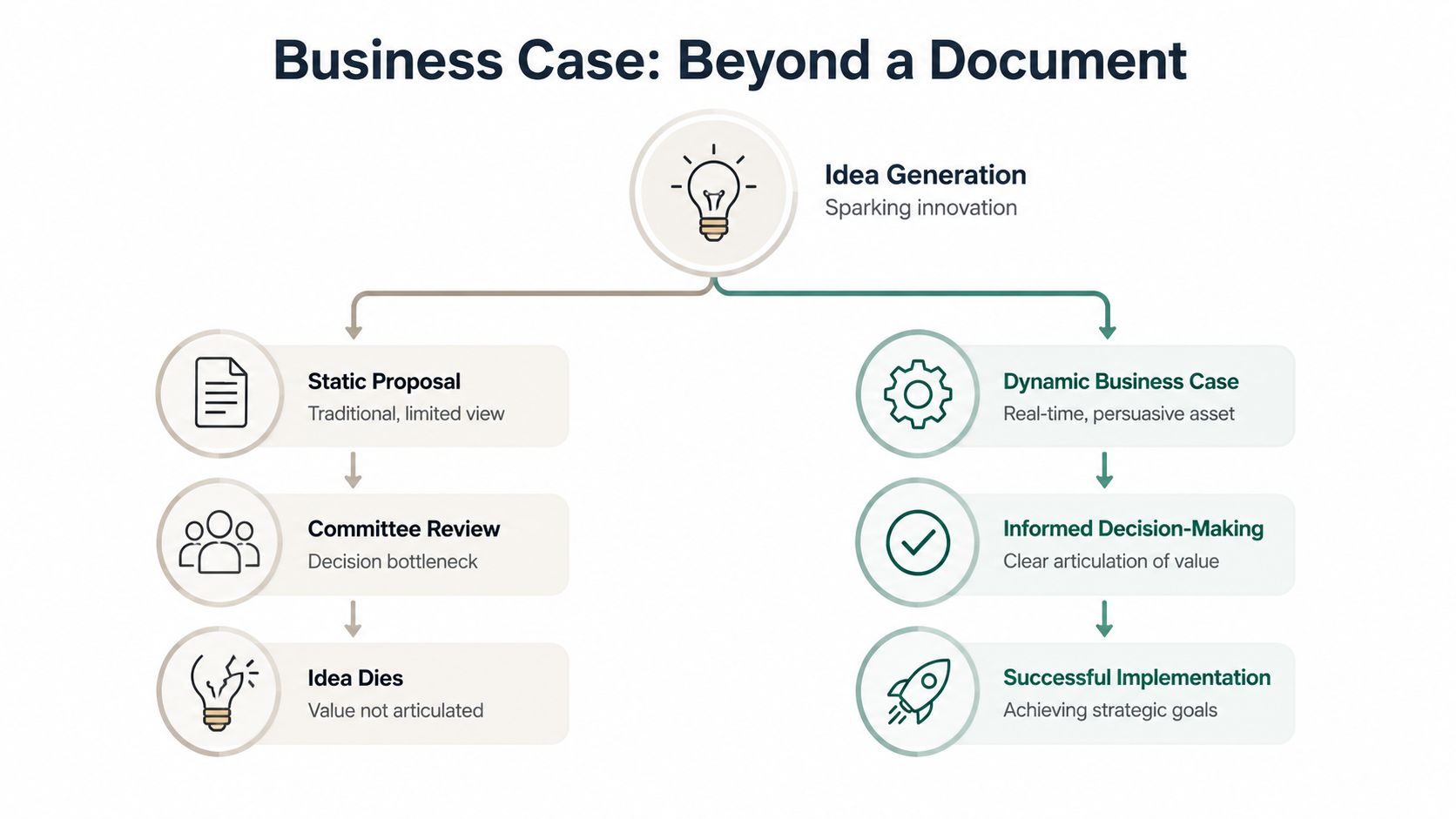
For that reason, I treat the business case template as a decision instrument. It’s what you use when you’re asking for funding, redirecting scarce people, changing customer-facing services, or introducing material operational or compliance risk. A useful structure has to cover benefits, costs, risks, and strategic alignment in a way an executive team can absorb quickly and challenge productively.
Knowledge Train’s guidance on business cases notes that many internal business cases run 2 to 10 pages plus appendices for calculations and evidence. Slideworks, whose template comes from ex-McKinsey consultants, puts larger or more complex initiatives at 10 to 20 pages, or 30 to 50 slides, excluding appendices. That range matters because it reminds people of something practical. A business case shouldn’t be short because brevity feels elegant. It should be as long as the decision requires.
Static templates help. Dynamic thinking wins
A static Word or PPT template is a starting point. It gives teams structure and prevents obvious omissions. But static files also encourage a dangerous habit. People freeze assumptions too early, then defend outdated numbers in meetings.
Practical rule: If your figures need verbal explanation every time someone opens the file, the business case isn’t finished.
The strongest cases work because they force clarity before the review meeting. They make trade-offs visible. They show what happens if the organization does nothing. They reveal where the proposal is strong and where it’s sensitive to cost, timing, or adoption.
What decision-makers actually want
Committees don’t want more content. They want fewer unresolved questions.
That means your business case template should help you answer four things fast:
- Why now: What problem or opportunity is material enough to act on now?
- Why this option: Why is the chosen route better than alternatives, including doing nothing?
- What will it cost: What one-off and ongoing commitments are required?
- What could go wrong: Which risks are acceptable, and how will the team monitor them?
When a business case handles those well, approval becomes a judgment call. When it doesn’t, approval becomes a credibility test.
The Anatomy of a Winning Business Case
Most weak business cases fail in predictable places. The summary reads like background, not a decision note. The problem is described qualitatively when it should be quantified. Options are fake options. Risks are hand-waved. The recommendation arrives before the argument earns it.
A stronger structure is already well established. Deckary’s business case template guide identifies six core elements that a rigorous business case should include: a one-page executive summary, a quantified problem statement, an options analysis that includes a do-nothing baseline, financial metrics such as NPV, IRR, payback, and ROI with sensitivity analysis, a granular risk assessment with probability and impact ratings, and a clear recommendation.
Executive summary
This is the only section some stakeholders will read before the meeting. Write it as if that’s true.
Keep it tight. State the problem, the preferred option, the expected business effect, the major risks, and the specific decision required. Don’t hide the ask in paragraph four.
Example snippet
Approve the proposed customer onboarding redesign to reduce operational friction, improve handoff quality, and replace manual reporting with a standardized workflow. The recommended option requires one-off implementation effort plus ongoing support, with a staged rollout and defined review points to manage delivery and adoption risk.
Problem statement
A vague problem statement triggers vague debate. “Our process is inefficient” is not a business case. It’s a complaint.
Define the current state, the business impact, and the consequences of maintaining it. Quantify it where you can. If you can’t quantify precisely, state the operational effect in plain terms and identify the missing assumptions openly.
What to write
- Describe the current state in observable terms.
- Show who is affected.
- Link the issue to cost, time, quality, revenue, compliance, or customer impact.
- Separate symptoms from root causes.
Example snippet
The current reporting process relies on manual consolidation across disconnected sources, which delays weekly decision-making, increases the risk of inconsistent figures, and pulls senior team members into low-value reconciliation work.
Options analysis
Many proposals lose trust at this juncture. Teams present one preferred option, one obviously bad option, and one strawman. Decision-makers notice.
A real options analysis includes a do-nothing baseline and evaluates each path against common criteria. Cost, feasibility, strategic fit, implementation burden, and risk usually belong here. The point isn’t to make alternatives look weak. It’s to show that the recommendation survived comparison.
Financial case
The financial case translates enthusiasm into an investment argument. It should show one-off costs, ongoing costs, expected benefits, timing, and assumptions.
Don’t bury assumptions in appendices if they drive the headline result. Put them where reviewers can inspect them. If a figure depends on adoption, cycle time reduction, or staffing impact, say so explicitly.
A finance section becomes persuasive when every meaningful number can be traced back to an assumption someone can challenge.
Risk assessment
Good business cases don’t pretend certainty. They show control.
List the main risks, assign probability and impact, and explain the mitigation approach. This keeps the discussion grounded. It also tells decision-makers that the team understands delivery realities, not just benefits.
A practical risk table often works better than prose:
| Risk | Probability | Impact | Mitigation |
|---|---|---|---|
| Delayed implementation | Medium | High | Stage rollout and confirm dependencies early |
| Low user adoption | Medium | High | Include training, local champions, and usage reviews |
| Incomplete data inputs | Medium | Medium | Validate data sources before launch and define ownership |
Recommendation
The recommendation should be direct. Not “consider proceeding.” Not “the team believes this may be beneficial.” State what should be approved, under what conditions, and what happens next.
Example snippet
Proceed with the phased implementation of Option B, subject to confirmation of resource availability, sign-off on cost assumptions, and a formal checkpoint after the initial operating period.
The best business case template doesn’t just make writing easier. It makes weak logic harder to hide.
Building Your Financial Model and Calculating ROI
Financial modeling is where many business cases either become credible or collapse. That’s not because every reviewer wants a spreadsheet lesson. It’s because money forces precision. Once you show costs, timing, and expected returns, vague optimism disappears.
The finance section should include a cost-benefit analysis and sensitivity analysis, because decision-makers need to see both the upside and how the case reacts when assumptions change. Canva’s business case guidance also points to the need for tools such as PESTLE analysis and competitor assessment so the proposal aligns with long-term strategy, not just short-term need.
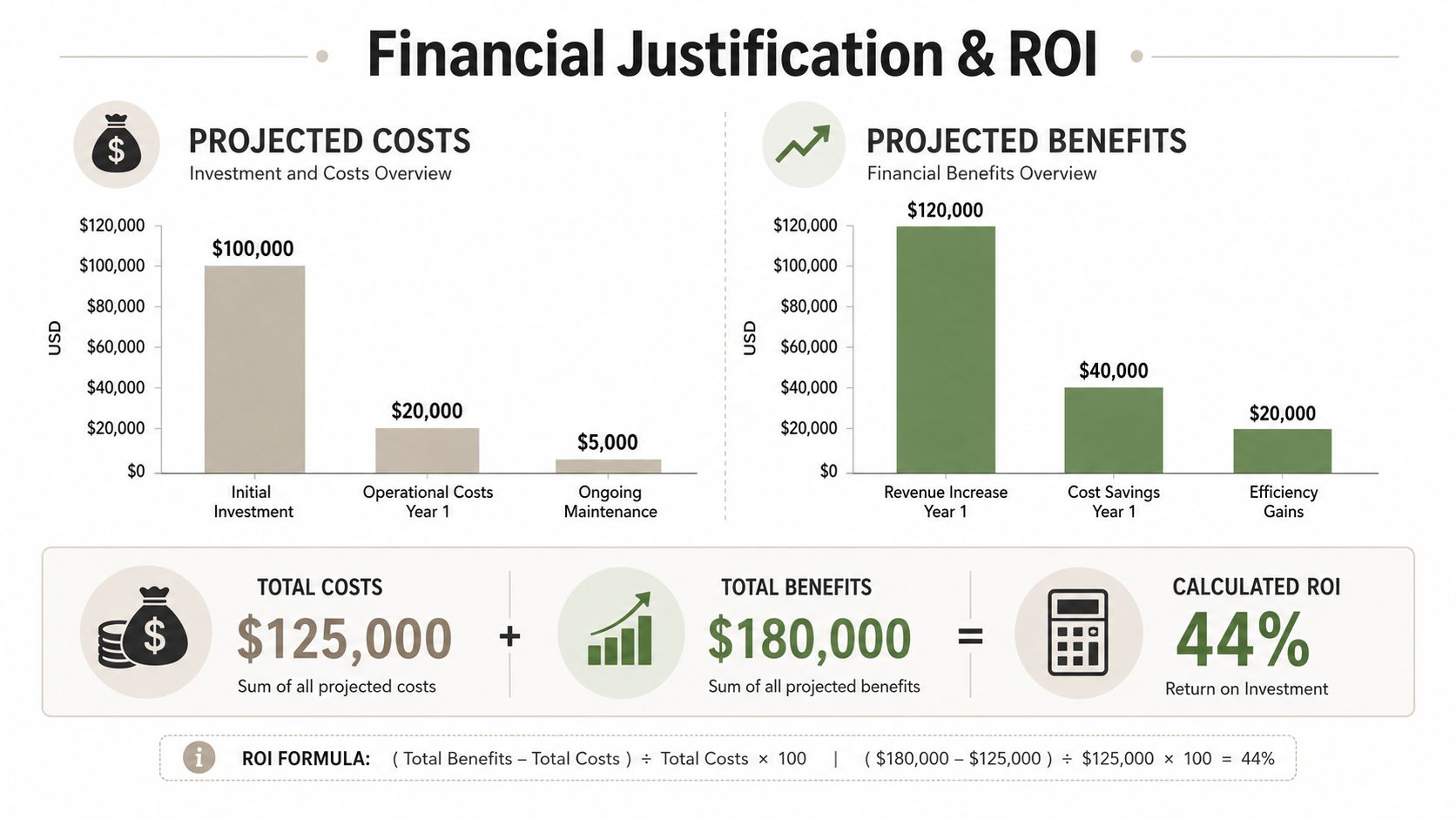
One important caution. The image above illustrates a sample ROI layout, but when you build your own business case template, don’t copy example numbers unless they are your numbers. Executives can spot decorative finance immediately.
Start with cost categories people usually miss
The most common financial mistake isn’t arithmetic. It’s omission.
A robust business case breaks costs into development, infrastructure, people, contingency, and change management. That structure matters because hidden items like training, internal time, and rollout support often surface late and damage confidence.
Build your model with at least these buckets:
- Development costs: Configuration, implementation, design work, external specialists, and integration effort.
- Infrastructure costs: Licenses, hosting, data services, hardware support, or related platform overhead.
- People costs: Internal project time, backfill needs, subject matter expert involvement, and management oversight.
- Contingency: A realistic allowance for uncertainty. Not padding. A visible acknowledgment that delivery rarely follows the first draft.
- Change management: Training, communications, process documentation, stakeholder support, and adoption monitoring.
If your organization already uses a finance template, keep those categories visible even when they roll into higher-level lines later.
Model benefits with discipline
Benefits usually split into two groups. First, direct effects such as lower operating cost, reduced manual effort, or clearer revenue impact. Second, strategic effects such as faster decisions, improved customer experience, or lower operational risk.
Direct effects are easier to model. Strategic effects still belong in the business case, but they should be described carefully. Don’t force them into false precision just to make the spreadsheet look complete.
Here’s a practical way to write the benefits side:
- State the mechanism. Explain how the initiative creates value. For example, fewer handoffs, lower rework, better visibility, or faster approvals.
- Name the owner. Identify which team realizes the benefit. Finance reviewers trust benefits more when ownership is explicit.
- Set the timing. Distinguish implementation period effects from steady-state effects.
- Record assumptions. If a benefit depends on process adoption or a new data source, write that down next to the figure.
Useful test: If someone asks “what would have to be true for this benefit to happen?” and your case can’t answer in one sentence, the model is still too loose.
Use analysis tools decision-makers expect
A business case template should create room for the standard metrics most approval groups expect:
- ROI: A high-level check on whether projected benefits outweigh costs.
- Payback period: How long it takes for benefits to recover the investment.
- NPV: The value of future returns in present terms.
- IRR: The implied rate of return for the proposed investment.
- Sensitivity analysis: What happens when assumptions move.
If you’re presenting this in deck form, visual clarity matters as much as formula accuracy. A reviewer should be able to see which assumptions are fixed, which are variable, and which metrics change when scenarios change. Good data visualization practices for business presentations help here because they reduce debate caused by confusing charts rather than by the business logic itself.
A simple scenario view is often enough:
| Scenario | Cost position | Benefit realization | Decision signal |
|---|---|---|---|
| Base case | As planned | As planned | Proceed if strategic fit is strong |
| Downside case | Higher than planned | Slower than planned | Proceed only with tighter controls |
| Upside case | Stable | Faster than planned | Consider accelerating rollout |
Financial credibility beats financial complexity
A dense spreadsheet doesn’t make a stronger business case. Traceability does.
That means your financial model should show:
- where each input came from
- which assumptions are management judgments
- which benefits are hard versus soft
- how the result changes when key variables move
When people can inspect the logic quickly, the numbers stop being an obstacle and start doing their real job. They help the organization decide.
Tailoring Your Case for Different Audiences
A business case template should keep one core argument intact while changing the emphasis for the room you’re in. The mistake I see most often is over-rotating into one audience. Finance gets every detail while delivery leaders get none. Engineering gets architecture depth while executives never hear the decision in plain language.
Same proposal. Different framing.
Executives want a decision frame
Senior leaders usually don’t need every input. They need enough information to make a defensible call.
Lead with the business issue, the preferred option, strategic alignment, financial summary, and major risks. Keep operational detail available, but not in the main line of the argument. They’re asking, “Should we back this now, and what are we taking on if we do?”
Engineering leaders want delivery realism
Engineering and technical stakeholders usually test feasibility before enthusiasm. They’ll want to know about dependencies, sequencing, integration constraints, data quality, resource load, and what has to be true for implementation to succeed.
If your business case template only speaks in commercial terms, technical reviewers will fill the gaps with caution. That usually slows the proposal.
Your case gets stronger when technical leaders can see themselves delivering it, not just funding it.
Sales leaders want commercial relevance
Sales managers and revenue leaders typically focus on customer impact, competitive differentiation, process friction, and time-to-value. They care whether the initiative improves how teams sell, respond, forecast, or support accounts.
That doesn’t mean they ignore cost. It means cost alone won’t persuade them. Commercial upside, execution speed, and practical usability usually carry more weight.
Business case focus by audience
| Audience | Primary focus | Key metrics | Level of detail |
|---|---|---|---|
| Executive team | Strategic alignment and decision rationale | ROI, payback, risk exposure, business impact | High-level summary with clear recommendation |
| Engineering lead | Feasibility and implementation demands | Resource needs, dependencies, delivery risk, support model | Detailed operational view |
| Sales manager | Market and customer effect | Pipeline relevance, adoption practicality, competitive advantage | Moderate detail with clear frontline implications |
A good business case template doesn’t force you to rewrite the whole narrative. It lets you keep one source of truth, then adjust the summary, examples, and emphasis for each audience.
That’s the practical standard. One backbone. Several lenses.
Presenting and Maintaining a Live Business Case
The biggest weakness in the traditional business case template isn’t the structure. It’s the format. A static file captures one moment in time, but the decision often happens later, after assumptions have already shifted.
That gap matters more in projects tied to live systems, operational data, or AI-assisted workflows, where the inputs a business case depends on — adoption rates, data volumes, unit costs — keep moving after you write them down. If your business case freezes those moving parts into a static snapshot, reviewers are left comparing old numbers to current questions.
Why static files lose credibility
A PDF is clean. A slide deck is familiar. Neither solves version drift.
The moment a forecast changes, a cost line moves, or a dependency slips, the business case starts aging. Teams then patch credibility with follow-up emails, side spreadsheets, and verbal caveats in meetings. That creates friction for reviewers and confusion for stakeholders who are trying to understand which version is current.
A live business case fixes this by connecting the narrative to the underlying data. That doesn’t mean every proposal needs a complex system. It means high-stakes initiatives benefit from a presentation format where assumptions, visuals, and operating metrics can update without rebuilding the argument from scratch.
What a live business case should include
Think of the modern business case template as a dashboard with judgment built into it. The narrative still matters. So does the recommendation. But the supporting model should be inspectable, current, and interactive enough to answer obvious challenges in the room.
Useful components include:
- Live financial views: ROI models tied to current planning inputs rather than copied spreadsheet screenshots.
- Scenario controls: Simple toggles for best case, base case, and downside views.
- Implementation tracking: Gantt or milestone views that show timing assumptions and ownership.
- Data-linked charts: Visuals connected to tools like Google Sheets or a CRM so pipeline or operating figures stay current.
- Assumption panels: A visible place where reviewers can inspect what drives the headline result.
A business case presented this way becomes easier to trust because it can respond under pressure. If someone asks how the payback changes when adoption slips, you shouldn’t need to promise a revised deck tomorrow.
For teams trying to avoid version confusion across approvals, review notes, and post-signoff updates, strong version control practices for documents are part of the business case itself, not just an admin concern.
Keep the case alive after approval
Organizations often stop using the business case once funding is approved. That’s a missed opportunity.
The same asset should support delivery reviews, steering updates, and checkpoint decisions. A simple discipline helps: set a review checkpoint — many teams use a six-month gate — to reassess whether to continue, pivot, or stop. In practice, that works far better when the original case already lives in a format that can be refreshed and reviewed, rather than reconstructed from archived files.
A live business case should answer three post-approval questions:
- Are costs landing where expected?
- Are benefits appearing through the mechanism originally described?
- Have any risks changed enough to alter the recommendation?
A video walkthrough can help teams see the difference between static reporting and a web-native, interactive presentation environment.
Used well, a live business case becomes more than a proposal. It becomes the operating reference for the investment decision the organization already made.
Your Blueprint for Actionable Results
A business case template works when it helps people decide, not when it helps authors feel thorough. That means structure first, evidence second, and presentation format close behind. If the summary is weak, the case stalls. If the options are flimsy, the recommendation feels preloaded. If the financial model is opaque, trust evaporates.
Strong cases share a few traits. They define the problem in business terms. They compare real options, including doing nothing. They expose assumptions instead of hiding them. They treat risk as something to manage visibly, not something to mention politely. And they adapt the same core argument for the people who need to approve, deliver, and use the outcome.
The modern shift is just as important. Static files still have a place, especially for archives and formal submission. But the most persuasive business case today is often a live one. It can show current data, test assumptions in front of stakeholders, and remain useful after approval as the baseline for review.
If you need a practical starting point, use a structure that’s simple enough to complete and rigorous enough to defend. A well-built proposal follows the same logic as any strong pitch. Problem. Options. Economics. Risk. Recommendation. The difference is that this one has to survive scrutiny from people who control budget, resources, and timing.
For teams that want a cleaner foundation before building the case itself, this guide on how to structure a proposal is a useful companion.
If you want to turn a standard business case into something stakeholders can interrogate and trust, Encelade gives teams multiple ways to package the same proposal, whether you need a traditional PPTX, a shareable PDF, or a fully interactive, web-native deck with live data and interactive elements. That makes it easier to build a case once, present it clearly, and keep it useful after the approval meeting ends.