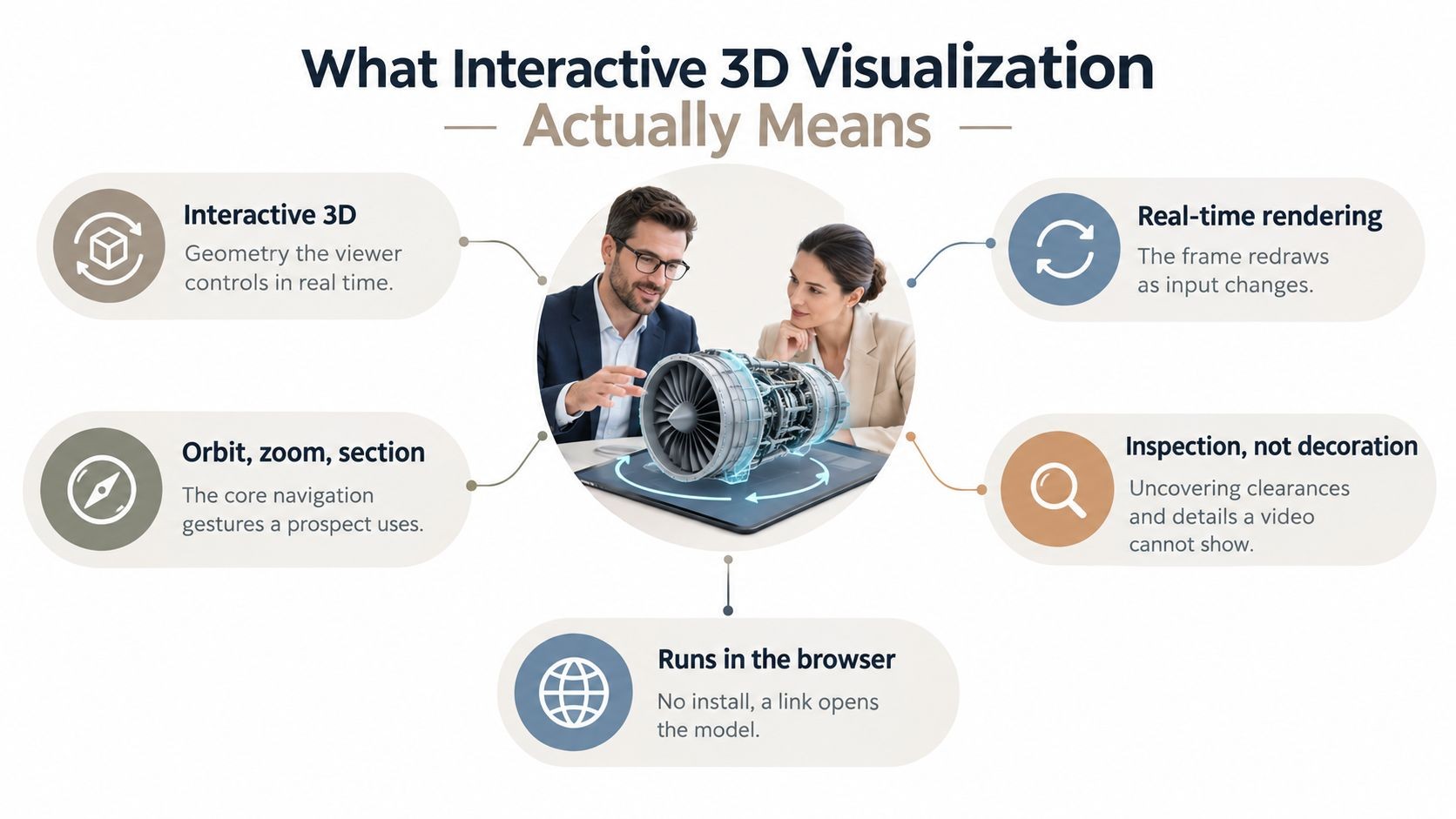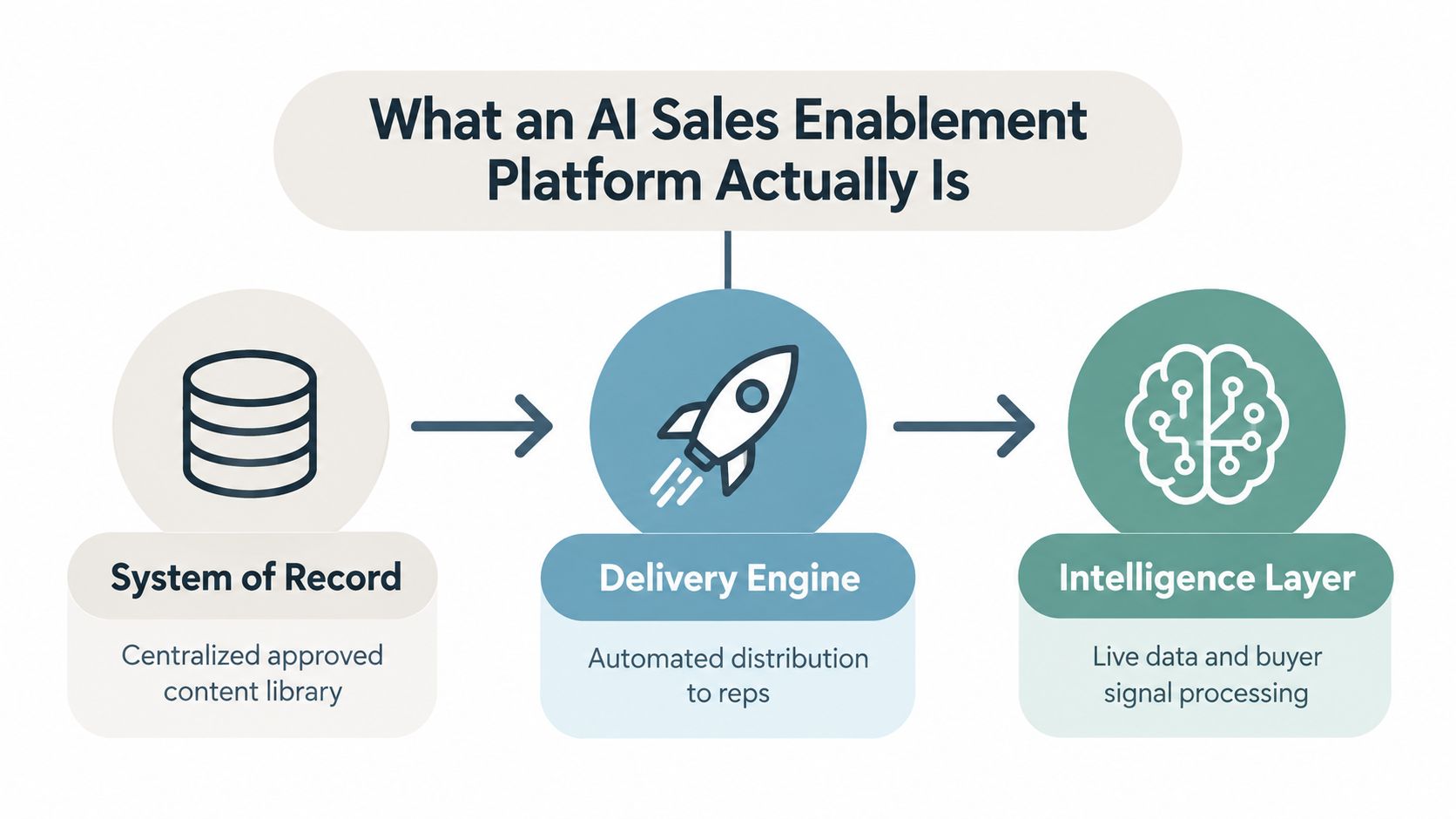
You’ve done the work. You researched the account, shaped the offer, polished the language, exported the PDF, and sent it off. Then the waiting starts. No clue whether the buyer opened it, forwarded it, skimmed the pricing page, or stalled because one number changed the next day.
That old workflow breaks more deals than is often admitted. A marketing business proposal template shouldn’t be a static file you throw over the wall. It should be a living sales document that reflects account context, shows value clearly, and gives you usable feedback after you share it.
The teams winning larger B2B deals aren’t just writing better proposals. They’re delivering proposals in a format that fits how buyers review information now: on multiple devices, across multiple stakeholders, with live numbers, visual proof, and a clear path to approval.
Why Your Static Proposal Is Already Outdated
Most proposal workflows still assume the document is the product. It isn’t. The proposal is a decision tool, and static files are bad decision tools because they freeze the story the moment you send them.

A PDF attached to an email creates immediate friction. Version drift starts fast. One stakeholder downloads it, another forwards it, someone asks for a revised budget, and soon there are multiple copies with no clear source of truth. That’s exactly why the format matters. As Assembly’s guide to writing a marketing proposal notes, proposal software lets you see when a buyer opens the document, how long they spend on each section, and whether they shared it — visibility a static PDF or PPTX simply can’t give you, and one that fragments into competing versions the moment someone asks for an edit.
Static files hide the buyer’s behavior
When you send a file, you lose visibility. You don’t know whether the operations lead spent time on the timeline, whether procurement stopped at the pricing page, or whether the CMO only read the summary. That lack of feedback weakens your follow-up because every next step becomes a guess.
A link-based proposal changes the operating model. Instead of sending a dead attachment, you share a responsive document that stays current and gives you a better read on buyer interest.
Practical rule: If your proposal can’t be updated after sending, tracked after viewing, and read cleanly on a phone, it already feels older than the deal you’re trying to win.
Living proposals fit modern buying groups
Six-figure deals rarely depend on one reader. Marketing, finance, operations, and leadership all review different parts for different reasons. A modern marketing business proposal template needs to support that reality.
A living proposal does a few things a static export can’t:
- Keeps numbers current so buyers aren’t reviewing outdated assumptions.
- Supports multi-stakeholder review without creating file confusion.
- Improves readability through responsive layouts instead of pinched slide screenshots.
- Creates a single source of truth that sales and delivery teams can both reference.
The point isn’t novelty. The point is control. Buyers want clarity, current information, and confidence that your team operates like a serious partner. A web-native proposal signals all three before the kickoff call ever happens.
The Anatomy of a High-Converting Proposal
Winning proposals don’t start with branding. They start with structure. If the sequence is wrong, even strong strategy feels vague.
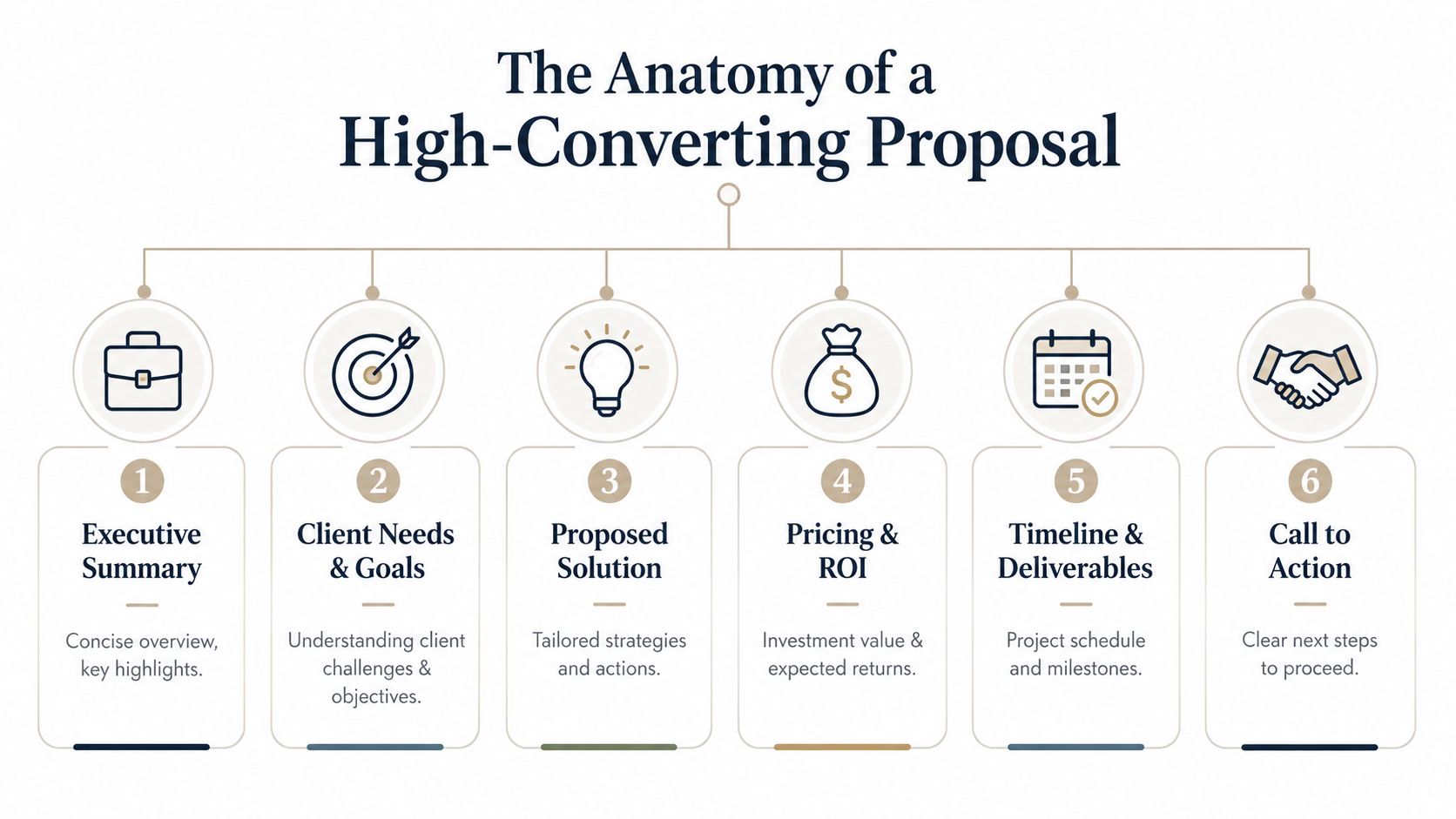
A reliable marketing business proposal template is built around eight essential sections, not a loose set of pages. The Qwilr breakdown of marketing proposal examples identifies core components such as the Executive Summary, Problem Statement, Proposed Solution, and Timeline with Milestones, and frames them as a strategic system rather than formatting.
Start with structure, not styling
The fastest way to weaken a proposal is to jump straight to design. Fonts, screenshots, and brand colors matter, but only after the document answers the questions buyers have.
A solid proposal moves in a clean arc:
| Section | What the buyer needs from it |
|---|---|
| Executive Summary | A fast reason to keep reading |
| Problem Statement | Proof that you understand the situation |
| Proposed Solution | A clear answer tied to the problem |
| Goals and KPIs | Evidence that success will be measured |
| Timeline with Milestones | Confidence that execution is realistic |
| Budget and Pricing | Transparent investment logic |
| Case Studies or Testimonials | Social proof that lowers risk |
| Call to Action | A clear next step |
That arc matters because proposals don’t just inform. They guide a decision.
The sections that do the selling
The Executive Summary should read like a concise diagnosis and recommendation, not an agency bio. Lead with the client’s business context, the opportunity you see, and the commercial outcome your plan is built to influence.
The Problem Statement is where trust starts. Spell out what isn’t working, where previous efforts likely broke down, and what operational or market constraint is holding performance back.
The Proposed Solution should map directly to the problem. If the issue is weak pipeline quality, don’t bury the answer in vague “full-funnel growth support.” Name the channels, assets, experiments, and ownership model.
Then come the sections many teams underwrite and later regret:
- Measurement Plan with clear KPIs, plain-language formulas, and reporting cadence
- Timeline with Milestones that shows phases, launch points, and decision moments
- Assumptions and Exclusions that define dependencies and what sits outside scope
- Budget and Pricing that separates fees from pass-through costs for transparency
- Payment Schedule that distinguishes one-time work from recurring costs
A strong proposal tells the client’s story back to them, then makes your solution feel like the logical next chapter.
A practical template outline
Use this outline when building your next marketing business proposal template:
- Title and Table of Contents. Make navigation easy. Senior buyers skim first.
- Executive Summary. State the business problem, proposed direction, and intended outcome.
- Problem Statement. Describe current pain, internal constraints, and why previous attempts didn’t land.
- Goals and Success Metrics. Define KPIs in plain English. Tie them to revenue, pipeline, or another business outcome the client already cares about.
- Proposed Solution and Scope of Work. Break the work into channel strategy, deliverables, ownership, and operating rhythm.
- Timeline with Milestones. Show phases, dependencies, review points, and when each initiative goes live.
- Investment. Separate strategic fees from media, production, software, or other pass-through costs.
- Assumptions, Exclusions, and Approval Path. Protect margin, reduce disputes, and make acceptance simple.
That’s the core. Add case studies, team bios, or appendices only if they strengthen the decision.
Writing Copy That Persuades and Converts
A buyer opens your proposal at 10:14 p.m. after a long day of internal meetings. They skim the first page, looking for one signal. Do these people understand the actual revenue problem, or are they sending the same deck they sent the last five prospects?
Copy answers that question faster than design ever will.
Strong proposal writing sounds like a strategist who has already spotted the bottleneck, the risk, and the commercial upside. It keeps the client’s situation in the foreground and uses every paragraph to reduce doubt. If the writing reads like agency positioning copy, the proposal feels generic. If it reads like a sharp diagnosis, the proposal earns the next conversation.
Put the client’s operating reality on the page
The fastest way to lose credibility is to fill a proposal with claims about your agency before proving you understand the account.
Weak copy:
- We are a full-service agency with deep cross-channel expertise.
- We use proven frameworks and creative campaign execution.
- Our team has extensive experience across verticals.
Convincing copy:
- Paid search is producing volume, but lead quality falls after the form submission stage.
- Organic traffic is growing, but non-brand pages are not turning that attention into qualified pipeline.
- Sales follow-up appears inconsistent across inbound sources, which likely lowers conversion from response to opportunity.
That shift matters because buyers are not hiring for activity. They are hiring to fix a specific commercial problem.
A useful rule is simple. Every major section should contain more lines about the client’s constraints, decisions, and goals than about your credentials. Credentials still matter, but they work best as proof attached to a relevant point, not as the main story.
Write the problem statement with diagnosis, not drama
The problem statement is where strong proposals separate themselves from polished brochures. Generic language leaves buyers with work to do. Precise language makes the path forward feel clearer.
Write the problem the way an experienced consultant would explain it in a room full of stakeholders:
Your team has already invested in paid acquisition and content. The gap is not effort. The gap is that channel activity has not been tied closely enough to a measurable conversion path, so results are not compounding across campaigns.
Or:
Previous reporting focused on clicks, traffic, and form fills. Leadership is judging performance on pipeline contribution and sales efficiency, so marketing performance is being presented in a way that makes approval harder.
This kind of copy shows pattern recognition. It also shows restraint. Good proposal writing does not exaggerate the problem to make the solution sound bigger. It identifies the issue clearly, names the likely cause, and frames the cost of leaving it unresolved.
For a stronger narrative arc, apply the same sequencing used in storytelling structures for persuasive presentations. Start with tension, define the stakes, then show the resolution. That sequence works especially well in web-based proposals because buyers rarely read in order. They scan, click, and revisit sections. The story still needs to hold together.
Make the strategy legible
Buyers should not have to decode phrases like “integrated omnichannel execution” or “full-funnel optimization approach.” Those labels hide the actual logic.
Spell out the sequence of decisions:
- Fix tracking gaps so the team can trust attribution.
- Tighten targeting and landing page alignment to improve lead quality.
- Rebuild reporting around pipeline and CAC, not channel vanity metrics.
- Scale only after the first conversion path shows stable performance.
That is more persuasive because it gives the buyer a plan they can inspect.
This is also where interactive proposals beat static PDFs. A living proposal can reveal strategy layer by layer. Buyers can open a funnel visual, click into a sample dashboard, review a phased rollout, and see how each recommendation connects to a business outcome. Static documents force all of that into flat pages. Web-native proposals let the logic breathe.
Use visuals where explanation slows the sale
Some parts of a proposal should be read. Others should be seen.
Use visuals when they shorten decision time:
- Journey diagrams to show where handoff friction is hurting conversion
- Channel maps to show where spend or effort is scattered
- Reporting mockups to show how leadership will evaluate performance
- Milestone views to show what happens first, what depends on approval, and when results can reasonably be expected
The trade-off is clarity versus clutter. Too many visuals make the proposal feel decorative. The right visual replaces a paragraph and helps the buyer explain your recommendation internally.
Edit for confidence
Strong proposal copy is usually the result of subtraction.
Cut filler. Cut slogans. Cut any sentence that sounds expensive but says nothing. If a line could appear in any other agency’s proposal, remove it or make it specific to the account.
A reliable test is this. If a buyer reads a sentence and cannot answer “so what changes?” the sentence is not doing enough work.
Good proposal copy feels observed, commercially aware, and easy to trust. In a six-figure deal, that standard is not optional. It is often the difference between a proposal that gets forwarded and a proposal that gets approved.
Showcasing Value with Smart Pricing and ROI
A pricing page often decides whether your proposal gets approved, delayed, or dies in procurement.
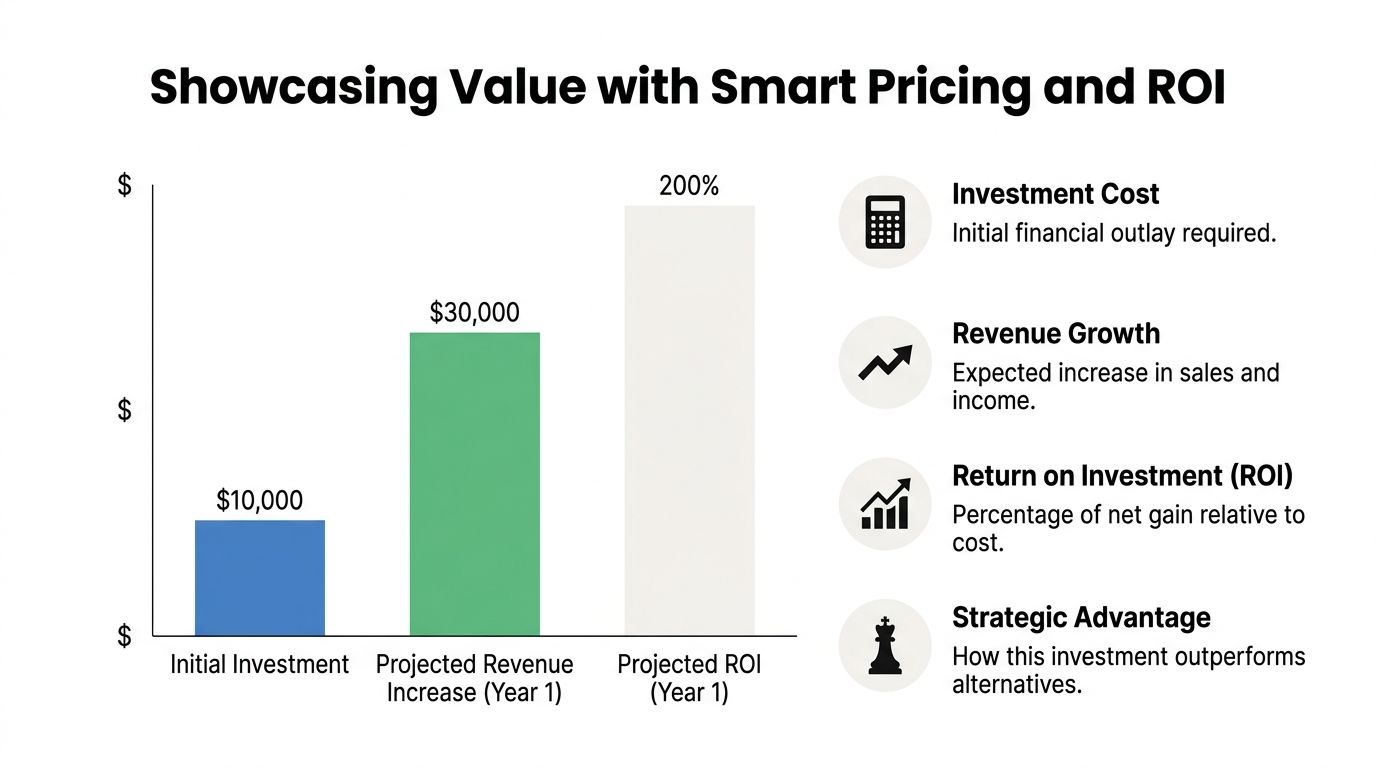
Buyers are not judging the fee alone. They are judging whether the investment feels controlled, whether the path to return is believable, and whether they can defend the recommendation in front of finance, sales leadership, or a CEO who only reads one page.
Why pricing pages fail
Weak pricing sections usually break in one of three places. The scope is vague. The options are poorly structured. The ROI story depends on channel metrics the buyer does not use to make budget decisions.
A single flat fee can work for small projects. In larger engagements, it often creates friction because it hides trade-offs. Buyers want to see what changes if they start smaller, expand scope, or prioritize speed over breadth. Structured options give them a way to buy without rewriting your whole proposal.
A practical pricing table helps because it turns abstract scope into a commercial decision:
| Package | Best for | Includes | Commercial logic |
|---|---|---|---|
| Pilot | Teams validating one channel or offer | Focused scope, shorter timeline | Lower commitment, faster proof |
| Growth | Teams ready for multi-channel execution | Strategy, production, reporting cadence | Balanced depth and speed |
| Expansion | Teams needing cross-functional rollout | Broader scope, more stakeholders, advanced reporting | Built for scale and governance |
The point is not to offer three arbitrary tiers. The point is to anchor the buyer around decision paths. Start small. Fund the core program. Roll out across the business.
Build a business case, not a rate card
Rate cards describe effort. Business cases justify spend.
That distinction matters in six-figure deals. Marketing leaders may like the strategy, but approval often comes from someone who cares more about pipeline coverage, payback period, margin, retention, or launch velocity than deliverables. A good proposal translates your work into those terms.
For example, do not stop at “paid media management and landing page optimization.” Show the operating logic. Faster test cycles can reduce wasted spend. Better conversion paths can improve lead-to-opportunity efficiency. Cleaner reporting can shorten decision time between teams. If you need a format for laying that out clearly, use this business case template for structuring assumptions and expected outcomes.
Good ROI framing also includes assumptions the buyer can inspect. State the baseline. State the expected lift range. State what must be true for the model to hold. That level of clarity makes the proposal easier to trust because the client can see where the upside comes from and where the risk sits.
What a strong pricing section includes
Use this checklist to tighten the investment page:
- Separate fees from pass-through costs so strategy, execution, media, and production are not blended into one confusing total.
- Show one-time and recurring costs distinctly because setup work and ongoing management are approved differently.
- Add a payment schedule tied to milestones, not just dates, so billing follows delivery logic.
- Define KPI formulas in plain language so “qualified lead,” “pipeline influenced,” or “return” does not become a debate after kickoff.
- State assumptions clearly including access, approval times, internal resourcing, platform availability, and dependencies on client data.
One more rule. Never force ROI to look more certain than it is.
Experienced buyers can spot inflated projections fast. A tighter range with visible assumptions is more persuasive than a huge upside number with no model behind it. In a web-native proposal, this section works even harder because the buyer can interact with the pricing logic, review scope by tier, and inspect the math instead of scrolling past a dead PDF table.
Clear pricing reduces negotiation drag. Credible ROI helps your champion sell the deal internally. Together, they turn the investment page into one of the strongest closing tools in the proposal.
Making Your Proposal Interactive and Data-Driven
Static proposals ask buyers to trust your interpretation. Interactive proposals let them inspect the logic themselves. That difference is bigger than it sounds.
A modern proposal can show live pipeline context, updated benchmarks, working timelines, interactive maps, and product or campaign visuals that move beyond screenshots. That format feels more credible because it behaves like the work you’ll deliver: current, connected, and inspectable.
Turn static proof into live proof
Modern presentation platforms let sales teams bind widgets directly to live data fields like pipeline stage or adoption trends, then share live links so buyer-facing numbers stay current, as described in this guide on interactive slides with live data.
That changes how you build key proposal pages:
- Executive summary becomes a live overview with current account context.
- Performance snapshot can pull directly from a sheet or API-backed source.
- Roadmap page can use an interactive Gantt instead of a flat timeline image.
- Territory or rollout plan can use a map the client can explore.
- Product demonstration page can embed native 3D or device mockups instead of static renders.
Build the proposal like a working sales asset
A useful workflow looks like this:
- Pull in account research, CRM notes, spreadsheets, and supporting documents.
- Build the narrative around the client’s operating reality, not a generic service menu.
- Replace flat charts with live-bound visuals where numbers are likely to change.
- Use interactive components where exploration helps understanding.
- Share a link instead of an export, then refine based on engagement.
There’s also a practical production advantage. Presentation generation APIs can accept up to 20 diverse sources per call, including raw text, URLs, DOCX, CSV, and XLSX files, which makes it possible for AI agents to move from data collection to a shareable presentation URL without manual formatting work, according to Encelade’s write-up on generating presentations from AI agent output.
That matters when proposal volume rises and customization still needs to stay high.
Use interaction to improve understanding
Not every section needs motion or live data. Use interactivity where it improves decision quality.
Good candidates include:
- Budget scenarios when buyers may compare phased rollout options
- Channel plans when leadership wants to inspect priorities by segment
- Timelines when delivery depends on multiple internal approvals
- Creative concepts or product visuals when static screenshots undersell the idea
Poor candidates include decorative animation, auto-playing media, or widgets that distract from a simple yes-or-no decision.
The best interactive proposal doesn’t feel flashy. It feels easier to understand.
That’s the standard to aim for.
Sharing Securely and Measuring Engagement
A proposal starts doing real work after the send.
Once it reaches the client, two things matter. First, control who sees which version. Second, learn how the buying group is reviewing it. Static attachments are weak on both fronts. They get forwarded without context, saved under vague filenames, and split into competing versions the moment someone asks for a revision.
Share one controlled version
Use a secure link as the primary delivery format. It keeps pricing, scope, timelines, and approvals in one place, and it lets your team update the live proposal without restarting the thread every time a detail changes. That matters in six-figure deals, where legal, procurement, finance, and marketing rarely review the document at the same time.
A controlled link also shortens the path to approval. Earlier in the article, we noted that strong proposals make the next step explicit. In practice, that means a visible approval CTA, a clean sign-off flow, and an e-signature option inside the proposal experience instead of in a separate document chain.
That structure closes faster because it removes handoff points.
Security matters here too. Set permissions intentionally. Some proposals should be open to anyone with the link for speed. Others need email gating, password protection, expiration settings, or restricted access by stakeholder group. The right choice depends on deal size, sensitivity, and how many people need to review the proposal without delay. Good proposal teams do not treat sharing settings as an afterthought. They treat them as part of deal strategy.
Use engagement signals to sharpen follow-up
Engagement data makes follow-up specific.
If a prospect spends time on scope but barely looks at pricing, the next conversation should focus on delivery confidence, dependencies, and what is included. If they revisit pricing three times and skip the implementation plan, the commercial model is probably raising questions. If the proposal gets opened by new viewers late in the cycle, a stakeholder you have not met is now influencing the decision.
Those signals are more useful than guesswork. NICE explains in its overview of interaction analytics that behavioral data helps teams understand patterns and respond with better decisions. The same logic applies to proposals. Review behavior shows where interest is high, where friction is building, and where your champion may need help selling internally.
This is one reason web-native proposals outperform dead PDFs. A PDF can be opened, forwarded, or ignored, and you learn almost nothing. An interactive proposal gives your team a review trail. You can see which sections earned attention, which ones got skimmed, and where the buyer stalled. That changes the follow-up from “just checking in” to a useful message tied to what the client valued most.
Offline exports still have a place. Procurement teams may need them. Compliance reviewers may require them. Some clients will archive a final copy internally. Use exports as a backup format, not the main experience.
A strong marketing business proposal template does more than present an offer. It gives buyers a secure way to review, approve, and share feedback, while giving your team the signals needed to close the deal with better timing and better context.
If your team is still sending dead PDFs, upgrade the format, not just the copy. Encelade helps sales, marketing, and revenue teams turn research, CRM notes, spreadsheets, and documents into interactive, web-native proposals with live data, flexible branding, secure sharing, and engagement analytics. It is a practical way to build proposals that feel current when buyers open them and stay useful after you send them.