
More than half the drama of a Shark Tank pitch happens after the cameras stop. Only about 45 to 50% of on-screen deals finalize after due diligence, even though more than half of pitches secure a deal in the studio. Across the first 16 seasons the Sharks have struck 840-plus on-screen deals, and only about half survive the paperwork, discrepancies, and renegotiations that follow, according to Shark Tank Blog’s deal closure analysis.
That number changes how you should prepare. A winning Shark Tank pitch isn’t just a performance. It’s a compressed test of judgment, credibility, emotional control, and operational discipline. Founders who treat it like theater usually get exposed. Founders who treat it like a board meeting with cameras tend to survive both the pitch and the diligence that follows.
Most advice stops at “be confident” or “know your numbers.” That’s incomplete. Confidence without warmth reads as ego. Warmth without competence reads as weakness. The founders who consistently land well understand how to signal both at once, especially when the pressure spikes.
Why Half of Shark Tank Deals Fail and How to Avoid It
Roughly half of the deals celebrated on camera never make it through diligence. That gap matters because a Shark Tank pitch is not only a performance test. It is an investor trust test under bright lights.
A handshake gives you momentum, attention, and a shot at terms. It does not give you a closed deal. Once filming ends, the mood changes fast. Producers step back. Lawyers, accountants, and investor teams start checking whether the story you told in the room matches the business on paper.
That is where founders lose deals. Not because the product suddenly got worse, but because credibility got weaker.
The causes are not mysterious
After watching founders win the room and then lose the deal, the pattern is pretty consistent. Four problems come up again and again:
- Financial mismatch: Revenue, margins, cash flow, or customer counts do not match the books, bank statements, or tax filings.
- Valuation drift: The founder treats the on-air valuation like identity, not a negotiation based on risk, growth rate, and downside.
- Legal gaps: IP is not properly assigned, contractor agreements are missing, cap tables are messy, or obligations were disclosed loosely.
- Founder behavior: Follow-up answers turn slippery, defensive, or inflated once someone starts probing the weak spots.
Practical rule: If you cannot support a claim in writing within minutes, do not make it in the room.
The strongest founders project two things at once: warmth and competence. That combination closes more deals than bravado ever will. Warmth makes the sharks feel they can work with you. Competence makes them believe the business will hold up after the cameras are gone.
Founders get into trouble when they signal only one side. Too much warmth without command reads as naive. Too much competence without openness reads as brittle, and brittle founders scare investors because diligence always gets uncomfortable.
What investors are testing behind the questions
A hard question is rarely just about the number being discussed. It is also a test of how you handle pressure, uncertainty, and ego.
When a shark pushes on margins, they are checking whether you understand your machine well enough to steer it. When they challenge valuation, they are watching whether you can defend assumptions without acting entitled. When they ask the same question twice in different language, they are checking for consistency.
That is why polished founders still fail. They prepared to impress. They did not prepare to be examined.
Use this standard before every claim, ask, and slide:
| Question | Bad signal | Strong signal |
|---|---|---|
| Can you prove it? | “We estimate” without backup | Clean support in records |
| Can you defend it? | Emotional valuation logic | Clear assumptions and trade-offs |
| Can you survive follow-up? | Vague answers under pressure | Direct, consistent responses |
A closeable pitch sounds slightly different from a flashy one. It is clear, specific, and calm. It acknowledges risk without handing control to the room. It answers the question asked, then stops. That restraint reads as authority.
Build for diligence early and your pitch gets better in public too. Your claims get tighter. Your ask gets more defensible. Your confidence stops sounding rehearsed and starts sounding earned.
Nailing the First 90 Seconds
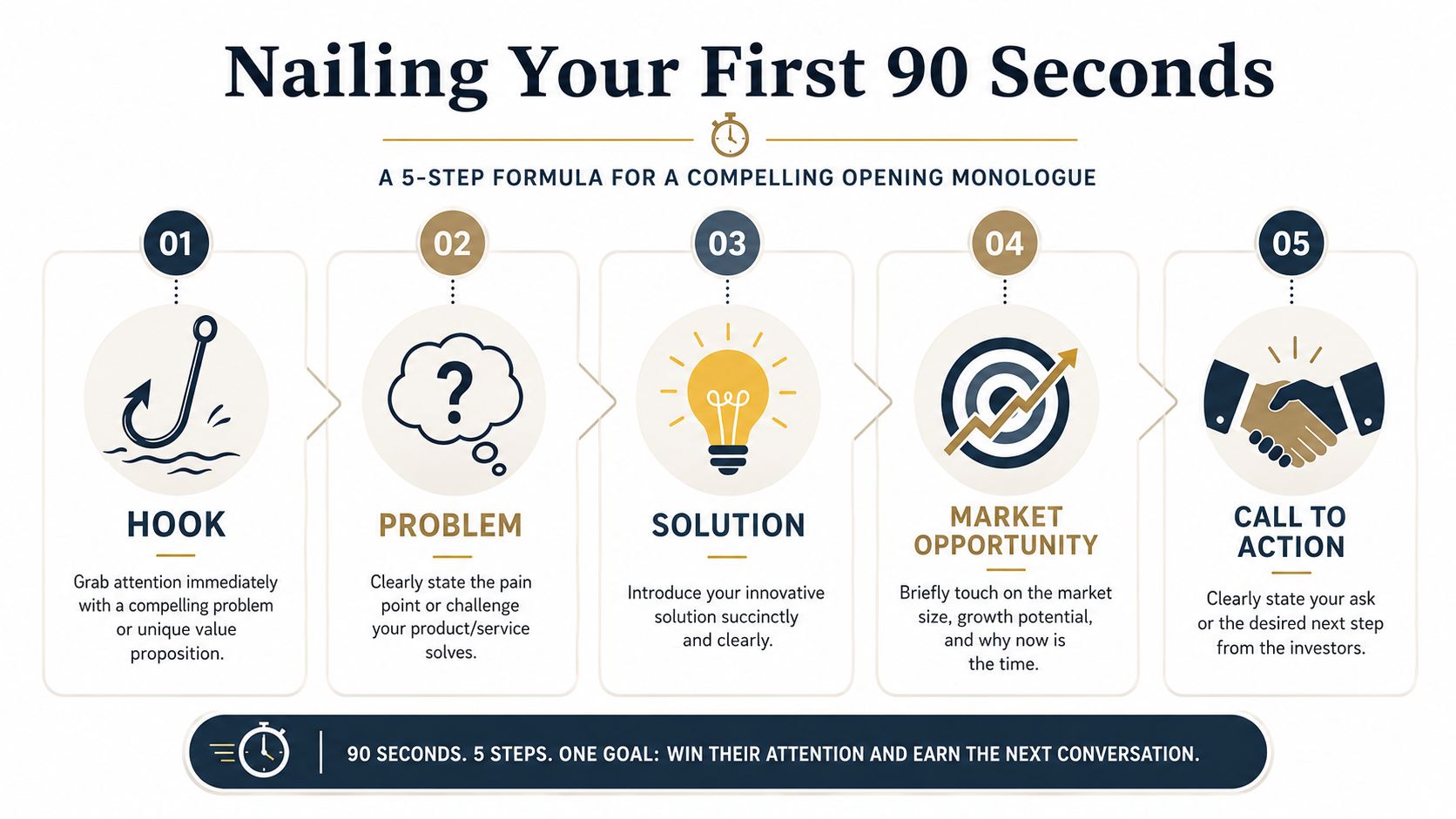
The opening of a Shark Tank pitch has one job. It must make the listener understand your business fast enough to care before skepticism takes over.
Founders who ramble lose control of the room early. The structure matters because the format rewards a tight opening: a roughly 90-second elevator pitch that names the company, states the problem being solved, presents the unique solution, and makes the exact revenue or valuation ask. Wander off that structure and you can lose one or more sharks before you ever reach the number.
Use a four-part opening, then earn the right to elaborate
Most founders try to sound polished. Better founders try to be unmistakably clear.
A strong opening usually sounds like this:
- Name the company immediately. Don’t make the sharks guess who you are or what brand they’re hearing.
- State the problem in plain language. If the pain point sounds minor or abstract, the room goes cold.
- Present the solution with contrast. Show why your product is different from the obvious alternative.
- Make the ask cleanly. State what you want and what the investor gets.
Here’s the key nuance. Your opening isn’t a brand movie trailer. It’s a compressed operating summary with enough tension to pull people in. Urgency matters, but clarity matters more.
What works and what loses the room
I’ve seen founders sabotage a good business by opening with origin story, mission language, or a bloated market speech. That’s wasted oxygen. In the first minute, the sharks are trying to answer a simpler set of questions:
- What is it?
- Who wants it?
- Why now?
- Why are you asking for this deal?
Use narrative sparingly. Use specificity aggressively.
If your first sentence could fit any startup, it’s too generic for the Tank.
A useful self-test is to remove your company name and ask whether the opening still sounds like ten other businesses. If it does, sharpen the problem or the wedge. “We help people live better” is invisible. “We reduce a painful, recurring purchase decision with a simpler product and repeat demand” is at least discussable.
Try this adaptation template:
- Company and category: “We’re [Company], and we make [plain-English product].”
- Problem: “Right now, customers deal with [specific pain], which creates [cost, hassle, delay, or risk].”
- Solution: “We solve it by [distinct mechanism or model], which makes the experience [clear benefit].”
- Ask: “We’re seeking [investment ask] for [equity or deal structure], and we’re here to scale [distribution, production, or growth lever].”
That format works because it gives the sharks handles. They can challenge your market, margins, demand, or valuation, but they can’t say they don’t understand what you’re selling.
A good opener also controls pace. Don’t sprint. Pause after the problem. Let the implication land. Then move to the solution with enough energy to show conviction, not enough force to sound rehearsed.
Founders often ask whether they should memorize every word. No. Memorize the sequence and the transitions. If you lock yourself into exact phrasing, one interruption can wreck your rhythm.
Building an Unforgettable Pitch Deck
A pitch deck shouldn’t decorate your story. It should help you defend it.
That’s why static slides often underperform in investor settings. When a founder relies on screenshots, stale charts, and dense text, the sharks have to trust that the numbers and product views are current. That creates unnecessary doubt, especially when the questioning turns tactical.
Static slides make you defend too much
A weak deck forces you to do all the explanatory work verbally. A strong one reduces friction before the first challenge comes.
The best investor decks I’ve seen do three things well:
- They make the product legible fast. A shark should understand the user experience without needing a five-minute demo.
- They present evidence visually. Sales trends, margin logic, and distribution traction should be easier to inspect than to question.
- They support interruption. If an investor jumps to pricing, channels, or product details, the deck should help you pivot without losing coherence.
That’s one reason more founders are moving beyond traditional slide software. Interactive, web-native formats can make the deck feel less like a lecture and more like a working model. If you want a concrete example of how stronger sequencing improves flow, this guide on structuring a presentation outline for persuasive delivery is useful because it forces you to think in narrative blocks instead of disconnected slides.
Build a deck that can answer questions live
The biggest advantage of interactive decks is not novelty. It’s credibility.
When you can show a product in motion, let an investor inspect a configuration, or pull current figures from a connected source, you stop asking the room to imagine your business. You let them test it. That shift matters because sharks naturally look for cracks. A deck that responds cleanly under scrutiny sends the message that the business itself is organized.
Use interaction selectively. Don’t add movement for its own sake. Add it where it resolves common investor doubt.
A practical build standard looks like this:
| Deck element | Weak version | Better version |
|---|---|---|
| Product view | Static screenshot | Clickable flow or embedded product state |
| Sales proof | Manually updated chart | Live-connected visual from current data |
| Unit economics | Text explanation | Interactive calculator or scenario toggle |
| Technical product | Flat mockup | Rotatable 3D model or guided walkthrough |
The point is not to impress with software. The point is to shorten the distance between claim and proof.
If your deck can’t survive interruption, it’s not investor-ready. Sharks don’t consume presentations in order. They pull threads. They challenge assumptions. They skip ahead. Build for that behavior and your visuals start working like evidence instead of wallpaper.
Mastering Your Numbers and Valuation
Most founders think investors are testing ambition when they press on valuation. They’re usually testing judgment.
The funnel is punishing long before anyone gets on camera. According to Slidebean’s analysis of Shark Tank admission odds and deal outcomes, the show admits only 0.4% of applicants and gives roughly a 0.2% chance of appearing on air, with about 88 companies reaching air each season from more than 40,000 annual applicants. The same analysis notes that roughly half of the deals announced on air never actually close, and many fall apart afterward once the terms no longer look as good as they did under the lights.
What sharks are really testing
They want to know whether you understand the machine underneath the brand.
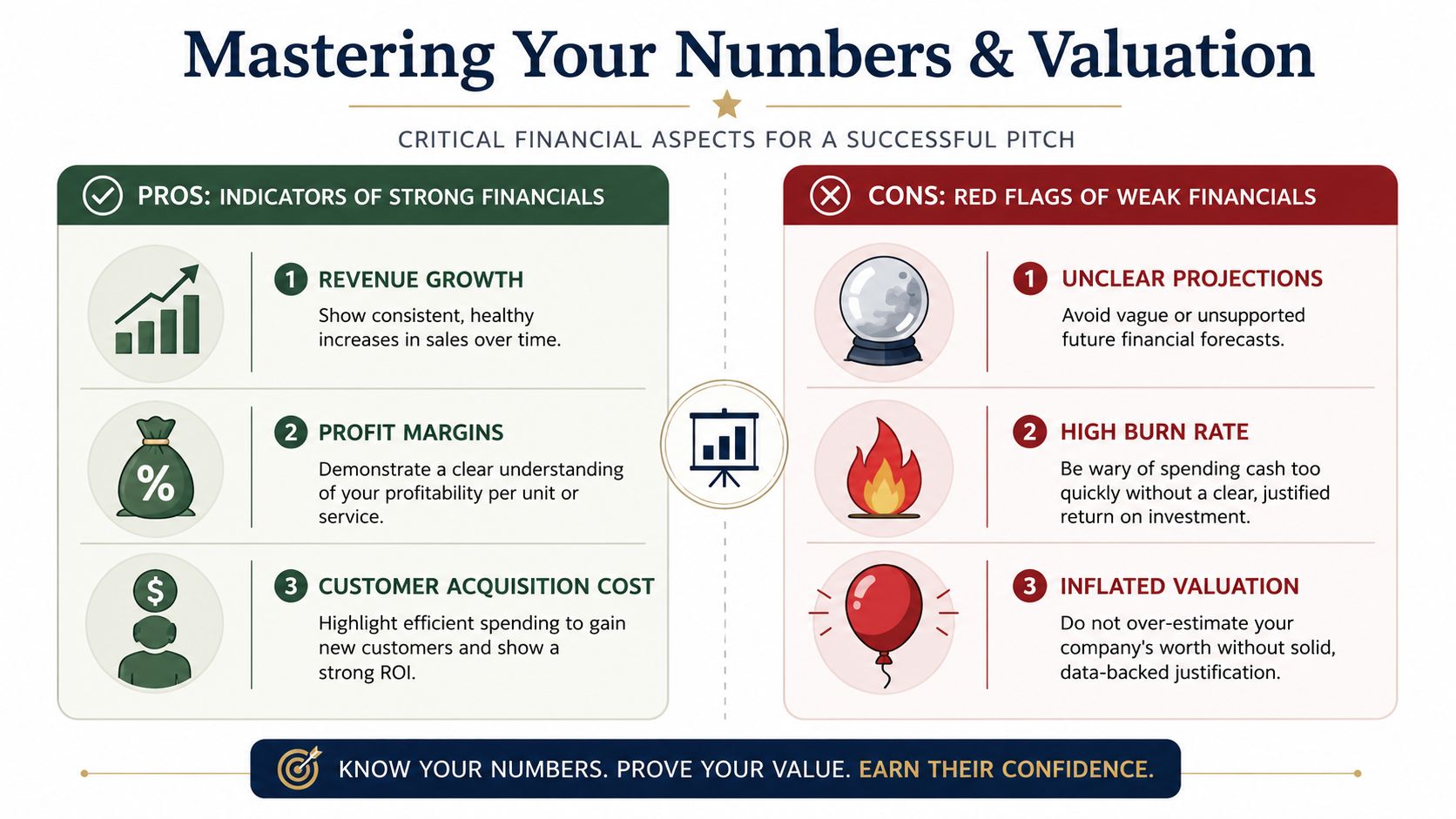
That means you need fluent command of the few numbers that explain your business model:
- Customer acquisition cost: What you spend to acquire a paying customer, by channel if possible.
- Lifetime value: What that customer is worth over time, not in theory but in observed behavior.
- Gross margin: Whether you make enough on each sale to fund growth.
- Burn rate: How quickly the business consumes cash and what that spending is buying.
You don’t need to bury the room in spreadsheets. You do need to answer basic financial questions without hedging, drifting, or sounding surprised by your own business.
A defensible ask beats a flattering ask
Valuation is where founder psychology leaks into the pitch. Many entrepreneurs use the ask to signal confidence. Sharks read that differently. If your valuation ignores risk, execution stage, margin reality, or channel dependency, they don’t think you’re bold. They think you’re inexperienced.
A strong valuation tells investors you understand both upside and downside.
Your ask should do three things at once:
- Reflect current traction. Don’t price the company purely on what it could become.
- Leave room for investor return. If the deal only works in your best-case scenario, it isn’t attractive.
- Stay consistent with your own economics. A founder can’t claim premium valuation while sounding fuzzy on margins, retention, or payback logic.
One practical way to pressure-test your ask is to write two versions of the story. In one, you explain the valuation to a friendly customer who loves the product. In the other, you explain it to a skeptical operator who has seen overhyped deals before. If the second version falls apart, the number is vanity.
This also applies to proposal discipline. A good investor ask has structure. It ties capital to a specific use, timeline, and business inflection. If you need a clean framework for presenting terms logically, this article on how to structure a proposal is a useful reference because it forces tighter reasoning around the ask.
A founder who says, “We want this valuation because we know what we’re worth,” sounds fragile. A founder who says, “Here’s the basis for our ask, here’s what capital enables, and here’s where we know execution risk still exists,” sounds investable.
Rehearsing for the Shark Attack
“Be confident” is weak advice because confidence isn’t a tactic. It’s an output.
The key skill is regulating how confidence is perceived under pressure. One of the most useful data points comes from Science of People’s analysis of 495 Shark Tank pitches (also covered by Business Insider). Founders who smiled and nodded before they launched into the pitch nearly doubled their odds of hearing a yes — a small warmth signal that reads as “friend, not foe” before a single number gets discussed. That tracks with researcher Vanessa Van Edwards’ broader work on charisma: the most persuasive people blend warmth and competence rather than leaning on either one alone.

Confidence is not the goal
A founder can answer every question correctly and still lose the room by sounding combative. That happens when competence is high but warmth disappears.
Warmth doesn’t mean softness. It means your body language and delivery tell investors you’re secure enough to listen, adapt, and stay collaborative while defending the business.
Here’s the contrast:
| Situation | Overdone competence | Balanced response |
|---|---|---|
| Tough margin question | Rapid-fire defense, clipped tone | Direct answer, brief pause, calm expression |
| Valuation pushback | “You don’t understand the category” | “I see the concern. Here’s how we’re thinking about it” |
| Product criticism | Visible irritation | Clarify, then redirect to evidence |
The founders who handle Q&A well don’t just know more. They feel safer to investors.
Train for pressure, not recitation
Most rehearsal is too polite. Friends ask easy questions. Advisors let you finish. That doesn’t prepare you for interruptions, skepticism, or blunt challenges.
Run practice sessions with role constraints instead:
- One person plays the hostile shark. Their job is to interrupt, doubt assumptions, and push on inconsistencies.
- One person tracks nonverbal leakage. They note when you cross your arms, rush, smirk, or tighten your jaw.
- One person scores answer quality. Not whether the answer sounded smart, but whether it was direct, complete, and calm.
Don’t rehearse until you can repeat the pitch. Rehearse until you can stay composed when the pitch breaks.
Interaction planning proves helpful. If you use visuals during practice, make them part of the stress test rather than a script. A useful set of ideas for making presentations respond better in real conversations appears in this guide on presentation interaction ideas, especially if you tend to default to monologue mode.
A few habits consistently improve performance:
- Answer first, explain second. Lead with the conclusion, then support it.
- Acknowledge valid pressure. “That’s a fair concern” buys trust when used sincerely.
- Avoid overcorrection. Smiling at the wrong moment can look evasive. Warmth works best when paired with crisp substance.
- Stay coachable. Sharks often invest in founders they can influence, not founders who need to win every exchange.
If your practice only strengthens competence, you’ll still sound brittle. If it only softens your delivery, you’ll sound unprepared. The blend is the edge.
From Handshake to Closed Deal
A handshake on camera starts a different pitch. The audience sees a win. The investor’s team starts checking whether your story survives contact with documents, contracts, and old emails.
This stage is where warmth and competence have to keep working together. Founders who close deals stay responsive, organized, and calm under scrutiny. They do not get defensive when an investor asks for backup on a claim. They answer quickly, provide clean records, and show that the confident person in the pitch is the same person running the company day to day.
What happens after you hear yes
Post-show diligence tests consistency.
Investors usually review four areas first:
- Financial records: Revenue recognition, gross margins, debt, cash flow, refunds, and any gap between reported numbers and bank activity.
- Legal structure: Formation documents, cap table accuracy, prior investor rights, board approvals, and unresolved disputes.
- Contracts: Customer agreements, channel partnerships, supplier terms, employment obligations, and concentration risk.
- Intellectual property: Trademark ownership, patent filings if relevant, assignment agreements, and any dependency on third-party code, formulas, or manufacturing.
I have seen founders lose credibility here for a simple reason. They treated the pitch like a performance instead of a compressed due diligence meeting. On set, a broad answer can sound polished. After the handshake, broad answers create suspicion.
Your diligence checklist
Build the data room before anyone asks. Make it easy to review, easy to verify, and easy to match against what you said on camera.
A useful starting set includes:
- Corporate documents: Incorporation or formation papers, bylaws or operating agreement, board consents, and an up-to-date cap table.
- Financial package: Historical financials, tax returns, bank statements, and the internal reports used to make operating decisions.
- Commercial proof: Signed customer contracts, purchase orders, renewal data, distribution agreements, and any terms that affect margins.
- IP and brand files: Trademark registrations, assignment documents, licenses, and records showing the company owns its core assets.
- Team records: Founder vesting, employment agreements, contractor IP assignments, advisor agreements, and any unusual compensation terms.
Investors accept risk. Hidden mess is harder to forgive.
The psychology matters as much as the paperwork. If every follow-up answer sounds irritated, evasive, or overly polished, diligence starts to feel like discovery instead of confirmation. Founders who handle this well project competence through clarity and warmth through steadiness. They do not try to win every exchange. They make it easy for the investor to keep trusting them.
Clean records also protect valuation. If your books need interpretation, if your cap table has side promises no one documented, or if key agreements live across personal inboxes, you give the other side a reason to retrade the deal or walk away. A good on-air pitch gets attention. A disciplined back office gets the wire signed.
If you’re building investor decks, sales narratives, or high-stakes presentations and you want them to be interactive, current, and easier to defend under pressure, Encelade is worth a look. It helps teams turn documents, spreadsheets, and research into web-native presentations with live data, interactive elements, and cleaner version control than static files.