Your sales dashboard looks fine until the forecast call starts. Then someone notices the pipeline tile hasn't refreshed, a partner feed is missing a batch of opportunities, and the slide that looked “live” in the deck is yesterday's truth. That's the failure mode of REST API integration in revenue systems—not downtime, but wrong numbers, duplicated records, and alerts that land after the damage is done.
REST has become the default integration pattern for a reason. Postman's State of the API surveys have consistently shown REST adoption above 85% of respondents, and that share has held steady year over year. That dominance matters because the hidden cost of integration work isn't writing one request—it's keeping dozens of slightly different systems in sync without corrupting the business view.
Table of Contents
- The Hidden Cost of a Broken REST Integration
- Planning the Integration Before You Write a Single Request
- Choosing the Right Authentication for Your Use Case
- Designing and Consuming Endpoints That Scale
- Retries, Timeouts, and Rate Limits as One Policy
- Connecting REST APIs to Encelade for Live Decks and Widgets
- Testing, Monitoring, and Troubleshooting in Production
The Hidden Cost of a Broken REST Integration
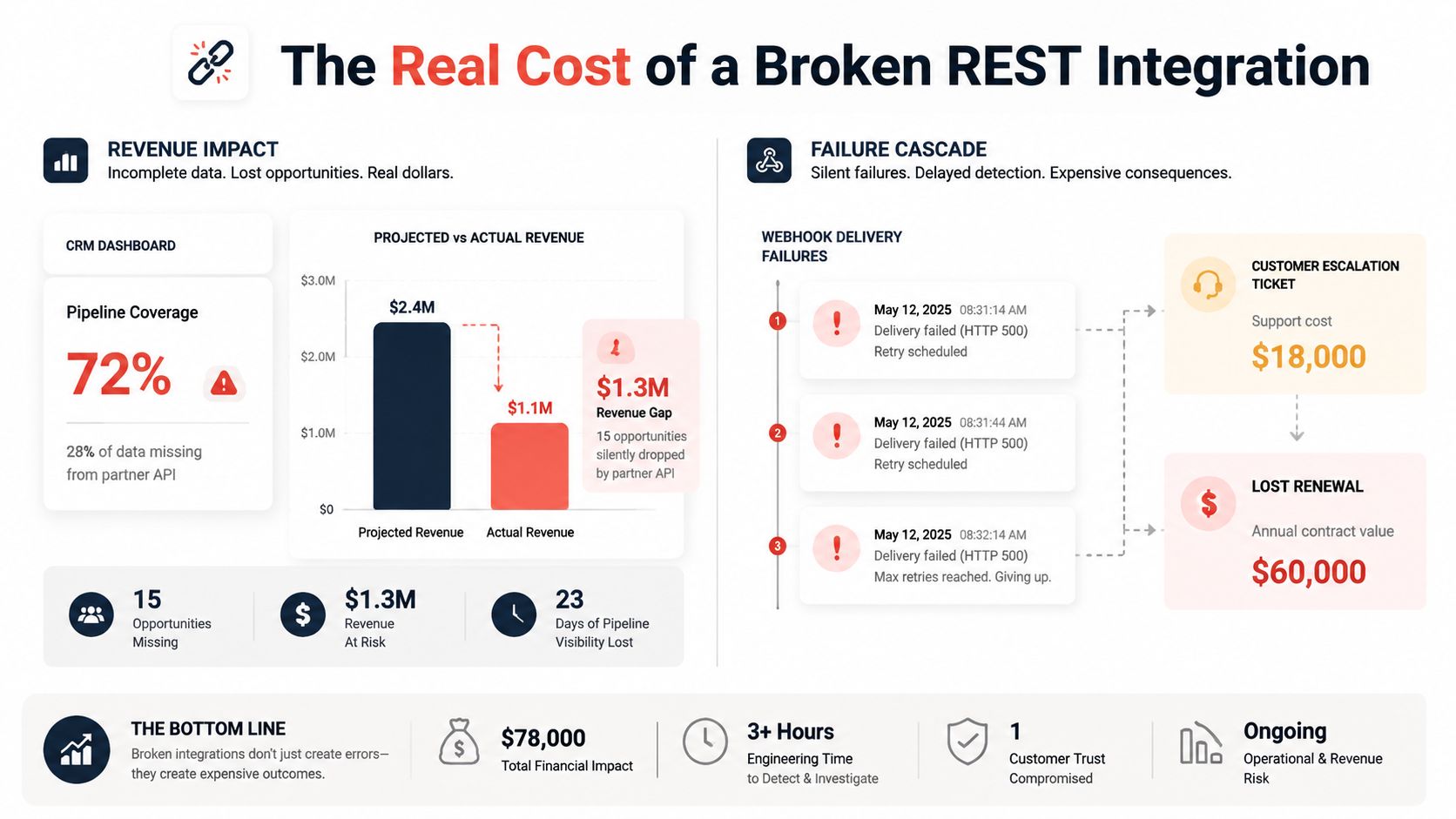
A rep opens a live CRM tile during a late-stage deal review, and the number is wrong. The deck says coverage is healthy, the partner system has already dropped a page of opportunities, and the room acts on stale data because the integration looked fine until the moment it mattered. That is how REST failures show up in revenue teams—as a believable lie.
The ugly part is that the API can be technically healthy while the business outcome is wrong. One widget can cache too long, another can miss a page because traversal drifted, and a webhook retry chain can hammer the downstream system until support gets the escalation instead of the alert. The result is usually a slow burn, not a dramatic outage.
Four failure modes that hurt revenue operations
Pagination drift is the first one. Records get inserted or deleted while a client is walking a collection, and the next page no longer means what the caller thinks it means.
Stale caches are next. A GET can be cacheable by default, which is useful until a dashboard keeps serving an old answer after the underlying record changes.
Retry amplification turns a small upstream issue into a broader incident. If several layers all retry independently, traffic can multiply far beyond what the downstream service can handle, and a partial outage becomes a full one.
Idempotency violations are the silent money leak. A retry on a non-idempotent write can create the same row, charge, or event twice, which is exactly the kind of bug finance notices after the fact.
Treat REST integration as production plumbing for revenue operations, not as a demo exercise. The rest of this guide uses Encelade's live widgets and Presentation API as the running example because that is where stale numbers become visible fast.
Planning the Integration Before You Write a Single Request
The planning mistake many teams make is jumping straight to auth headers and sample curls. The better move is to decide how fresh the data needs to be, how the shape will be represented, and what failure looks like before the first line of code ships. That single page of decisions saves more time than any SDK shortcut.
Start with the sync model
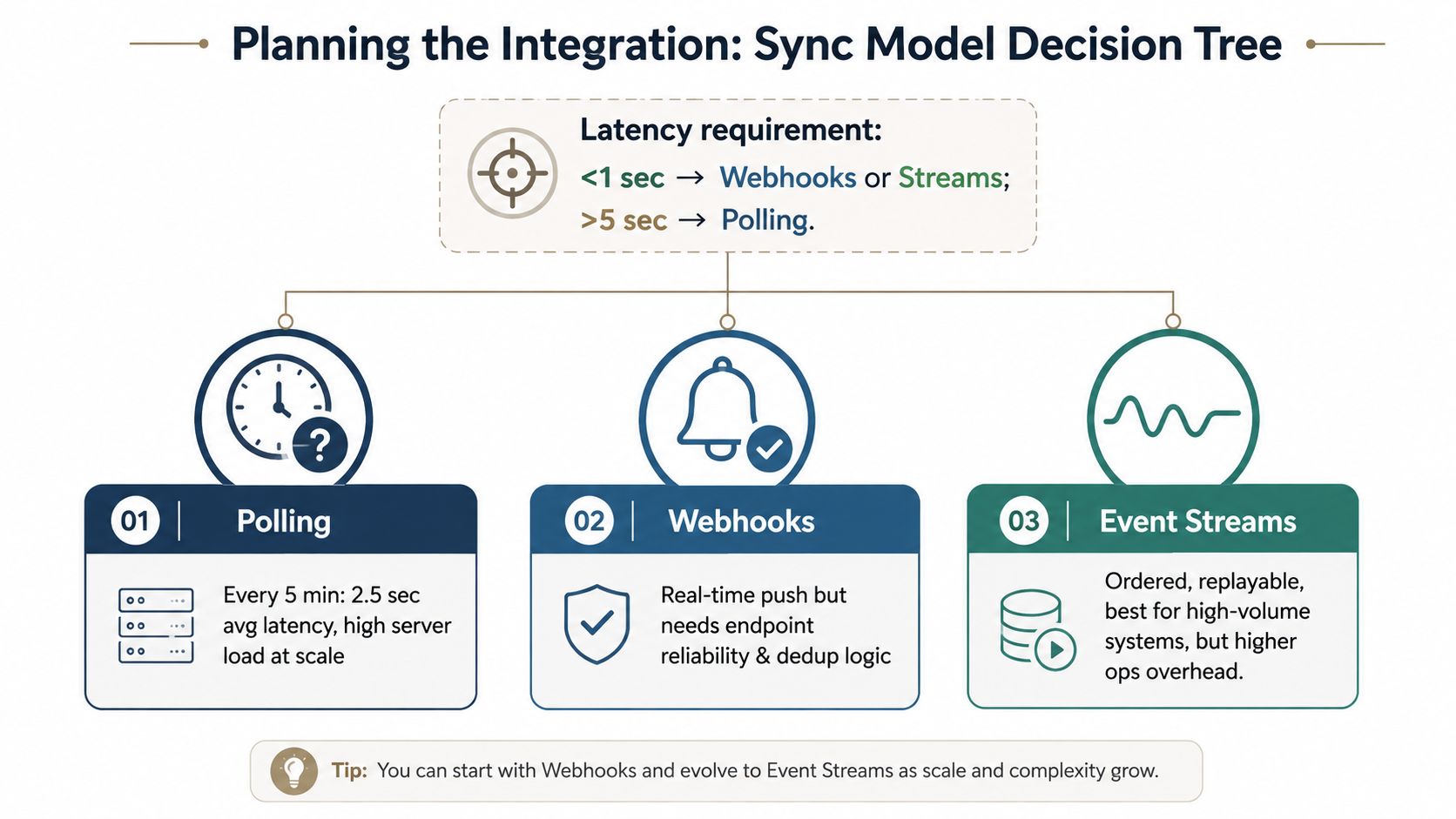
Polling, webhooks, and event streams solve different problems. Polling is easier to reason about but forces you to pick a refresh interval, which means latency and load are coupled. Webhooks push changes faster, but the receiver has to be reliable and dedupe-aware. Event streams are strongest when ordering and replay matter, but they come with more operational overhead.
Practical rule: if the business can tolerate a brief delay, polling is often enough. If a widget or workflow needs near-real-time freshness, webhooks are usually the better fit, as long as the receiver can fail safely.
Then decide what you're syncing. A revenue team usually doesn't need every field in the source system—it needs a stable identifier, a few display fields, and timestamps that support change detection. Fetching too much data makes the integration harder to cache, harder to version, and harder to debug.
Auth belongs in the planning document too, even if the implementation comes later. If the API is acting on behalf of a user, you're likely in OAuth territory. If a backend job or webhook is calling another service, API keys may be sufficient. The choice changes the shape of your tokens, rotation process, and audit trail.
For a concrete planning artifact, keep four fields on one page: sync model, primary key, freshness budget, and failure policy. If you're deciding whether deal widgets should pull from CRM on render, cache for a deck refresh window, or subscribe to a webhook for faster updates, that page forces the trade-off into the open instead of hiding it in implementation details. The same decision set also helps when you connect live widgets to Encelade's REST integration support.
Choosing the Right Authentication for Your Use Case
API keys and OAuth 2.0 often get treated like ideology. They're not. They're different answers to different trust boundaries, and the wrong one creates operational pain later—usually during rotation, auditing, or incident response.
API keys fit machine-to-machine calls
API keys are simple to issue and easy to use in server-to-server integrations and webhook callbacks. A request usually looks like a static credential in a header, which makes it fast to wire into a backend job or a receiver endpoint. That simplicity is also the problem, because a leaked key is often broad in scope and awkward to rotate without touching deployments.
OAuth fits delegated access
OAuth 2.0 is the better fit when the API is acting for a user or another tenant. Client credentials work well for service-to-service access, while authorization code flows support user consent and scoped permissions. PKCE matters for public clients because it reduces the risk of intercepted authorization codes being reused.
| Dimension | API Keys | OAuth 2.0 |
|---|---|---|
| Setup cost | Low | Higher |
| Rotation | Usually manual | Better supported |
| Scoping | Often coarse | Fine-grained |
| Audit trail | Limited | Stronger |
| Delegated access | Weak | Strong |
A mixed-auth provider can get messy fast. One route might use an API key, another might demand OAuth, and a third might support both with different rate-limit rules. That's where teams lose time, because the integration no longer fails on one credential model—it fails on the mismatched assumptions between all three.
Choose API keys for internal jobs and webhook receivers. Choose OAuth when the action needs to be tied to a person, a tenant, or a consented workflow.
That rule is usually enough to keep the initial design sane. If you need both, document where each credential type is allowed and keep the token refresh logic isolated so it doesn't leak into unrelated code paths.
Designing and Consuming Endpoints That Scale
Most REST integration pain isn't in the verb—it's in the shape of the resource and the way clients walk it. A clean endpoint still fails if the payload is bloated, the page boundary shifts, or a retry creates duplicate writes. The endpoint contract and the client contract need to be designed together.
Narrow the response before you optimize the transport
Field selection is one of the fastest ways to surface hidden bloat. A request like ?fields=id,name,updated_at keeps payloads small and makes it clear which attributes the caller depends on. It also reduces the temptation to treat the full response as a schema dump.
Cursor pagination is the other pattern that holds up under change. Offsets look convenient, but they drift when records are inserted or deleted while a client is paging through data. Cursors, whether opaque tokens or encoded timestamps, preserve traversal state much better for long lists.
| Strategy | Drift Under Writes | Cursor Required | Best For |
|---|---|---|---|
| Offset pagination | High | No | Small, stable lists |
| Cursor pagination | Low | Yes | Large or changing datasets |
| Unbounded list fetch | Very high | No | Almost never in production |
For a deeper look at how live data feeds prevent stale numbers, see our guide to building real-time data dashboards.
The write side needs guardrails too. An Idempotency-Key header on POST or PATCH requests lets the server deduplicate a repeated submission so a retry doesn't create a second record or charge. That matters more than many teams expect, because network uncertainty is normal and duplicate business actions aren't.
ETags and If-None-Match are useful when you need cheap polling. They let the client ask whether the resource changed instead of re-downloading the same representation. That helps for widget refreshes, where the goal is freshness without turning every render into a full fetch.
Practical rule: don't let a health check stand in for a real resource check. An endpoint can answer quickly and still hide a degraded downstream state.
Webhook signatures deserve the same care as write safety. Verify the HMAC on receipt, reject bad signatures early, and keep a replay-detection strategy in place so a duplicate delivery doesn't look like a new event. The REST verb is only half the story—the receipt logic is what keeps the data trustworthy.
The reason this matters in live revenue tooling is straightforward. If a slide widget fetches a bloated payload and the source system starts shuffling records, the audience sees old numbers with a fresh timestamp. That is the kind of lie that gets repeated in executive rooms.
Retries, Timeouts, and Rate Limits as One Policy
Retries are not a convenience feature. They're part of your failure policy, and if you treat them as an afterthought, the integration will punish you during the first real incident. The same is true for timeouts and rate limits, which need to work together instead of competing with each other.
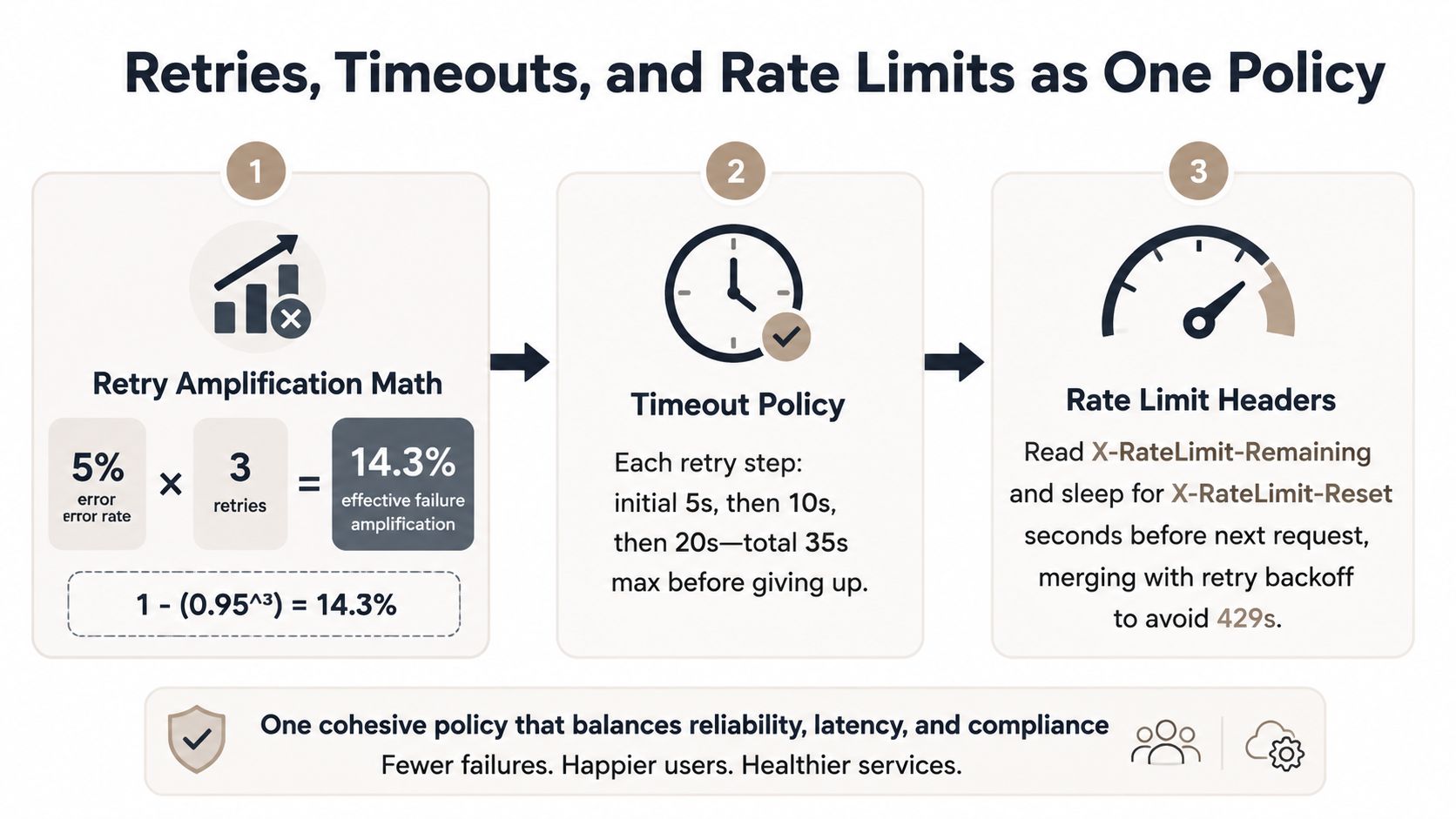
A good policy starts with a single timeout budget per request, not a pile of unrelated timers. Separate connection and request timeouts, bound the downstream deadline to the caller's remaining budget, and retry only transient, replay-safe failures such as 429s, connection resets, or select 5xx responses (production reliability guidance). The important part is that retries are selective, not automatic.
The hidden trap is amplification. If three layers each allow up to four attempts (original plus three retries), the load on the downstream system can multiply by 64×, turning a partial outage into a much larger incident (retry amplification warning). That's why every retry path needs a cap, and why a circuit breaker should open when 5xx or 429 spikes become persistent.
Read the headers, don't ignore them
Rate-limit headers are inputs, not decoration. The common pattern is to look at Retry-After when it exists, and otherwise use exponential backoff with full jitter so callers don't synchronize into a thundering herd. X-RateLimit-Remaining, X-RateLimit-Reset, and similar headers belong in the client's limiter logic, not just the logs.
Honor
Retry-Afterfirst. If the upstream tells you when to come back, let that beat your local guess.
The last piece is idempotency. A retry on a non-idempotent POST is a bug unless the server can dedupe it safely. If the write can't be repeated without side effects, the client needs a different strategy—not a more aggressive retry loop.
Connecting REST APIs to Encelade for Live Decks and Widgets
A revenue team doesn't want another static export. It wants numbers that stay current while the deck is being used, and that means the integration has to support refresh, generation, and recovery without handholding. The practical pattern is to split the system into three paths: widget refresh, server-side deck creation, and agent-driven updates.
Live widgets need a freshness contract
The simplest pattern is a small REST poller with ETag caching. The widget asks the CRM contacts endpoint for the current state, compares the response with the cached version, and only re-renders when the data changed. That keeps live widgets responsive without forcing every slide render to become a full data sync.
Deck generation needs an idempotent job
The second pattern is server-side presentation generation. A backend job posts a deck template ID, a payload, and an idempotency key, then gets back a generated URL that can be shared or embedded. If the request times out, the same key lets the job retry without creating a duplicate deck.
MCP can keep conversational decks current
The third pattern is real-time sync through MCP. An agent can call connector tools mid-conversation, pull fresh numbers into a narrative slide, and keep the deck aligned with what the user just asked for. That's especially useful when the presentation is part of a live sales motion instead of a one-time artifact.
For teams using Encelade's REST API integration, the useful discipline is to define the sync contract explicitly. Webhook in, poll fallback, dead-letter on terminal failure, and a freshness budget that the widget is never allowed to exceed. If the source feed goes stale, the system should fail visibly instead of pretending nothing changed.
Practical rule: a live deck should degrade to obviously stale, never quietly wrong.
That's the difference between a presentation tool and a reliable revenue surface. The first can look polished while lying. The second makes freshness part of the contract.
Testing, Monitoring, and Troubleshooting in Production
REST integrations need a different test mix than a normal app. Contract tests should run against recorded fixtures or mocks so you can verify the mapping layer without hitting a live vendor every time. Unit tests catch conversion mistakes, and a thin set of gated live tests confirms auth and transport still work.
The signals that catch silent failures
Four signals matter most in production: error rate by endpoint, p99 latency, retry budget burn, and stale-data alerts on widget freshness. Those metrics show whether the integration is merely noisy or wrong. A low error rate does not help if the widget is six hours behind.
Troubleshooting should start with the write path. Check Idempotency-Key logs first to confirm a request landed once, then look for 429 patterns in the rate-limit headers, and only then inspect upstream latency or schema drift. If the problem sits in a webhook, validate the signature and the expected nonce before blaming receiver logic.
A useful monitoring checklist includes structured logs with correlation IDs, dashboards that separate client errors from upstream errors, and synthetic checks that exercise auth refresh flows. Add a postmortem template that records pagination drift and retry amplification explicitly, because those are usually the causes when a REST integration misbehaves under load.
If the widget looks stale, trace the sync job first. The source API is often fine, and the failure happened in the layer that moved the data.
The hardest part of production support is resisting the urge to blame the vendor too soon. Most integration bugs turn out to be local—in the client's paging logic, refresh cadence, timeout budget, or retry policy.
Treat every “well documented” API as a moving contract. Documentation freshness, version changes, and silent response-shape changes are where teams lose time—not in the happy-path GET request.
Encelade gives revenue teams a way to generate, style, and share interactive decks with live data, so the slide does not drift away from the source system. If you are dealing with REST integrations that need to stay fresh in widgets, decks, or agent-driven workflows, book a demo and see how the presentation layer can stay connected to the same data contract as the rest of your stack.