The AE joins a discovery call with a 47-slide deck last updated in Q2. The prospect asks for current pricing. The rep scrolls through a static PDF, finds three conflicting figures, and promises to follow up. By the time the conversation returns to the buyer’s business problem, attention has already moved elsewhere.
That scene isn’t a presentation problem. It’s a revenue-system problem. Marketing created an asset once, sales customized it under pressure, and nobody can prove which version reached the buyer or whether any of it helped the deal progress.
An AI sales enablement platform should solve that operational failure. It should connect approved content, live business data, buyer behavior, and rep workflows so every customer-facing presentation remains relevant, governed, and measurable. The standard isn’t “can it create slides?” The standard is “does it change what reps do and help buyers move forward?”
Table of Contents
- Why Most Sales Decks Quietly Lose Deals
- What an AI Sales Enablement Platform Actually Is
- Core Capabilities That Separate Real Platforms from Repos
- How to Evaluate an AI Sales Enablement Platform
- Governance and Adoption as the Real Deciding Factors
- Revenue Team Use Cases and Where Capabilities Map to Pain Points
- A 90-Day Implementation Plan That Sticks
- Measuring Whether the Platform Is Actually Working
Why Most Sales Decks Quietly Lose Deals
The 47-slide deck rarely fails because every slide is badly designed. It fails because the organization treats a presentation as a finished file instead of a live selling instrument.
Marketing publishes a core narrative and moves on to the next campaign. Product changes a package. Finance updates pricing. A new customer story becomes available. And the PDF? It stays the same, unless someone remembers to edit it, re-export it, upload it, and tell every rep which version is safe. Under pressure, reps build their own combinations from old decks, email attachments, and slides copied from colleagues.
The result is predictable:
- Stale commercial details: Pricing, packaging, product claims, and customer evidence drift away from the current offer.
- Inconsistent narratives: Each rep assembles a different story for the same buyer profile.
- No buyer context: The deck reflects the company’s preferred sequence, not the prospect’s priorities, role, or objections.
- Invisible performance: A download or email send tells leadership almost nothing about what the buyer consumed.
None of this is new. Back in 2013, SiriusDecisions (now part of Forrester) estimated that 60% to 70% of the content B2B marketing organizations produce goes unused, sitting on sales portals and websites. It traced the root cause to content built without insight into buyer personas and how they buy. Shared folders make the problem worse. As TeamSlide’s guide to enterprise pitch-deck management points out, a folder can’t enforce versions, govern access, or retire slides that should no longer be in the field.
Practical rule: If a rep has to search, copy, paste, and verify an asset during a live deal, the enablement system has already failed.
Buyer attention makes the failure more expensive. A 2017 DocSend analysis of more than 34 million interactions with sales content on its platform found that prospects spend less than three minutes, on average, on a piece of sales content. Storydoc’s analysis of more than 1.3 million sessions on its own platform found that, among viewers who opened a deck and left without engaging, 31% were gone within the first 10 seconds, while 82% of people who got through the first three slides finished the deck. The opening and the first value exchange aren’t design details. They’re conversion points.
When the deck misses, the rep reverts to memory, the manager hears a vague forecast update, and marketing receives anecdotal feedback after the quarter is already at risk. Sales cycles stretch because the buyer has to ask for clarification, the champion lacks a clean artifact to forward internally, and the team can’t distinguish a weak message from weak execution.
The sales enablement category exists to break that cycle. The useful platforms don’t merely automate slide creation. They keep collateral live, restrict what can be shared, adapt the experience to the buyer, and show which content earns attention as opportunities progress.
What an AI Sales Enablement Platform Actually Is
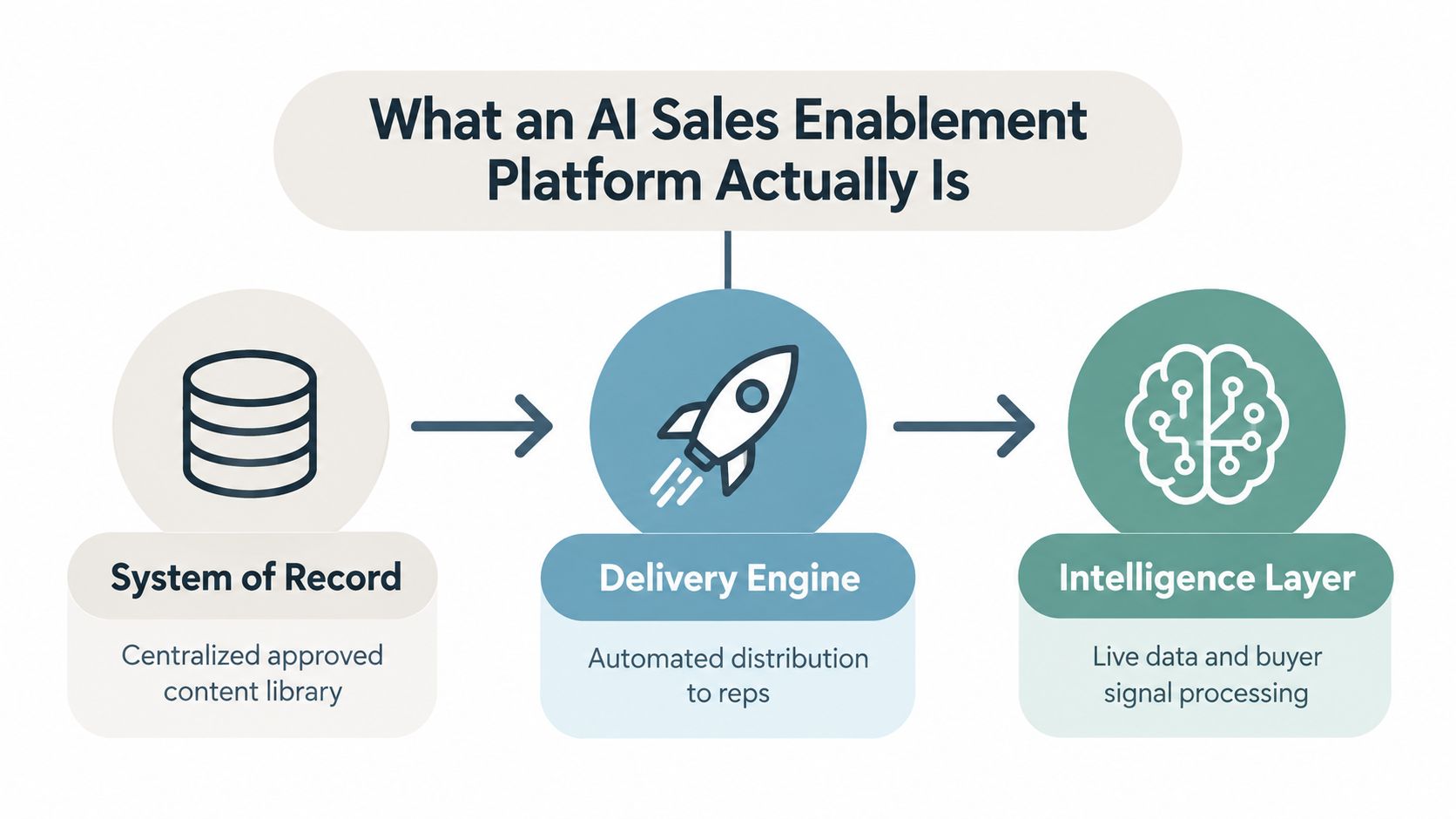
An AI sales enablement platform is a system of record and a delivery engine for customer-facing selling. It stores approved content, connects to operational data, assembles relevant experiences, distributes them inside rep workflows, and records how buyers interact with what they receive.
A useful analogy is a GPS. Your CRM knows where the customer has been. A content library is a static map. An AI enablement platform recalculates the route using the destination, current traffic, road closures, and the driver’s progress. It can assemble a route for a finance executive, a technical evaluator, or a procurement lead without asking the rep to rebuild the map from scratch.
The three operational layers
The system of record holds approved decks, talk tracks, case studies, pricing modules, product information, templates, and permissions. It should answer a simple question quickly: which material is safe and relevant for this rep, market, product, and deal stage?
The delivery engine puts that material where work happens. It can surface content in a CRM, assemble a buyer-facing link, generate a deal-specific presentation, or recommend a next asset after a meeting. The delivery layer matters because reps won’t consistently adopt a destination that requires a separate search habit.
The intelligence layer processes live data and buyer signals. It can use account attributes, deal stage, previous interactions, content engagement, and approved source material to shape the experience. The value comes from the connection between those signals and a specific action, such as changing the opening narrative or recommending an objection-handling module.
This category isn’t a CRM replacement. Salesforce or HubSpot remains the primary system for accounts, contacts, opportunities, and forecast data. It isn’t a slide maker, because freeform generation without approved inputs creates brand, legal, and factual risk. It isn’t a document repository, because storage alone doesn’t change distribution or usage. It also isn’t a sales-training LMS, although training, coaching, content, and deal execution can connect inside a broader enablement workflow.
For a practical explanation of how AI can support selling workflows, see our guide to using AI in sales. The buying test is straightforward: can the platform turn trusted inputs into a relevant buyer experience without making the rep perform another administrative project?
Core Capabilities That Separate Real Platforms from Repos
The market has already moved beyond early adoption. In the 2024 edition of its sales enablement platform market report, Grand View Research valued the market at USD 5.23 billion in 2024 and projected it to reach USD 12.78 billion by 2030, a 16.3% CAGR from 2025 to 2030. That growth doesn’t make every feature valuable. It makes disciplined evaluation more important.
| Capability | What Actually Moves Pipeline | Vendor Decoration to Ignore |
|---|---|---|
| AI content generation | Generates from approved modules, account data, and controlled templates | A generic chatbot that writes unsupported claims |
| Live data binding | Keeps pricing, charts, product facts, and account figures connected to source systems | A one-time spreadsheet upload presented as “real-time” |
| Interactive experiences | Gives buyers calculators, comparison views, product models, and shareable journeys | Animation added to static slides without a buyer action |
| Governance | Enforces permissions, approvals, brand rules, and retirement of stale content | A style gallery with no workflow controls |
| Behavioral analytics | Shows section-level engagement and connects it to deal movement | Open counts and download totals with no revenue context |
Generation must stay inside guardrails
AI content generation helps when it assembles approved building blocks around a real opportunity. A rep should be able to provide the account context, buyer role, use case, and deal stage, then receive a draft that uses sanctioned claims and layouts.
Freeform generation is a liability. A polished sentence can still contain an outdated product promise, an unapproved comparison, or an invented customer result. Require source grounding, reusable modules, approval status, and an audit trail. Speed matters only after accuracy and control are in place.
Live data beats manual refreshes
A pricing chart that needs a rep to update it is not live. Look for bindings to CRM objects, product catalogs, spreadsheets, REST APIs, or governed data services. The platform should show what source populated a figure and what happens when that source changes.
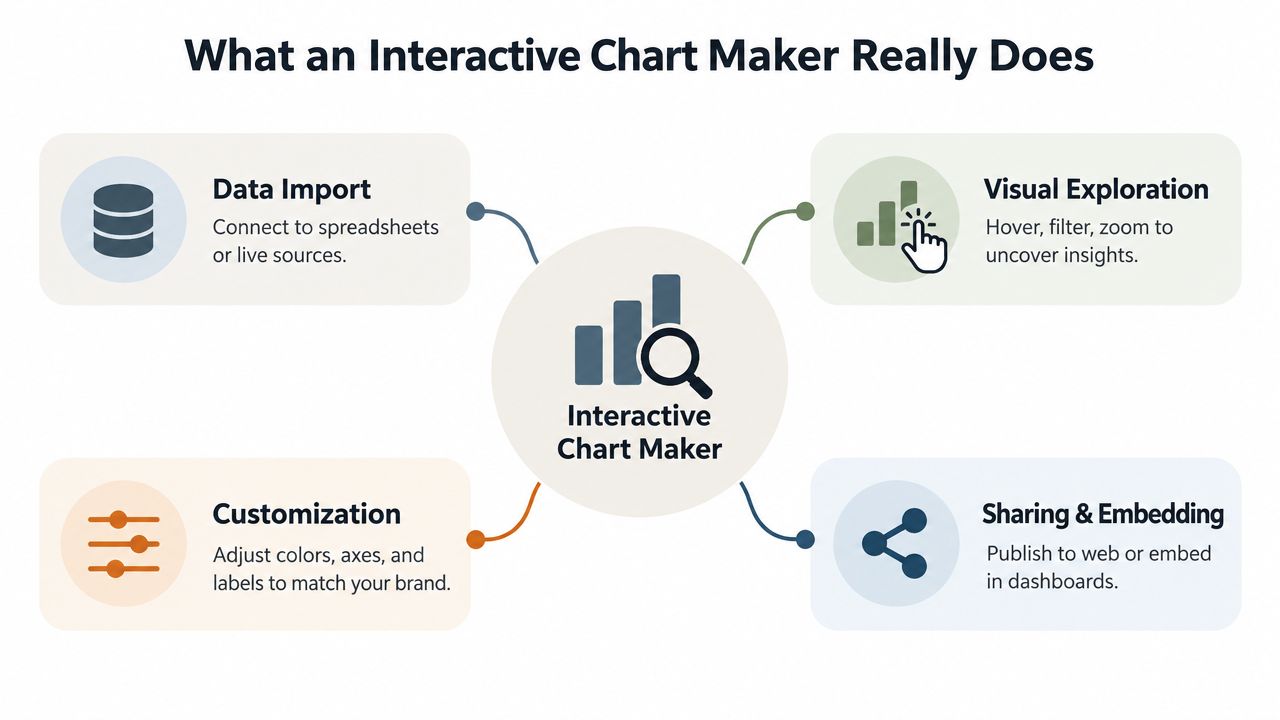
Interactive formats deserve the same scrutiny. A clickable deck, embedded calculator, or native 3D product view can help a buyer understand the offer, but only when it answers a real question. Engagement telemetry can capture opens, time spent on specific sections, forwards, and return visits, which turns a static deck into a measurable sensor on the buyer’s journey.
Analytics should reach the opportunity
Open rates are useful for diagnosing distribution. They aren’t proof of revenue impact. A serious platform connects content engagement, rep activity, historical win rates, and opportunity outcomes in one live view. Highspot’s sales analytics guidance describes this shift from static reporting toward live visibility into which assets and seller behaviors correlate with revenue movement.
Ask vendors to show a deal where analytics changed a content decision. If the demo stops at “this deck was viewed,” you’re looking at a repository with better instrumentation.
How to Evaluate an AI Sales Enablement Platform
Don’t run the selection process as a feature checklist. Vendors design demos to win checklist items. Your team needs a weighted decision matrix and a live test with real reps, real accounts, and real content.
Score the operating model
| Evaluation Dimension | Weight | What to Score | Red Flag |
|---|---|---|---|
| CRM and data integration | High | Live account context, bidirectional data flow, source traceability | Assets are pushed manually or data arrives through fragile workarounds |
| Governance controls | High | Role-based access, approvals, brand rules, legal status, retirement | Anyone can edit or share any asset |
| Behavioral analytics | High | Slide-level engagement, account activity, deal association, revenue reporting | Reporting ends at opens and downloads |
| API and automation maturity | Medium | Programmatic deck creation, webhooks, structured inputs, agent interfaces | The platform claims AI but has no usable automation layer |
| Revenue proof | High | Named references, clear measurement design, opportunity-level evidence | The vendor offers only usage charts and anonymous anecdotes |
Spend half your evaluation time outside the conference room. Give three reps a live prospect and ask them to create the next customer-facing deck in each shortlisted platform. Don’t provide a sanitized demo account. Use the same source notes, CRM fields, pricing rules, and brand requirements your team handles every week.
Measure the experience qualitatively and operationally:
- Rep effort: How many steps require searching, copying, reformatting, or asking enablement for help?
- Output quality: Does the first draft reflect the buyer’s role and current deal context?
- Editing burden: Can the rep trust the result, or must a senior seller rebuild it?
- Workflow fit: Can the rep share and monitor the deck without leaving the tools already used during the opportunity?
- Manager confidence: Can a leader inspect what was sent and whether the content was approved?
The strongest demo is a junior rep producing a credible, on-brand customer experience without heavy rescue work from marketing or sales engineering.
Ask for a reference customer who runs the same motion, not merely a large logo. Have that customer explain what changed in rep behavior, which metric moved first, what failed during rollout, and which controls they still manage manually. A vendor that can’t answer those questions is selling software capability, not operational proof.
If you’re still building the shortlist, our comparison of the best sales enablement tools groups the main products by the job they do, so you can match each one to the bottleneck you’re trying to remove.
Governance and Adoption as the Real Deciding Factors
Creation speed attracts buyers. Governance determines whether the system survives contact with the field.
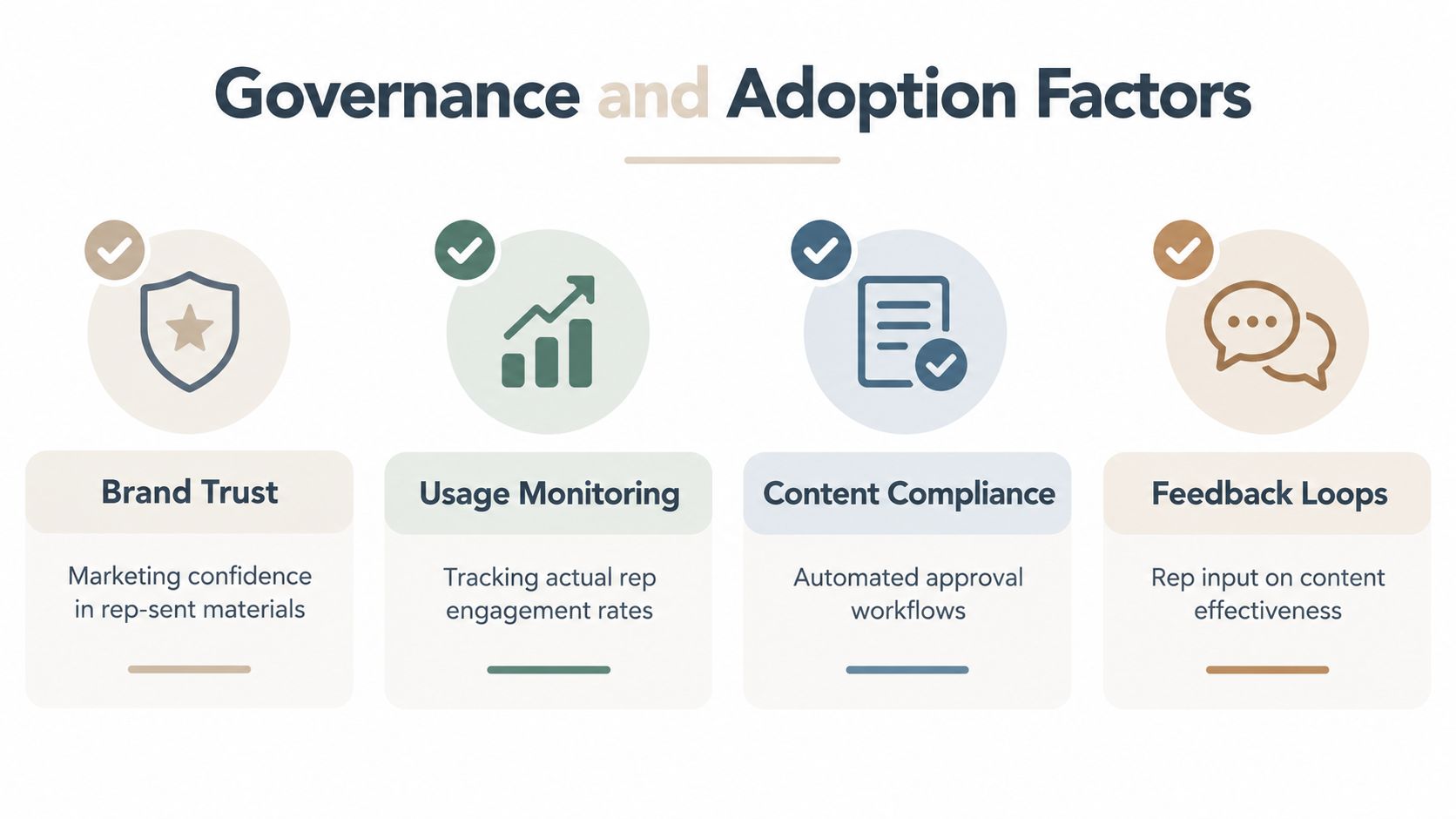
Marketing teams lose trust when reps send unapproved claims. Legal teams intervene when outdated language appears in a proposal. Sales leaders lose visibility when each region maintains its own deck library. The controls below matter more than another generative feature:
- Guardrailed templates: Reps can personalize within approved layouts, modules, claims, and brand rules.
- Compliance scans: The platform flags restricted language, obsolete claims, missing disclosures, and content awaiting review.
- Role-based libraries: Pricing, packaging, competitive material, and regional assets appear only for the right users and opportunities.
- Audit logs: Leaders can see who shared which asset, with which account, and when.
- Automatic retirement: Superseded versions disappear from search and links instead of remaining available in a forgotten folder.
Security and governance aren’t theoretical blockers. In Microsoft and LinkedIn’s 2024 Work Trend Index, a survey of 31,000 knowledge workers across 31 markets, 78% of AI users said they bring their own AI tools to work, and only 39% of people using AI at work had received AI training from their company. In sales, adoption is already mainstream. Salesforce’s 2026 State of Sales report, based on a survey of 4,050 sales professionals, found that 87% of sales organizations use some form of AI.
Remove friction from the rep’s day
Adoption collapses when the platform feels like extra work. Reps will email PDFs if the approved path is slower than the risky path.
Look for prompts that surface content at the right deal stage, mobile parity for tablet-based selling, and single sign-on that removes another login. Put the sharing workflow inside the CRM, email, or meeting process where possible. A platform that requires reps to remember a separate destination is a content graveyard waiting to happen.
Read our guide to compliance requirements for revenue teams when defining your control model. Then make governance measurable. Track how often stale assets are shared, how quickly marketing approves updates, whether reps use approved templates, and which content gaps repeatedly send sellers back to unofficial tools.
Revenue Team Use Cases and Where Capabilities Map to Pain Points
Capabilities only matter when they remove a named bottleneck. Start with the pain, then force the vendor to demonstrate the complete workflow.
Account executives and customization debt
An AE spends hours adapting a generic deck for a complex account. The useful response is API-driven generation that pulls CRM context, approved research, product data, and brand templates into a customized presentation. The rep should review the narrative and add judgment, not rebuild every slide.
Require a demonstration using a real opportunity. Ask the vendor to show how it handles missing fields, conflicting source data, restricted pricing, and a buyer who needs different versions for a technical evaluator and an executive sponsor. A reference customer should confirm that this process is part of daily selling, not a special project.
Champions and internal consensus
A champion may understand the product but still struggle to explain its value to finance, security, operations, or an executive sponsor. Interactive decks, calculators, comparison views, product tours, and shareable microsites give that champion something more useful than a static attachment.
The key feature is not interactivity by itself. It’s the ability to see who engaged, which sections they revisited, and where the buying group stopped. Those signals help the AE follow up with a specific question instead of sending another generic “checking in” email.
Marketing and pipeline attribution
Marketing often knows which assets were created but not which ones influenced progression. Require analytics that connect asset usage to account activity, stage movement, and closed-won attribution in the CRM.
A useful report should answer questions such as:
- Which narrative blocks appear in progressing opportunities?
- Where do buyers leave or return?
- Which assets do champions forward internally?
- Which content gets used often but produces weak engagement?
- Which high-performing assets are difficult for reps to find?
If the vendor only reports total views, it hasn’t solved attribution. Ask for an account-level walkthrough from first share through opportunity outcome.
Product launches and changing offers
Product launches lose momentum when every update depends on manual slide editing. A live data layer can keep pricing, roadmap information, configuration details, and charts aligned with approved sources. Native 3D or embedded product scenes can give evaluators a more concrete experience than screenshots, particularly when physical configuration or spatial understanding matters.
Encelade covers the buyer-facing presentation layer of this category. It provides browser-based interactive presentations, API and MCP interfaces for programmatic deck generation, live connections through Sheets and REST APIs, widgets, native 3D support, brand kits and themes, a content-editor role that can edit content but not layout, sharing, and engagement analytics. Evaluate it against the same requirements as any other platform, especially governance, integration depth, and opportunity-level measurement.
A useful vendor demo should begin with the pain point, not the product tour. Show the old manual process, the new workflow, the buyer experience, and the report a manager receives afterward.
A 90-Day Implementation Plan That Sticks
Treat implementation as behavior change. A technically successful deployment can still fail if reps return to PDFs and marketing stops maintaining the source content.
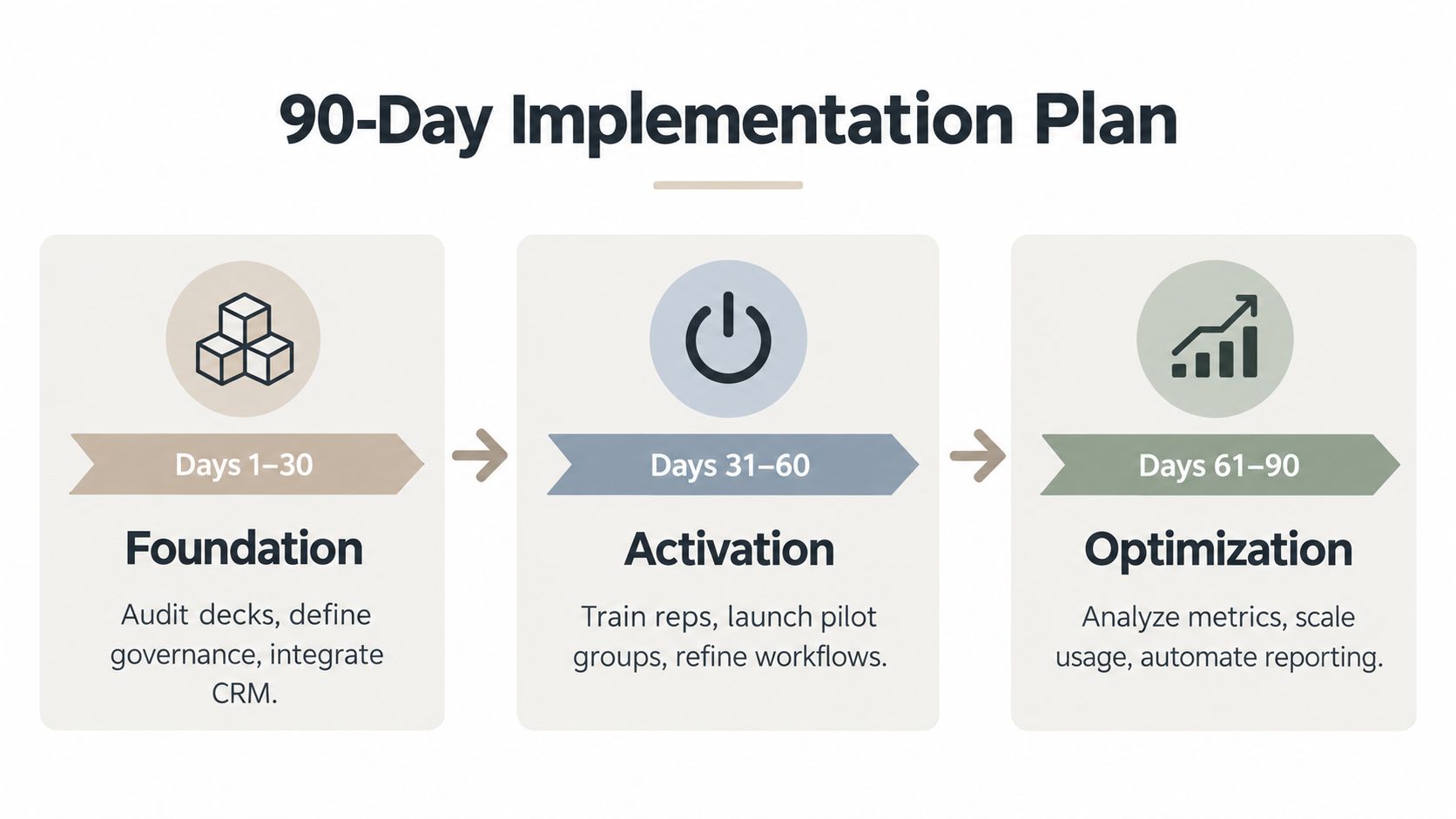
Days 1 to 30 build the foundation
Audit the existing deck estate. Identify duplicate assets, stale claims, regional variations, approval owners, and the presentations reps use. Define brand, legal, access, and version rules before importing content.
Connect the CRM and relevant data sources. Capture baseline measures for content usage, creation effort, stale-asset sharing, and buyer engagement. Without a baseline, the team will argue about impressions instead of measuring change.
Days 31 to 60 activate one team
Choose one high-volume revenue team with a clear selling motion. Configure interactive templates, live data bindings, approved modules, and account-specific generation. Train reps on the workflow they’ll use in active deals, not on every feature in the platform.
Collect friction feedback weekly. Watch where reps abandon the system, which fields are missing, and which approval steps create delays. Fix those issues before expanding.
Days 61 to 90 optimize and expand
Add two more teams once the pilot shows repeatable behavior. Formalize approval routing, version retirement, permissions, and reporting ownership. Build dashboards for usage, buyer engagement, content freshness, and opportunity influence.
Use explicit checkpoints:
- Pilot usage: Above 60%, with the target defined before launch.
- Creation time: Reduced by at least 50% against the baseline.
- Active usage: At least three interactive decks in active deals.
Those checkpoints are implementation targets, not proof of revenue by themselves. A team can create decks faster and still send irrelevant content. The next measurement layer must connect usage to buyer behavior and opportunity movement.
Measuring Whether the Platform Is Actually Working
Login counts are not success. Neither are downloads. They prove that someone touched the system, not that a rep improved a deal or that a buyer understood the value.
Use a four-layer scorecard and review it quarterly.
| Layer | Key Metrics | Healthy Benchmark |
|---|---|---|
| Buyer engagement | Time on interactive content, section depth, repeat views, forwards | Engagement concentrates on value and proof sections, with follow-up tied to observed behavior |
| Rep behavior | Personalized-deck usage, follow-up speed, approved-content usage, stale-asset reduction | Reps use the platform in active deals without manual intervention |
| Pipeline impact | Stage progression, velocity, conversion, CRM-attributed revenue | Opportunities receiving relevant experiences show stronger movement than a comparable baseline |
| Governance health | Compliance, freshness, approval time, unofficial sharing, maintenance effort | Marketing trusts the system and spends less time correcting field usage |
A mature platform should capture engagement signals such as time on slide and repeat visits, then connect them to the account and opportunity. Our guide to engagement reporting for revenue teams is a useful reference point for thinking about buyer-level presentation measurement.
Interpret the scorecard diagnostically:
- Strong engagement, flat pipeline: The content may be interesting but poorly matched to the buying problem, offer, or stage.
- High adoption, weak engagement: Reps may be sharing the right-format assets without a relevant narrative.
- Low adoption, strong buyer response when used: The workflow has value, but distribution, training, or friction is blocking behavior.
- High usage, declining governance: The platform is becoming a faster way to spread unapproved material.
- Healthy usage and engagement, weak stage movement: Inspect qualification, pricing, product fit, and follow-up. Don’t blame the presentation system automatically.
The quarterly decision should be blunt. Expand when rep behavior is repeatable, buyer engagement is meaningful, governance is trusted, and opportunities show measurable movement. Iterate when one layer is strong and another is weak. Replace when the platform cannot connect approved content, workflow adoption, and revenue evidence after a properly supported pilot.
If your team is still rebuilding decks from stale PDFs, Encelade can turn research, deal notes, spreadsheets, and documents into interactive, web-native presentations with live data, branded templates, programmatic generation, and engagement analytics. Visit Encelade to see whether its presentation workflow fits your revenue use case, and run it against a real active deal.