
Mondays are the same for most sales teams. Slack is already on fire, a remnant of the old playbook is still around, pricing has been set in one channel, while in others, it's still up for grabs, and a manager is trying to run a forecast call, as usual, using notes that don't align with what the representatives were told at the end of the week.
That isn't a content problem; it's an internal communication strategy problem, and the gap is usually invisible from the top. In Axios HQ's 2025 research, 80% of leaders claimed their internal communications were relevant and provided the context teams need to do their job, while only 53% of employees agreed. Success is measured by the people it is intended to assist. Leaders assess the systems they created. Representatives assess what has reached them.
Table of Contents
- Why Sales Teams Need an Internal Communication Strategy
- The Four Key Objectives That Anchor Every Strategy
- Mapping Your Sales and Enablement Audiences by Real Job To Be Done
- Picking Channels and Cadence That Sales Teams Will Actually Use
- Creating Content that Drives Engagement, Not Skips
- Governance, Key Performance Indicators, and the Right Tools that Close the Loop
- Implementation Checklist and Common Blunders to Avoid
Why Sales Teams Need an Internal Communication Strategy
By 8:30 a.m., sales managers are likely working with three competing versions of the same truth. Product Marketing posted an update in Slack. RevOps sent a pricing update in an email. A regional manager sent last week's deck, which was the last communication he or she could find. As a result, reps spend time trying to resolve the conflicting communication, and managers end up coaching the reps based on old information.
Internal communication is connective tissue, not an extra task. It combines enablement, product marketing, RevOps, and front line sales teams at a common cadence to align the field on what is important and what can be ignored. The burden of not having this infrastructure in place is felt in the way teams execute work: Axios HQ's 2026 Report, which surveyed over 1,200 US executives and employees, showed that only 1 in 6 employees feels entirely aligned with organizational goals, and misalignment drove nearly twice as many missed deadlines in 2026 as it did in 2025.
Why the sales floor feels the pain first
It's their high-velocity communication environment that makes sales teams feel the pain of poor communication first. Product launches, special discount promotions, competitor shifts, and the introduction of a new talk track can all impact how sellers manage deals in a given week. If a company's communication infrastructure is lacking, the sellers in the field don't just miss messages, they draw their own conclusions.
Practical rule: if a sales rep cannot determine the current communication in the system in less than one minute, the communication system is fragmented.
In order to resolve this, organizations need processes to easily identify the communication, determine who sees it, where the communication lives, and how the system provides feedback in a timely manner. Treat communication as a backbone of the company, and ramp, adoption, and execution discipline all improve.
The Four Key Objectives That Anchor Every Strategy
Focusing on these four objectives in a sales communication system will make it easier to operate: aligning reps to current priorities, shortening ramp time, accelerating enablement rollouts, and creating a feedback loop from the field back to product and marketing. Those are not abstract ideals. Implementing these systems improves revenue goals and can be defended at executive staff meetings.
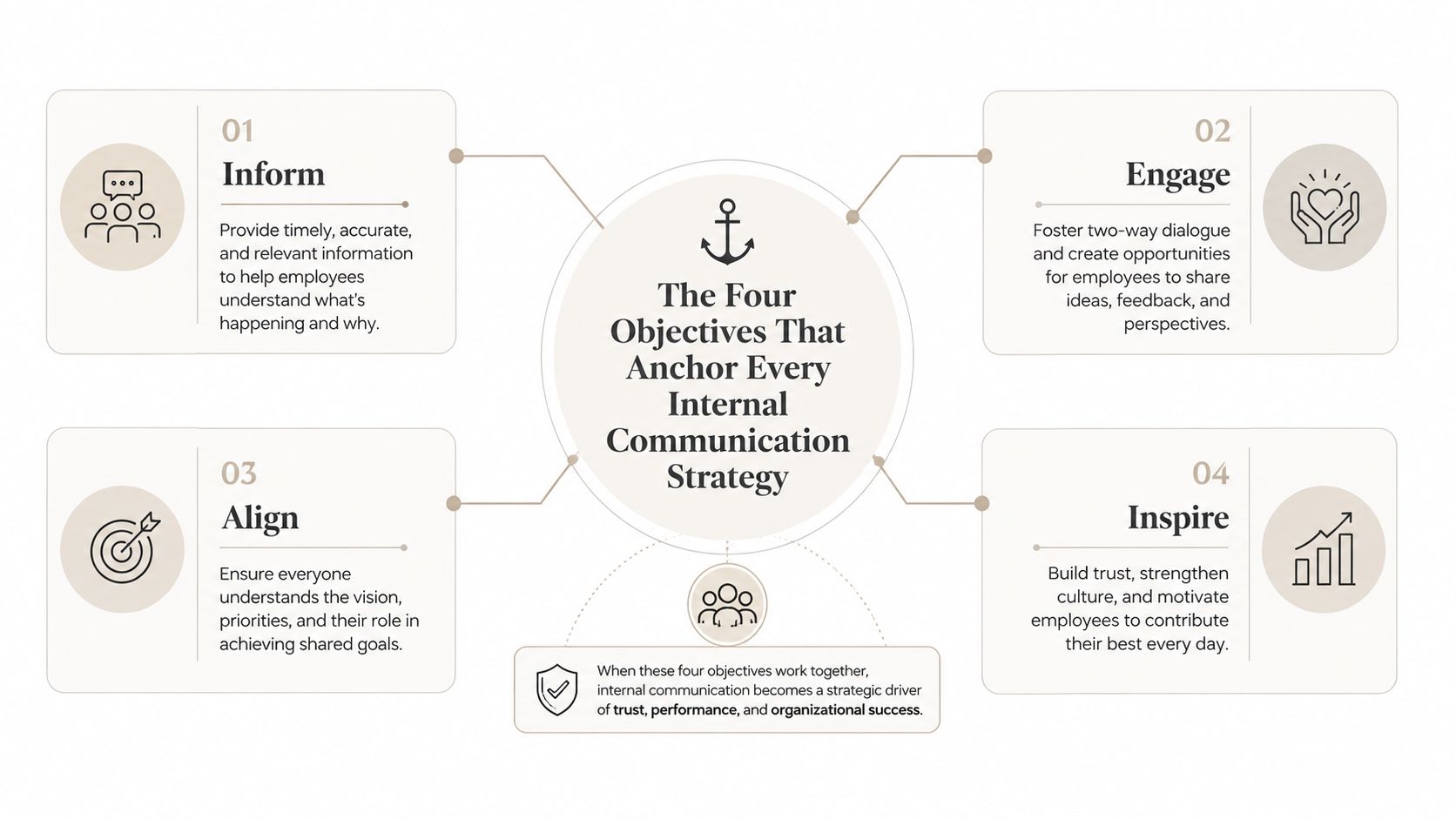
There is a well-documented gap between aiming for certain outcomes and achieving them. Gallagher's 2026 Employee Communications Report, based on a survey of over 1,300 global communications and HR professionals, revealed that 73% of internal communicators want to be strategically consultative to their organization, but only 18% said they do so routinely. The same research noted that teams with a clear, shared understanding of the strategy were four times more likely to attain strategic alignment. Writing the strategy down, making it stick, and ensuring that it can be recited is the majority of the work.
The four objective test
Before rolling out a new program, ask yourself the following diagnostic questions for each objective:
- Align reps to current priorities. Can a manager state the priority in a single, concise sentence without opening the deck?
- Shorten ramp time. What does a first-week rep need that is not relevant in month three?
- Accelerate enablement rollouts. What will provide you evidence that the field has adopted the new messaging, as opposed to simply acknowledging it?
- Close the field loop. Where does rep feedback go and who turns it into the next version?
Behavior beats broadcast, and this is where most programs stall. Gallagher found that 70% of comms teams focus on measuring output metrics while only 16% measure outcomes, and only 12% address how their work connects to business outcomes. Views tell you a message reached the inbox. They don't tell you whether the rep changed what they said on calls, used the right slide, or stopped relying on a dead battlecard.
Practical rule: for behavioral objectives, the plan gets more precise. You are then writing for the audience of one, the individual responsible for performing the behavior required of them.
Mapping Your Sales and Enablement Audiences by Real Job To Be Done
Sales is a category broader than useful. An announcement meant for an SDR, an AE, and a sales engineer can evoke different questions from each. The better map is job to be done, as that's what influences what the respective groups will need to read, use, or ignore.
The honest split for revenue teams is AEs, SDRs, sales managers, sales engineers, enablement leaders, and RevOps. They all consume information in a different way during a singular business week. They also fail in a different way due to communications being generic. It's not about more segments. It's about not communicating to audiences that require a different approach.
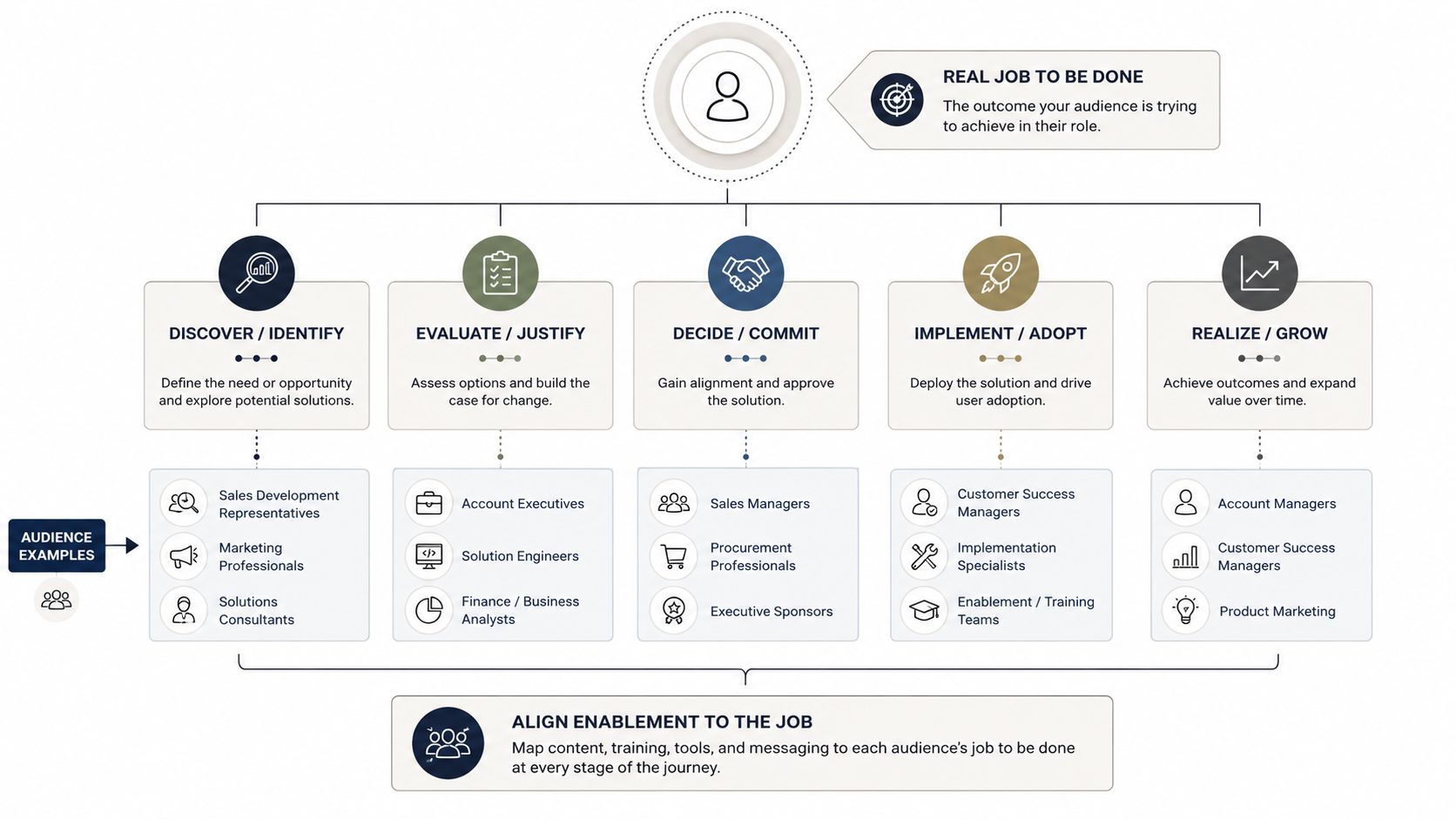
Aligning audiences with the stages they represent is what makes the matrix honest. Even if the release announcements are the same, the justification for a business case requires different ammunition than that which is used to obtain internal approvals.
A simple audience matrix
| Persona | Primary job to be done | What they need most | What they don’t need |
|---|---|---|---|
| SDR | Start conversations fast | Fresh objection-handling scripts, talk tracks, and timing notes | Long launch narratives |
| AE | Move deals forward | Pricing changes, competitive positioning, proof points, and next-step guidance | Broad company news with no deal impact |
| Sales manager | Run the team well | A Monday brief, forecast cues, coaching notes, and a clean summary for huddles | Scattered updates across five tools |
| Sales engineer | Support technical credibility | Updated reference architectures, integration notes, and demo-safe assets | Generic messaging that skips product detail |
| Enablement leader | Package change into practice | Input from the field, adoption signals, and the gaps reps keep reporting | Unfiltered raw content dumps |
| RevOps | Keep the system consistent | Policy changes, pipeline definitions, routing updates, and source-of-truth decisions | Opinion-heavy commentary without operational detail |
That matrix can sit in a spreadsheet and still transform the way a company operates. The issue is not who should get this, it is who should act on it. The answer is straightforward, the message is clear, and the noise is reduced.
Picking Channels and Cadence That Sales Teams Will Actually Use
Channel sprawl is where a lot of otherwise solid strategies fall apart. Depending on the channel, a rep checks email for an update, Slack for another, a live document for a price change. However, if the same message type is repeated across numerous channels, the system becomes pointless. Choosing a channel should be a decision matrix, not a checklist.
Data from employees suggests this tradeoff even more strongly and counters the desire to move all communication to chat. From Axios HQ's survey of more than 800 people, 67% opt to receive critical company updates via email or newsletters, and only 14% prefer them in a chat channel, and only 16% prefer them on the internal company website. Email still carries the weight. It just can't be the whole system.
Match the channel to the message
Use channels for the job they do best:
- Email for messages that have context and a permanent home.
- Slack or Teams for messages that have a limited lifespan and should be intended as reminders.
- Live-data decks for pricing, quota, or competitive intelligence that should not be sent in a PDF.
- Recurring manager standups for rollouts that require an explanation, not just distribution.
- Intranet pages for evergreen policy, process, and source-of-truth content.
The cadence of a channel is as equally important as the channel itself. Reps prefer touchpoints to be predictable rather than repeatedly interrupted, at which point they learn to expect what the communication is about. Desirable, repeatable, and scannable communications are boring in the right way.
The reply path tends to be the missing component. In the same Axios HQ research, 72% of leaders thought their teams had an easy way to give feedback about internal communications, but only 46% of employees agreed. A channel plan will only work if the underlying stack is fit for purpose, so it's worth taking a look at the best sales enablement tools before locking in your communication model.
Practical rule: every broadcast needs a reply path. If reps can't ask a question, bring up a conflict, or send a correction, the channel is only half built.
Creating Content that Drives Engagement, Not Skips
At the end of every quarter, the sales org is in full-go mode, and attention becomes harder to come by. One of the better strategies is having recurring formats. Each recurring format incorporates some advance preparation, within which reps can easily identify where the most helpful information lies. A Monday sales brief, a weekly competitive update, a monthly enablement deep dive, and a quarterly launch playbook create rhythm instead of surprise.
Design for speed and scanning first. The Nielsen Norman Group does some really great usability testing, and found that 79% of test users always scanned any new page they encountered, and only 16% read word-by-word. If the headline doesn't tell the story and the first three bullets don't prompt the action to be taken, most of the audience will have already left.
Creating formats people can skim and trust
A good content pattern typically looks like this:
- Presentation title. State the change that the business underwent, not the internal steps that were taken.
- Three-bullet summary. State what, why, and who is affected.
- Proof points. Be selective. This is not the place for everything and the kitchen sink.
- Action statement. Close with a clear action for the reader.
The hardest part is input consistency. Innovation is good, but too much and people will ignore your updates. A consistent opening statement builds habit, and the habit of reading is what gets content read when the inbox is crowded.
Keep the format tight enough to survive reality
A good internal comms calendar for sales teams is short and sweet. It's a small collection of flexible assets that can be used and adjusted for things like launches, pricing adjustments, and market changes. One month you may need to add more details on field enablement. The next month you may need a simpler competitive recap and less commentary. The format should be flexible, and the skeleton should not.
The Sales team must be able to communicate the message to a customer or manager in plain terms. Content that cannot be explained in that fashion should not be included, which is why the same principles that create clarity in presentations should be used to craft internal updates. Reps remember a crisp narrative more easily than a pile of disconnected announcements.
Governance, Key Performance Indicators, and the Right Tools that Close the Loop
A lack of governance for a content calendar results in drift. Someone posts late, someone else edits an older asset, and eventually no one knows what the official version is. The operational model must define who owns each channel, what is approved for each channel, and what the cadence is for reviewing the channels and collecting feedback. Otherwise measurement becomes a dashboard exercise nobody trusts.
The goal beyond open metrics should be measuring the signals of reach, understanding, behavior change, and business outcomes. These measures should be analyzed in tandem so the team can determine which communication activities are value-add and which are merely noise. Since only 12% of comms teams connect their work to business activity, the bottom two tiers represent a good opportunity for differentiation.
KPI stack for a sales-team internal communication strategy
| Tier | Question answered | Example metric | Review cadence |
|---|---|---|---|
| Reach | Did the right people see it? | Open rate, views, click-throughs | Weekly |
| Comprehension | Did they understand it? | Survey responses, recap accuracy, manager check-ins | Weekly or monthly |
| Behavior change | Did they do something differently? | Playbook usage, talk track adoption, meeting follow-through | Monthly |
| Business outcome | Did communication help performance? | Ramp time, win rate, retention signals | Monthly or quarterly |
The monthly review is where governance and tooling meet. If a pricing deck is still attached as a file, version drift is almost guaranteed. If the deck is web-native and linked to live data, the rep doesn't have to wonder whether Friday's number is already stale.
For teams evaluating a broader operating stack, the revenue operations platform lens helps, because internal communication breaks fastest when it sits apart from the systems that drive pipeline, approvals, and reporting. Communication governance should sit next to those systems, not behind them.
Implementation Checklist and Common Blunders to Avoid
The first 30 days decide whether the strategy becomes habit or shelfware. Week one is a channel and audience audit. Week two locks the objectives and the KPI baseline. Weeks three to six pilot the new formats in one region or team. Days 60 to 90 bring full rollout, governance, and dashboards into the same operating loop.
People tend to assume that more communication is better. Reps can easily become overwhelmed by the same announcements that are sent via email, Slack, and then verbally announced in a meeting. That's duplication, not reinforcement, and you quickly lose credibility.
Be sure these things are cleared up before moving forward
- Audit every channel. Look at every single channel, identify who is posting announcements, and when messages are posted.
- Cut duplicate distribution. One message can travel in multiple places, but it shouldn't arrive as three separate official updates.
- Validate deck freshness. Pricing decks and competitive assets need a clear owner and a clear refresh cadence.
- Coach managers before launch. You don't want manager announcements to cascade and lose structure. That will result in the frontlines having to make things up on their own.
- Retire untrusted dashboards. If people don't think that the numbers are correct, then the reporting is broken.
- Protect decision relevance. Duplication of messages should be removed and only things that are easy to act on should be communicated.
Purpose should be the main focus of communication with sales teams, because reps are constantly switching context. They will benefit from a fast, scannable approach to communication. If a message doesn't help someone sell, coach, decide, or correct course, then it probably shouldn't be sent.
If you're creating a more streamlined method to keep sales teams aligned, Encelade takes live data, decks, and updates, and transforms them into interactive, web-based presentations that stay up-to-date without the hassle of version conflict, so the pricing deck a rep opens on Friday matches the one RevOps updated on Tuesday. You can also schedule 30 minutes here to see it in a real enablement rollout.