
You can feel proposal work pile up before lunch even ends. A rep drops a security questionnaire in Slack, a solutions consultant is fixing pricing in a spreadsheet, and someone else is still hunting for the latest case study in a buried folder. By Thursday afternoon, the team isn’t really writing proposals anymore—it’s stitching together answers, approvals, branding, and numbers from half a dozen places and hoping nothing breaks.
That pressure is why proposal automation became its own category instead of just another feature inside a document tool. The shift isn’t only about typing faster. It’s about building a repeatable system for sourcing approved content, assembling drafts, personalizing them for the buyer, delivering them in a trackable way, and learning from what happens after send.
Table of Contents
- The Proposal Pile-Up Most Revenue Teams Already Know
- What Proposal Automation Actually Means
- The Core Components of a Modern Proposal Automation Stack
- Traditional Proposals vs Automated Workflows
- Measurable Benefits and ROI for Revenue Teams
- Common Pitfalls That Block Real Adoption
- A Practical Implementation Roadmap
- Where Interactive Platforms Like Encelade Fit In
The Proposal Pile-Up Most Revenue Teams Already Know
The messy version of proposal work usually starts with urgency. A rep gets three RFPs at once, legal wants a clause checked, and the pricing team just sent a revised sheet that doesn’t match the version in the deck. Someone opens Word, another person works in Docs, deal context sits in the CRM, and the latest edits live in Slack threads no one can fully trace.
Why the hidden cost shows up late
The obvious cost is time, but the deeper cost is coordination. Every extra hop between systems creates another chance to introduce outdated branding, stale wording, or the wrong number in a pricing table. Teams often don’t notice the damage until the buyer asks a follow-up question and the answer no longer matches the PDF that was sent.
Practical rule: If your proposal process depends on someone remembering where the “real” version lives, the process is already too fragile.
Revenue teams weren’t asking for one more folder or a smarter template alone. They needed a way to handle repeatable proposal work at the scale of modern selling motions, where one account can involve multiple stakeholders, multiple revisions, and multiple approval gates.
The category emerged because occasional, hand-built proposals no longer fit the rhythm of enterprise sales. When every deal has custom security, commercial, and legal language, the old file-based approach turns into a bottleneck. Automation exists to turn that scramble into a governed workflow, not just a prettier draft.
What Proposal Automation Actually Means
Proposal automation is the use of software to source content, assemble drafts, personalize them, deliver them, and capture engagement signals after send. A chat model can write paragraphs, but proposal automation works inside a controlled system of approved answers, pricing inputs, brand assets, and review steps. That difference matters because revenue teams need speed without losing accuracy.
The layered model behind the category
Think of the stack in five layers. The content layer holds templates, snippets, case studies, and legal language. The data layer pulls from CRM records, product catalogs, CPQ tools, and questionnaires so the draft reflects current account and pricing information.
The generation layer uses rules, retrieval, and AI to assemble a first draft. The delivery layer gets the proposal to the buyer through tracked links, portals, or integrated handoff tools. The analytics layer shows what happened next, including who opened it, what they viewed, and where interest concentrated.
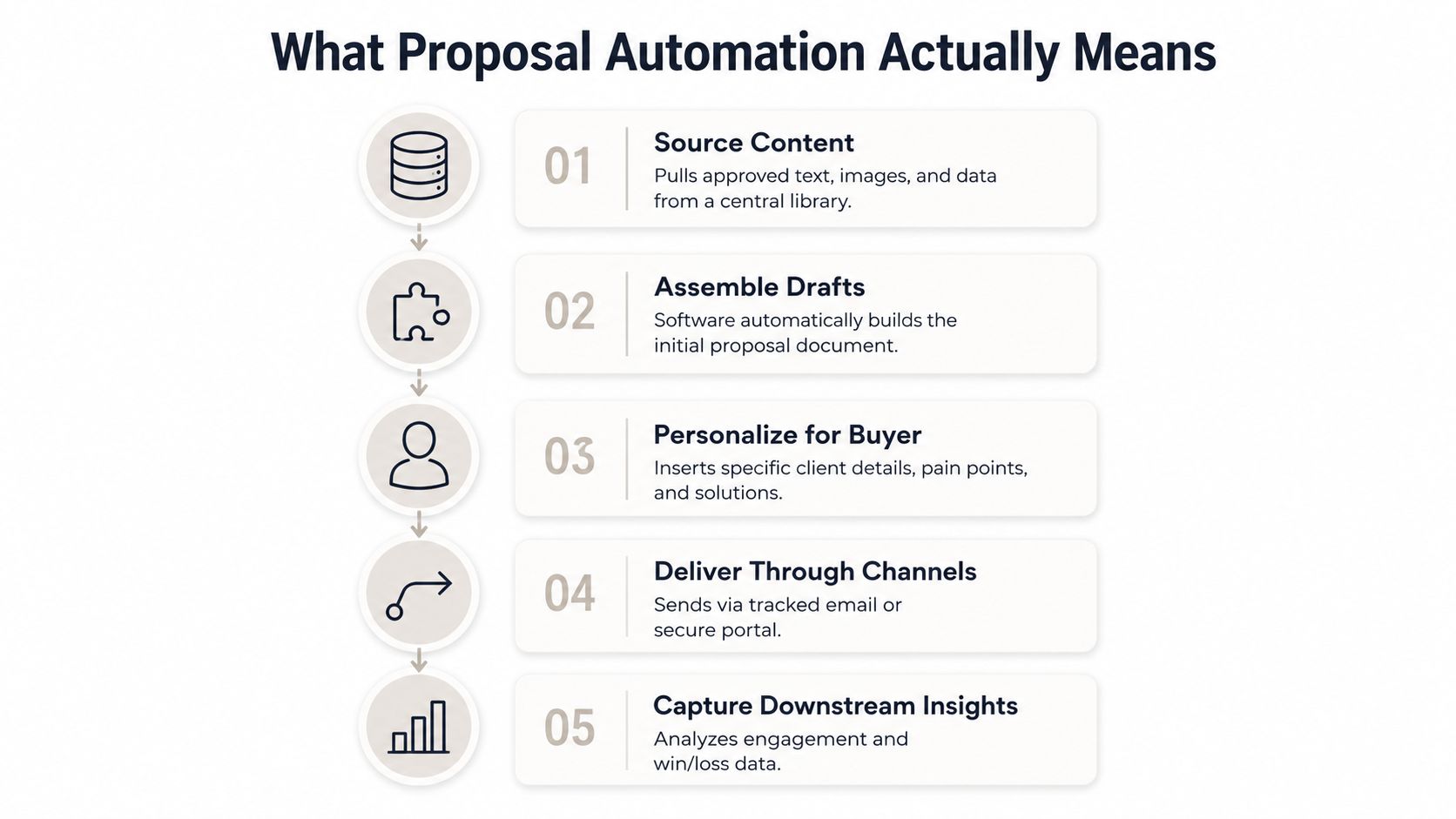
Proposal automation is not one click and done. It’s a workflow that keeps approved information moving from source to draft to buyer response.
That’s why the category is broader than “AI writing.” If a tool only generates text, the team still has to manage version control, factual accuracy, approvals, and delivery. Proposal automation is the discipline of reducing manual effort while keeping the proposal tied to governed source material.
The Core Components of a Modern Proposal Automation Stack
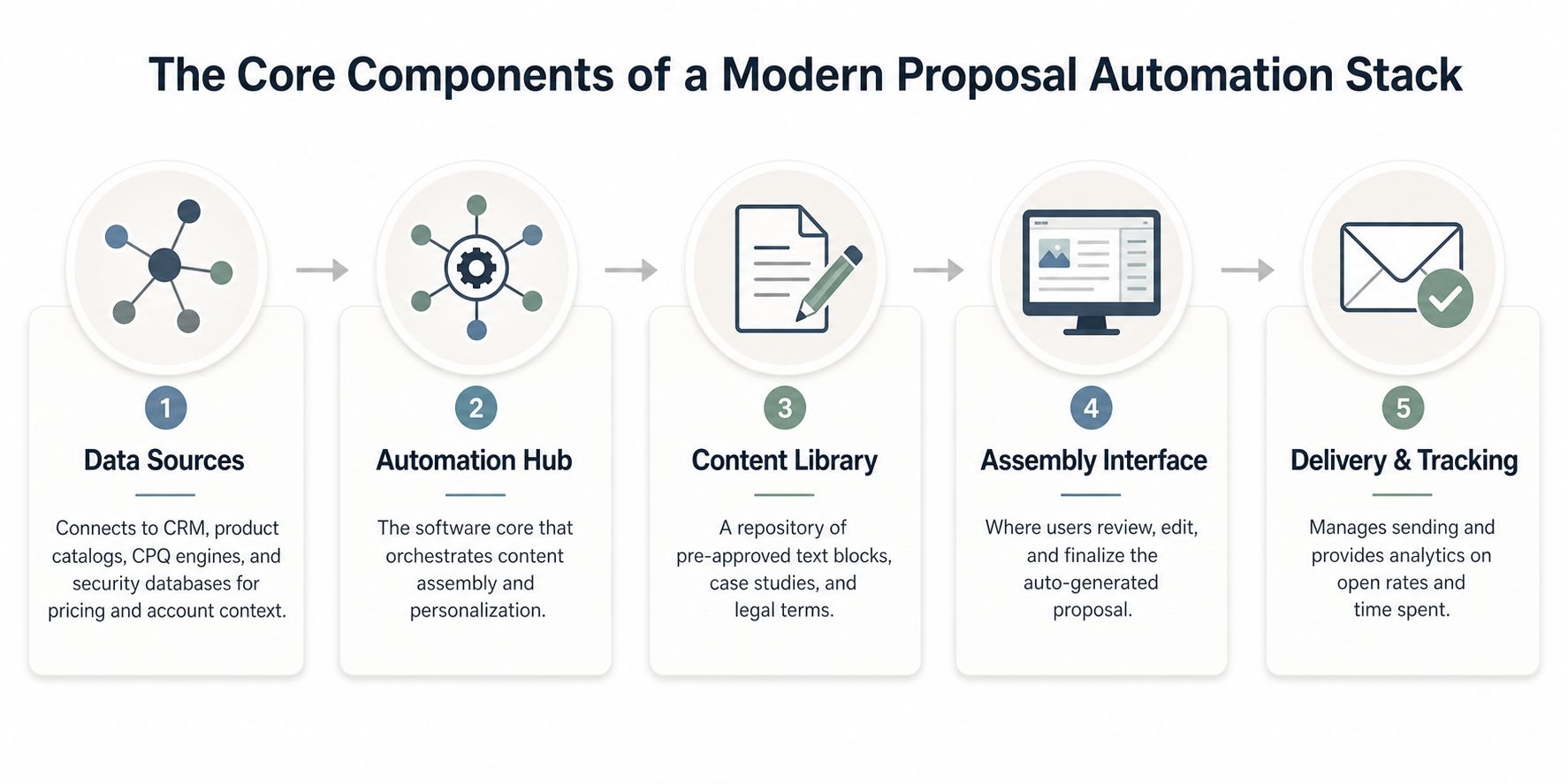
A modern stack replaces manual handoffs one step at a time. First, it connects the data the team already trusts. Then it uses that data to assemble content, route approvals, and deliver the final proposal in a way the seller can measure.
Data sources keep the draft grounded
When CRM, product, pricing, and security data connect to the proposal system, the team stops retyping information that already exists elsewhere. That cuts down on accidental drift between the opportunity record and the proposal itself. It also means the proposal can reflect account context without someone rebuilding it manually every time.
Content libraries keep language approved
Templates and libraries do more than save time. They encode the wording, brand treatment, legal terms, and case studies that the company has already agreed to use. If the library is clean and well-tagged, the system can pull the right answer quickly and the reviewer can spend time on judgment instead of hunting.
Personalization logic makes the proposal feel relevant
A good system doesn’t personalize by swapping a company name into a generic paragraph. It uses buyer role, industry, and deal stage to change the sections that matter. A finance leader and a technical evaluator often care about different outcomes, so the draft should reflect that difference without needing a full rewrite.
Delivery and analytics extend the process past send
Sharing a proposal as a link or through a portal keeps the document trackable. Open behavior, time spent, and stakeholder activity give the rep a second set of signals after submission. In practice, that changes the follow-up conversation because the seller isn’t guessing whether the buyer saw the deck or ignored it.
Sales proposal software usually sits across these layers rather than replacing all of them. The value comes from connecting the existing workflow, not forcing every team to rebuild its commercial stack from scratch.
Traditional Proposals vs Automated Workflows
The biggest difference isn’t formatting. It’s whether the workflow treats the proposal as a file or as a managed sales asset. File-based work depends on memory, inboxes, and manual cleanup. Automated work depends on governed content, repeatable routing, and buyer visibility.
| Workflow Step | Traditional Approach | Automated Approach |
|---|---|---|
| Intake | Someone forwards the RFP and asks who owns it. | The system routes the request and assigns owners by rule. |
| Content Assembly | A seller copy-pastes boilerplate from old decks. | Approved content and templates populate the first draft. |
| Stakeholder Review | Comments scatter across email, chat, and tracked changes. | Reviewers work from one controlled version with approvals. |
| Delivery | A PDF is attached and sent into the void. | The proposal is shared through a trackable link or portal. |
| Post-Submission Follow-Up | The rep asks if the buyer opened it. | Engagement signals show what the buyer actually viewed. |
Manual workflows also create a second problem—the wrong people end up doing the wrong work. Reps become file librarians. Subject matter experts become editors of last resort. Managers spend time chasing status instead of coaching deal strategy.
Automated workflows change who owns each step. Content owners maintain the source library, deal teams personalize within guardrails, and RevOps watches the health of the process. That shift matters because it makes proposal quality a system responsibility, not a late-night scramble.
Measurable Benefits and ROI for Revenue Teams
Proposal automation earns attention when it changes the metrics revenue teams already care about. Those metrics are cycle time, win rate, brand consistency, and forecast quality. If the tool doesn’t move those levers, it’s just another software line item.
One industry forecast values the worldwide sales proposal automation software market at USD 2.95 billion in 2025, up from USD 2.51 billion in 2024, and projects it to reach USD 7.78 billion by 2032—a CAGR of roughly 14.85%. Estimates for this young category vary widely between research firms, so treat any single number as directional rather than settled. What stays consistent across them is the trajectory: a shift from niche productivity tooling to a core revenue workflow.
What the operations side can actually measure
One market analysis of the category found that nearly 58% of enterprises reduced proposal preparation time after adopting automation tied to their CRM and CPQ systems, and that cloud collaboration tools improved proposal completion efficiency by 44%. It also reports that 61% of teams now generate proposals directly from their CRM, and that more than 75% of U.S. B2B organizations had implemented some form of sales automation by 2025. Those figures matter because they tie process design to real operational output.
How that translates into revenue work
When turnaround drops, sellers can respond sooner and buyers wait less. When content is governed, the proposal looks like the company rather than a patchwork of old files. When engagement is visible, managers can coach follow-up based on actual buyer behavior instead of assumptions.
Bottom line: ROI shows up first as less scrambling, then as cleaner data, and only then as better commercial outcomes.
A practical way to estimate ROI is simple. Start with annual proposal volume, multiply by the hours spent per response, then compare that to the time recovered after automation. From there, add the value of any extra capacity, faster submission, and fewer revision cycles. How workflow automation is structured follows the same logic—the system gets value by reducing repetitive work before it reaches the human reviewer.
Common Pitfalls That Block Real Adoption
Buying software doesn’t fix a broken proposal process. Teams often assume the AI is the solution, then discover the issue is trust, governance, or adoption. The tool can draft quickly, but it can’t clean up a messy operating model on its own.
A 2025 report from legal-technology vendor Ikaun shows the gap clearly. 79% of firms still rely on mostly or entirely manual proposal processes, 68% bypass their official tools in favor of workarounds, and over 50% cite branding and formatting as persistent problems. The lesson isn’t that AI failed. It’s that users won’t adopt tools that don’t fit the way work happens.
The most common failure modes
- Orphaned content libraries: No one owns cleanup, so answers drift out of date and the library becomes hard to trust.
- Fake personalization: The draft changes the prospect name, but the substance is still generic.
- Approval overload: Every deal goes through the same heavy review chain, even when the risk is low.
- Ignored analytics: Dashboards exist, but managers never use them to change the process.
Those failures are governance problems, not model problems. If the content owner doesn’t know when to refresh an answer, automation amplifies stale material. If approval rules are too rigid, the team routes simple work through an enterprise-size process. If analytics are not tied to decisions, the system becomes a reporting vanity project.
Early warning signs in the first 60 days
Watch for employees exporting drafts to edit offline, using side spreadsheets for pricing, or asking for exceptions to every rule. Those behaviors usually mean the workflow is too clunky or the source content isn’t trusted. They’re the first clues that the rollout needs operational fixes, not more features.
A Practical Implementation Roadmap
A quarter is enough time to stand up a useful proposal system if the rollout stays tight. The common mistake is trying to automate everything at once. A better plan is to choose a few high-volume deal types, define ownership clearly, and prove the workflow before broadening it.
Weeks 1 and 2 build the map
Run a discovery sprint with one accountable owner, usually RevOps or sales enablement. Document the current proposal path from request to send, identify the top three recurring deal types, and list who owns content, data, and analytics. The main artifact should be a simple process map with bottlenecks highlighted.
Weeks 3 to 6 create the foundation
Standardize two or three master templates, connect CRM and pricing data, and define approval and brand rules. The owner here should be the enablement lead, with support from operations and legal. The checkpoint is whether the template can produce a clean first draft without manual rework.
Weeks 7 to 10 run a controlled pilot
Choose one region, segment, or team and use the system only on that slice. Track turnaround time, template reuse, and whether the proposal team is sticking to the approved path. A pilot succeeds when the users trust the output enough to keep working inside the system.
Start small enough that the team can see what’s working, and strict enough that the early data means something.
Final weeks expand and govern
Roll the system out more broadly, add training, and set a monthly content review cadence. The owner should shift to a steady-state governance lead so the process doesn’t decay after launch. If the team can’t maintain the content library and approval rules, the rollout is not ready to scale.
How to structure a proposal is useful here because structure and automation need to reinforce each other. A good template makes the workflow easier to govern, and good governance keeps the template from becoming cluttered.
Where Interactive Platforms Like Encelade Fit In
Static PDFs stop being useful the moment they’re exported. Interactive proposal platforms keep the buyer-facing experience alive with link-based delivery, live data, and widgets that let the prospect engage with the content instead of just reading it. That matters most when pricing, usage assumptions, or stakeholder-specific sections may still need exploration after the document leaves your team.
Encelade fits in that buyer-facing layer. It turns research, CRM notes, spreadsheets, and documents into web-native decks with interactive widgets, live data connections, and shared workspaces. In practical terms, that means a seller can send a proposal that still reflects current inputs, and the buyer can respond inside the same experience instead of opening an attachment that freezes in time.
The strongest use cases are deals where the conversation doesn’t end at submission. Interactive pricing tables, ROI sections that pull from live assumptions, and collaborative review spaces can keep multiple stakeholders inside the same thread. For RevOps and enablement teams, the key point is simple—tools like this sit alongside CRM, CPQ, and content systems, they don’t replace them.
If you’re trying to turn proposal work into a repeatable revenue process, Encelade can help with the buyer-facing part of that workflow by turning research and CRM context into interactive, web-native proposals. Explore the Presentation API to see how live data, shared workspaces, and link-based delivery can fit into your existing sales stack.