The most popular advice about storytelling in sales is also the least useful: any story is better than a data dump. It isn't. A polished anecdote that has no connection to the buyer's decision, evidence, or timing can waste more attention than a clear chart. Effective storytelling in sales gives facts a decision path. It shows a buyer what changed, why it matters now, and what action follows.
That makes storytelling more than a presentation skill. It's a stage-spanning discipline that starts with relevance in first contact, creates common ground during discovery, clarifies trade-offs in negotiation, and helps stakeholders repeat the business case after the meeting. The strongest sales teams don't ask, "What's our best customer story?" They ask, "What job does this story need to do for this buyer at this stage?"
Table of Contents
- Why Most Sales Stories Fail and What Works Instead
- The Business Case for Storytelling in Sales
- Proven Storytelling Frameworks for Different Deal Types
- Crafting Account-Specific Narratives from CRM and Research
- Real Examples of Sales Stories That Moved Deals
- Scaling Stories with Interactive Presentations and Live Data
- Building a Measurable Storytelling System
Why Most Sales Stories Fail and What Works Instead
Most sales stories fail before the first sentence ends because they're built around the seller, not the buyer. The rep describes a famous customer, a dramatic transformation, or a clever product moment, yet the prospect still has to work out how any of it applies to their own operating reality. The result sounds polished but creates no urgency, no useful contrast, and no reason to change direction.
A data dump has the opposite weakness. It may be accurate, but isolated metrics rarely explain what caused the problem, who felt its effects, or what decision the number should support. The answer isn't to replace evidence with emotion. It's to connect evidence to a relevant narrative.
A 2015 peer-reviewed study on storytelling in buyer-seller exchange described storytelling as a way to inform, persuade, and build connection, and helped move the topic from an interpersonal skill into a studied commercial method across first contact, negotiation, and post-sales follow-up (the study on storytelling by the sales force). That broader view matters in pipeline reviews. A story can create relevance at the top of the funnel, clarify risk in a business case, or help a champion explain the decision internally.
Match the story to the stage
The same narrative shouldn't surface in every meeting. Early conversations need fast value framing. A discovery story should help the buyer name a problem without pushing them toward a conclusion. Later-stage stories need proof, stakeholder relevance, and a clear route to approval.
A useful stage-based test looks like this:
- First contact: Does the story establish a credible reason to engage?
- Discovery: Does it help the buyer name a problem in their own language?
- Evaluation: Does it connect the product to measurable business consequences?
- Negotiation: Does it make trade-offs and risk easier to discuss?
- Post-sale: Does it reinforce adoption, outcomes, and the next operational step?
Practical rule: If a story could be told unchanged to every account, it probably belongs in marketing, not in a live sales conversation.
Personalization doesn't mean inserting irrelevant details from a company website. It means selecting the right conflict, evidence, and consequence for the person in front of you. A finance leader may need a story about investment logic and controllable risk. A technical evaluator may need to understand implementation friction and system fit. An executive sponsor may need a concise account of what happens if the organization delays.
Teams often make the story harder than necessary. Start with one buyer problem, one meaningful data point, one implication, and one next decision. The narrative should make the evidence easier to understand, not hide weak evidence behind performance.
For practical guidance on making evidence readable in a sales setting, use these data visualization best practices. A better chart won't rescue an irrelevant story, but a clear visual can reduce the cognitive work required to follow the argument.
The Business Case for Storytelling in Sales
Leadership does not fund storytelling because buyers enjoy a good anecdote. They fund sales practices that improve understanding, conversion, retention, or execution. The commercial case is strongest when a narrative carries relevant evidence through the deal, rather than trying to replace missing proof.
Independent storytelling statistics and their commercial context report that 73.67% of marketers use storytelling to communicate sales-related information. The same collection associates data paired with storytelling with retention rising from roughly 5% to 10% for statistics alone to as high as 65% to 70% when the information is carried by a story. It also reports a 30% conversion-rate lift and 46% growth in storytelling marketing in 2024.
Those figures support testing, not blanket promises. A story can help a prospect remember the problem and explain it internally. It cannot repair poor qualification, weak proof, an unsuitable offer, or an unclear buying process. Revenue teams should connect narrative use to the stage where it has a job, then measure whether the buyer's behavior changes.

Why narrative improves decision quality
A buyer rarely evaluates a number in isolation. They need its context, materiality, comparison with the current state, and implication for the next decision. Narrative supplies that sequence and gives live data a reason to matter.
Retention is one practical benefit. A widely cited summary of storytelling and information retention reports that people are 22 times more likely to remember information when it's wrapped in a story. In a sales process, the useful interpretation is narrower: a structured business point has a better chance of reaching finance, procurement, or an executive sponsor after the meeting.
Conversion requires separate analysis. Treat the reported 30% lift as an external benchmark, not a forecast for your pipeline. Build your own case by comparing opportunities that use a narrative-led asset with those that do not, while controlling for segment, deal type, stage, and seller behavior.
Track signals that reveal whether the story is doing commercial work:
- Comprehension: Can the buyer restate the problem and proposed change?
- Stakeholder spread: Does the narrative travel beyond the original meeting?
- Next-step quality: Does the buyer agree to a concrete evaluation action?
- Commercial progression: Does the opportunity advance with stronger qualification?
The strongest business case joins narrative discipline with sales fundamentals. Use account-specific evidence, present it through a clear arc, and test the result across stages. A story should make the right proof memorable, make the recommendation easier to defend, and make the next decision explicit.
Proven Storytelling Frameworks for Different Deal Types
A framework gives sellers a reliable structure without forcing every conversation into a script. The right choice depends on the deal's involvement level, the number of encounters, and the buyer's immediate question.
Research on sales story types found that buyer-focused product stories and business point-of-view stories were especially effective in one-time, high-involvement encounters. In multi-encounter selling, entity stories and personal point-of-view stories become more useful because repeated interactions give trust and organizational identity more room to matter (Baylor's Keller Center research review of story types).
Use the product outcome arc for fast value framing
This is the practical structure for a first serious conversation or a one-time evaluation:
- Situation: Describe the buyer's operating context.
- Friction: Identify the costly delay, gap, or constraint.
- Change: Show what the customer did differently.
- Business result: Connect the change to a decision-relevant outcome.
- Application: Ask whether the same condition exists here.
A concise script sounds like this:
"Teams managing complex account research often have the information, but it's scattered across CRM notes, spreadsheets, and documents. One approach is to organize those inputs around the buyer's decision, then present the evidence in a format stakeholders can review together. Which part of that process creates the most friction for your team?"
Keep the example business-oriented. Don't lead with product features unless the buyer has already established that the feature addresses a live constraint.
Shift to the entity story in a longer cycle
Multi-touch opportunities need more than a product explanation. An entity story explains how an organization handles a recurring challenge, what it values, and why its operating model is credible. It can help a champion build internal trust, especially when the buyer must defend the vendor choice to people who weren't in the original conversation.
Use this structure:
- The organization faced a recognizable constraint.
- Its leaders made a deliberate operating choice.
- That choice changed how teams worked together.
- The lesson applies to the buyer's decision.
The seller shouldn't inflate this into corporate mythology. Keep it close to observable behavior, customer evidence, and the buyer's own evaluation criteria.
Anchor every data story to a recommendation
Data-driven storytelling starts with a point of view, not a chart. LinkedIn's guidance on data-driven sales stories makes a similar case: rather than opening with a dense deck of statistics, lead with one clear narrative, tailor it to the audience's situation, and tie each figure to the impact and recommendation that follow from it.
| Framework | Best for | Structure | When to use |
|---|---|---|---|
| Product outcome arc | One-time, high-involvement evaluation | Situation, friction, change, result, application | First serious value discussion |
| Entity story | Multi-touch B2B cycle | Organizational challenge, choice, behavior, lesson | Trust-building and champion enablement |
| Data point of view | Evidence-heavy decision | Signal, interpretation, recommendation, action | Executive reviews and business cases |
The discipline is simple: one story, one job. If the buyer needs a recommendation, don't bury it under background. If the buyer needs trust, don't rush straight to a feature list.
Crafting Account-Specific Narratives from CRM and Research
Account-specific storytelling starts with disciplined selection. CRM records contain useful context, but they also contain stale assumptions, copied language, and details that matter to one stakeholder but not another. The seller's job is to find the smallest set of verified signals that explains the buyer's current decision.
Extract the account signal
Begin with CRM notes, call summaries, opportunity history, open tasks, and prior objections. Look for repeated pain language, changes in ownership, deadlines, evaluation criteria, and evidence that the problem affects more than one team.
Then separate facts from interpretation. "The team is struggling with reporting" is an interpretation. "The operations lead described manual consolidation across several sources" is a more useful observation, provided the note is current and attributable to the conversation.
Analyze the business context
Research should answer questions the buyer will recognize, not decorate the deck. Review the account's public priorities, operating model, relevant market pressures, existing technology, and likely decision roles. Use competitive intelligence to understand the alternatives, but don't turn the narrative into an unsupported takedown of a competitor.
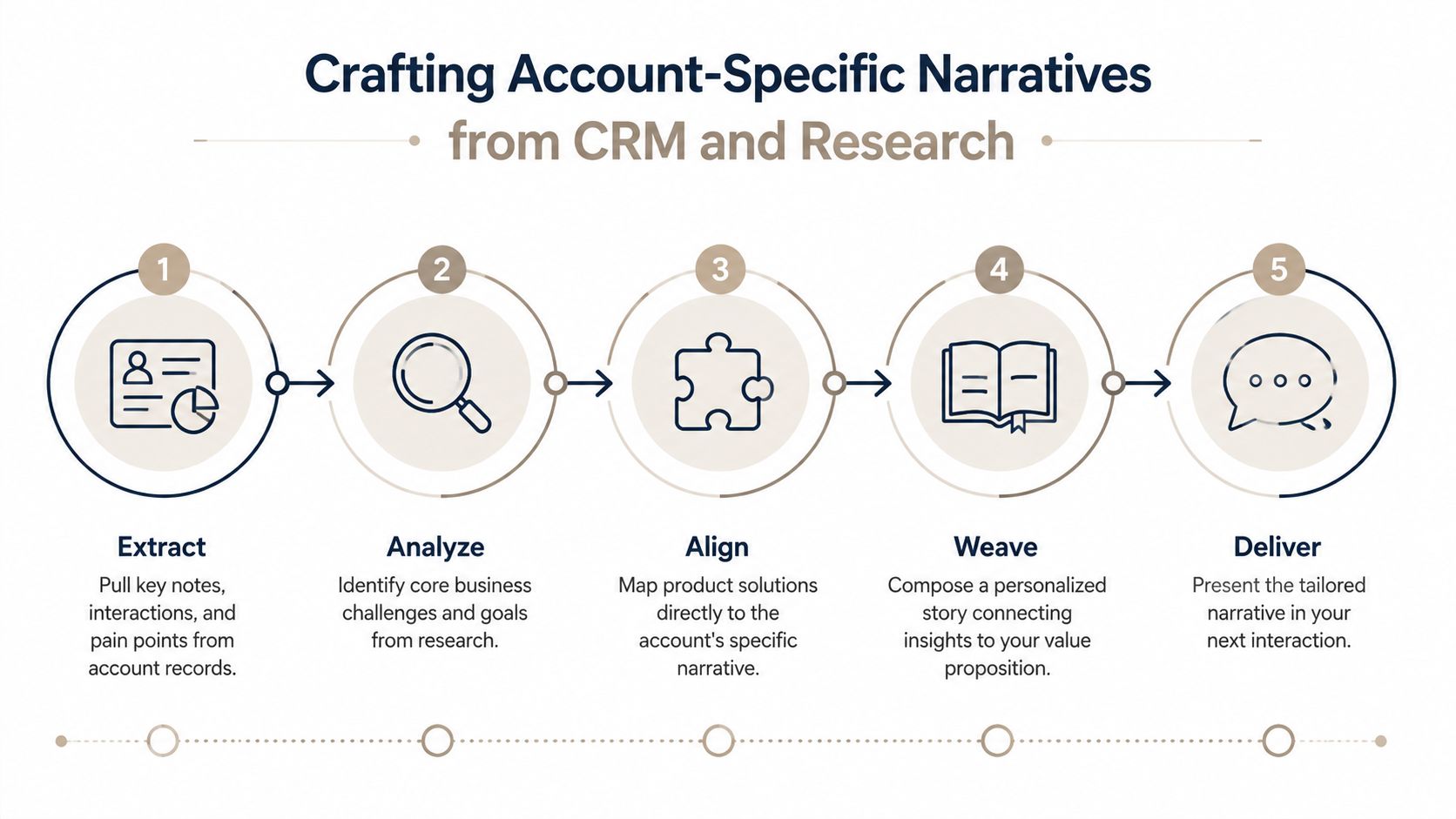
The process has five practical moves:
- Extract: Pull the account's notes, interactions, and pain points.
- Analyze: Identify the central business challenge and desired outcome.
- Align: Map only the product capabilities that address that challenge.
- Weave: Build a narrative from context to consequence to recommendation.
- Deliver: Present it, then ask the buyer to correct what doesn't fit.
Build for the decision role
A chief financial officer, sales engineer, and business champion can evaluate the same problem through different lenses. Keep the underlying facts consistent, but change the emphasis and recommendation.
For a finance audience, lead with resource allocation, avoidable exposure, and the evidence needed for approval. For a technical audience, explain dependencies, workflow changes, security considerations, and the boundaries of the proposed solution. For a champion, give them language they can repeat without the seller present.
Over-personalization is another failure mode. Mentioning a recent hiring announcement or executive quote won't make a narrative relevant if it doesn't connect to the decision. The account-specific story should feel informed, not surveilled.
A sales intelligence platform can help teams organize research and account context, but the seller still needs to validate the inputs. Automation can assemble a draft. It can't reliably determine which problem deserves the buyer's attention.
Use the video below as a visual reference for presenting complex commercial information with more structure.
Real Examples of Sales Stories That Moved Deals
A retail seller has one interaction to make a product meaningful. In that setting, a product story told from a business point of view can outperform a vague brand anecdote because it connects the product to a concrete buying reason. A field experiment distinguished entity stories, product stories, and digression stories, and found that product stories told from a business point of view were most effective for improving purchase intentions in one-time sales encounters (the field experiment on story types in retail sales).
The practical version is straightforward. Instead of describing a product's history, the seller explains the customer's situation, the business problem the product addresses, and the consequence of choosing it. The story stays short because the buyer isn't asking for a corporate biography. They're asking, "Why this option?"

A multi-touch B2B example
In a longer B2B cycle, an entity story can build confidence when the buying group needs to understand how the vendor works. The narrative might describe a recurring customer problem, the operating decision that addressed it, and the collaboration required to sustain the change. It earns trust when the seller can support each part with customer-approved evidence and avoids claiming outcomes the seller can't verify.
Personal point-of-view stories can help here as well. A sales engineer may explain why implementation teams typically resist a particular workflow change, then show how the evaluation process addresses that concern. The story isn't a performance. It's a way to establish common ground around a real trade-off.
A data story that explains the market
Buyers often want help interpreting the market, not just comparing vendors. A data-driven narrative can begin with a live signal, explain what it means for the account, and end with a recommendation. The seller might show a changing operational trend, identify the exposure created by the current process, and propose a focused evaluation.
The mistake is presenting a chart without a point of view. The second mistake is presenting a point of view without a source or a clear explanation of how the data was collected. Strong data stories disclose the date, scope, definition, and limitations of the evidence, then invite the buyer to challenge the interpretation.
Stories also fail when sellers confuse movement with progress. A dramatic customer anecdote may create attention but still leave procurement without a business case. The story has done its job only when the buyer can connect it to a decision, an owner, and a next action.
Scaling Stories with Interactive Presentations and Live Data
A sales story becomes difficult to scale when every seller rebuilds it from scratch. Static slides create version drift, outdated metrics, and inconsistent positioning. A system built around reusable narrative blocks, live data, and account inputs can preserve consistency while allowing sellers to tailor the argument.
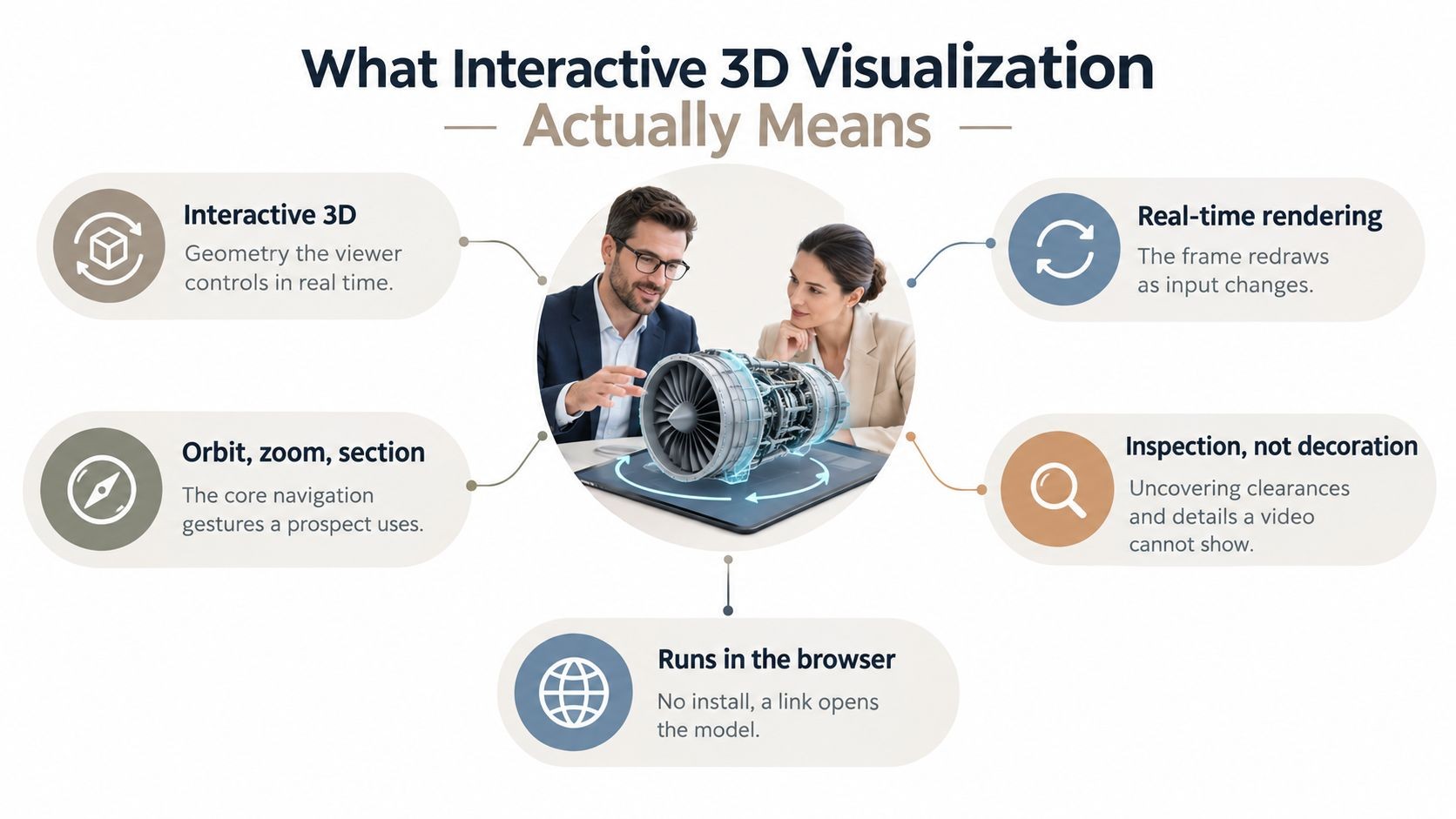
Interactive presentation tools such as Encelade can turn research, CRM notes, spreadsheets, and documents into web-native decks with interactive widgets, live data connections, and native 3D. That makes the presentation more than a sequence of screenshots. A buyer can inspect a chart, explore a workflow, or review an account-specific recommendation without losing the narrative thread.
Start with a governed story model:
- Narrative layer: Define the buyer, stakes, conflict, evidence order, and recommendation.
- Evidence layer: Connect approved metrics, research notes, CRM fields, Sheets, or APIs.
- Interaction layer: Choose charts, maps, embedded content, or 3D only when interaction improves understanding.
- Brand layer: Lock themes, terminology, visual rules, and approved proof points.
- Delivery layer: Share one responsive link, then review engagement signals and buyer feedback.
A live connection solves freshness, not credibility. If a spreadsheet contains an incorrect definition or an unreviewed assumption, real-time synchronization distributes the problem faster. Revenue operations needs ownership for data definitions, update permissions, source dates, and approval of customer-facing claims.
The trade-off between automation and authenticity is real. Automated generation can create a useful first draft from account research, but a seller must remove generic language, test the story against the buyer's actual words, and decide where a human explanation is essential. Personalization at scale should change the evidence and emphasis, not manufacture intimacy.
Use interactive slides for sales presentations when the buyer needs to explore a complex decision. Keep a static export available for offline review, compliance, or stakeholders who won't open the interactive version. The system should support the buying process, not force every stakeholder into the same format.
Building a Measurable Storytelling System
A storytelling program needs ownership, standards, and feedback. Without those elements, teams collect isolated anecdotes that sellers use inconsistently, while leadership has no way to connect narrative work to pipeline outcomes.
Start with a focused pilot. Select a small set of common buyer problems, create approved story structures, and define the evidence each story must contain. Coach sellers to deliver the same narrative in their own voice, then inspect call notes and follow-up assets for buyer language, decision relevance, and proof quality.
A practical operating checklist includes:
- Choose the use cases: Prioritize discovery, executive review, champion enablement, or post-sale adoption.
- Define evidence rules: Record source, date, owner, scope, and any limitations.
- Create story cards: Capture situation, conflict, change, result, and recommended action.
- Enable retelling: Give champions a concise version they can repeat internally.
- Measure behavior: Track reuse, stakeholder engagement, next-step completion, and progression by stage.
- Review failures: Identify whether the issue was relevance, proof, delivery, timing, or qualification.
Don't judge a story only by presentation feedback. A buyer may enjoy a narrative and still take no action. Connect storytelling activity to observable commercial outcomes, while recognizing that attribution will be imperfect. Compare patterns across similar opportunities, inspect qualitative buyer responses, and revise the story when the evidence or decision context changes.
The goal isn't to turn every AE into a keynote speaker. It's to make the team consistently capable of translating account evidence into a narrative that buyers understand, remember, and can defend. That's how storytelling becomes a revenue capability instead of an individual talent.
Encelade turns CRM notes, research, spreadsheets, and live data into account-specific interactive sales presentations. Build a governed storytelling workflow that gives sellers a credible narrative, current evidence, and a shareable format for every stakeholder in the deal. Book a 30-minute demo.