
You’ve just finished a strong demo. The buyer nodded at the right moments, the room felt engaged, and then the close landed with the usual soft landing, “Any questions?” A few people glanced at each other, someone asked for the deck, and the follow-up went quiet. That’s the part many teams misread. The presentation didn’t end badly because the middle was weak, it lost momentum because the final minute didn’t convert attention into a next step.
The problem is that most closings are built like polite summaries instead of sequenced conversion events. In B2B deal rooms, concluding a presentation has to do more than restate what was already clear. It has to compress the message, handle the buying group’s friction, and earn a concrete follow-up action while the room is still warm.
Table of Contents
- Why Most Presentation Closings Quietly Lose the Deal
- The Five-Beat Architecture of a High-Conversion Close
- A 60-Second Close Script You Can Reuse Tomorrow
- Sequencing Commitments Across a Buying Group
- Handling Last-Minute Objections Without Losing the Close
- Summary, Question, or Live Interaction at the Close
- Your Rehearsal Checklist and In-Room Signals
Why Most Presentation Closings Quietly Lose the Deal
The familiar end-of-demo moment is almost always the same. The presenter has done the work, the buyer has nodded through the strongest parts, and the final slide appears with a thank-you, a logo, or a contact email. Then someone says, “Any questions?” The room gives you polite silence, a vague objection, or a request to “circle back next week,” and the deal cools before the ask ever lands.
That failure usually isn’t about the product. It’s about sequencing. In the final stretch, most sellers try to summarize everything, thank everyone, and preserve goodwill, but that approach treats the ending like housekeeping instead of the most decision-sensitive moment in the room.
Presentation guidance has been pointing away from that habit for two decades. Guy Kawasaki’s 10/20/30 rule, published in December 2005, argued that a pitch should run to ten slides, twenty minutes, and no font smaller than thirty points, per Kawasaki’s original post. He wrote it for founders pitching venture capitalists rather than for presentations in general, but the underlying discipline transfers cleanly, because a constraint that tight forces you to decide what actually matters. The ending is where that discipline pays off. A close should feel sharp, not expansive, and it should leave the room with one action to take rather than a second tour of the deck.
What actually goes wrong
A weak close usually does one of three things. It replays the whole deck and burns time. It asks for too much, too early. Or it stops at a summary slide that sounds safe but doesn’t move the buying group any closer to a calendar event, a pilot, or an internal champion.
Practical rule: if your ending could be used on any deck, it’s too generic for a B2B deal room.
That’s where the practitioner gap shows up. Textbook advice assumes a summary is enough. Real revenue conversations need a close that compresses the message, responds to the room’s hesitation, and hands the audience a clear path into the next decision. That’s especially true when the final minutes are being watched by more than one stakeholder, because the last thing you say often becomes the version people repeat internally.
The Five-Beat Architecture of a High-Conversion Close
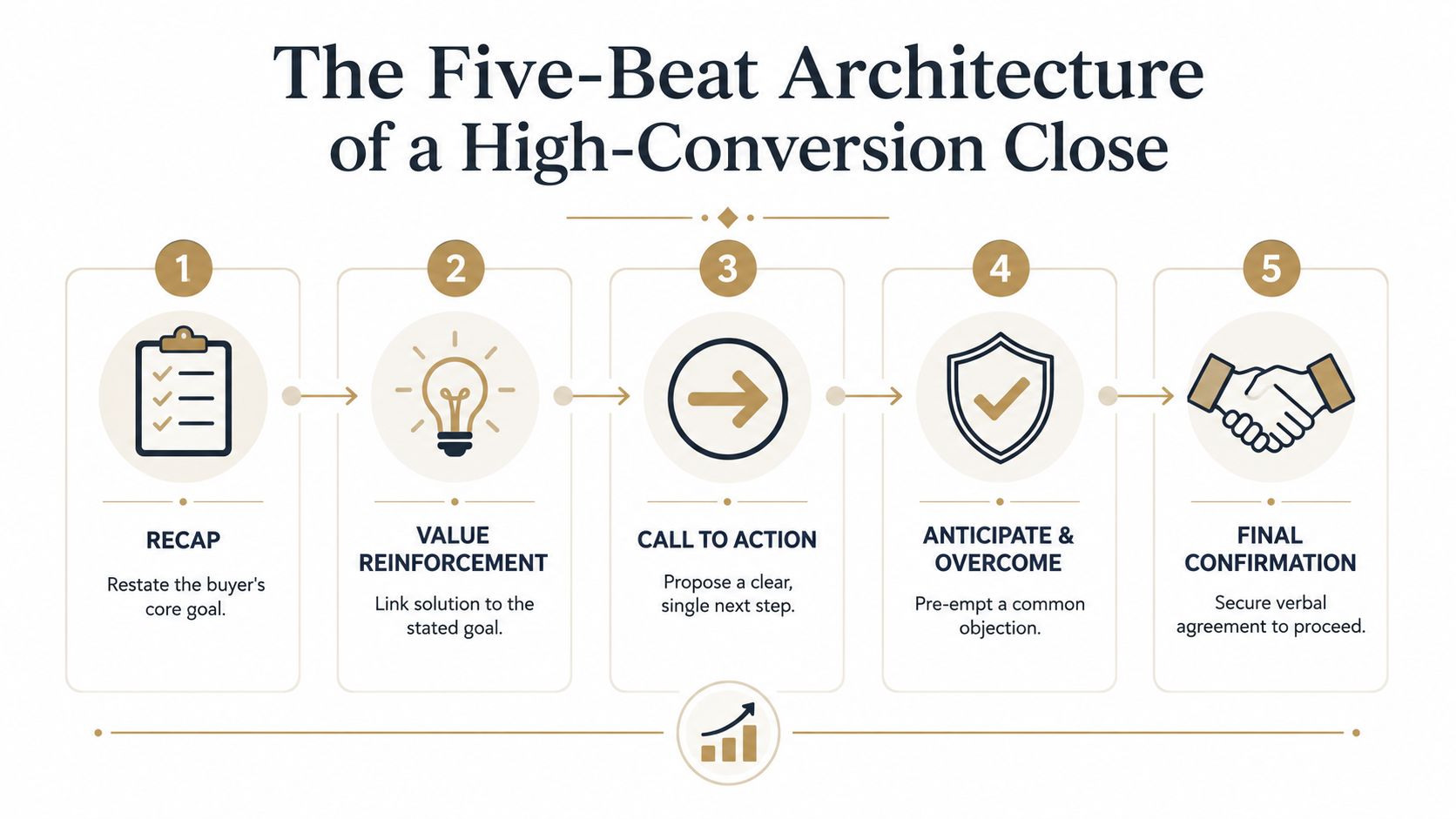
A strong ending works best when it follows five beats in sequence, not a pile of loose best practices. The cleanest close I’ve seen in B2B rooms starts with a recap, moves to value reinforcement, lands a call to action, pre-empts the objection you already know is coming, and finishes with a final confirmation that turns agreement into a scheduled next step. Adobe recommends spending about 5% to 10% of total presentation time on the conclusion, which on a 30-minute meeting is 90 seconds to three minutes, and puts the ideal written conclusion at 100 to 150 words, per Adobe Express. Five beats is a lot to fit in that window, which is exactly why they have to be rehearsed rather than improvised.
Beat 1, recap as a reframe
The recap should not replay the deck. It should restate the buyer’s goal in their language and show that the conversation was about that goal, not about your features. That’s the difference between “here’s what we covered” and “here’s why this matters to your team.”
Beat 2, value reinforcement
Proof belongs here. Not a feature tour, not a product inventory, and not another tangent. If you have one live metric, one customer outcome, or one specific workflow improvement, this is the place to connect it directly to the stated business problem.
Beat 3, call to action
The CTA is the explicit ask in the room. It should be singular and unmistakable. Multiple options feel generous, but they blur the decision, and a blurred decision is the one that gets deferred to email.
Beat 4, anticipate and overcome
This beat is about the objection you already know is coming, not the one someone raises unprompted. If every deal in this segment stalls on implementation effort, procurement timing, or an incumbent contract, name it yourself in a single sentence and answer it before it becomes the room’s reason to wait. Pre-empting a predictable objection reads as confidence. Getting ambushed by it reads as a gap in your preparation.
Keep it to one objection. A close that pre-empts four concerns sounds defensive and reintroduces doubt the room hadn’t reached on its own. Objections that surface live are a different problem, handled further down.
Beat 5, final confirmation
The last beat secures a verbal agreement to proceed and converts it into something on a calendar. That distinction matters in complex deals, because a team can agree with the direction without being ready to buy. “This makes sense” is not a next step. “We’ll get the ops lead on a call Thursday” is.
Only then do you open the floor. Don’t let questions hijack the ending, because a Q&A that starts before the ask dissolves the close into an open-ended discussion and the meeting runs out of time at the wrong moment. Confirm, name the path forward, then invite the room in.
If you want a practical reference for how strong sales decks structure the end, these sales presentation examples are useful because they show how closings can be built to support the conversation instead of just decorating it.
A 60-Second Close Script You Can Reuse Tomorrow
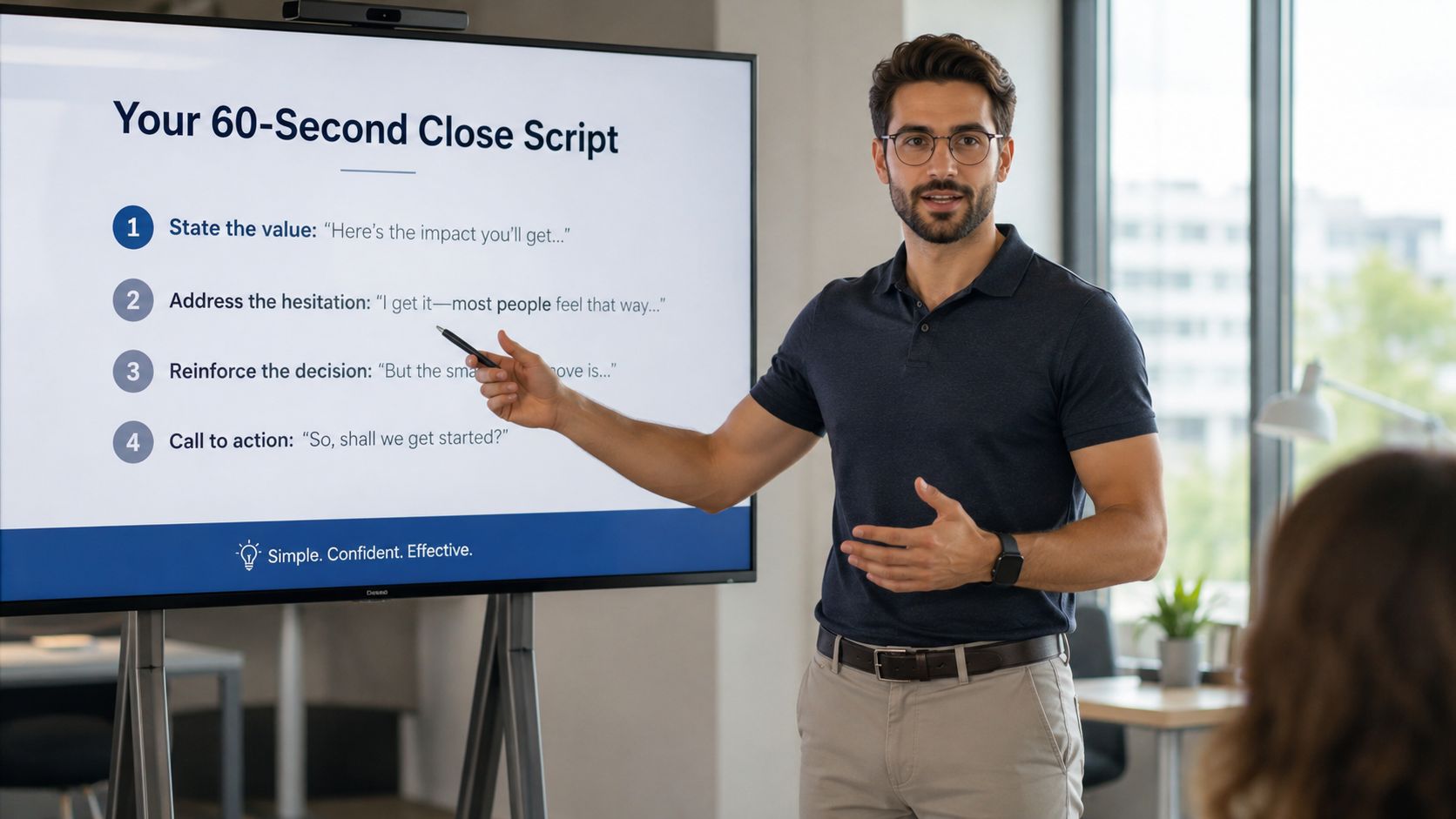
The fastest way to improve a close is to stop improvising the last minute. Use a script you can rehearse with a timer, then tighten it until it feels conversational. Presentation coaches converge on a surprisingly short window here. The Moxie Institute recommends 60 to 90 seconds for most business and executive presentations, up to three minutes for a longer keynote, and warns that if your conclusion runs past three minutes you are summarizing rather than closing, per Moxie Institute. That’s coaching experience rather than research, but it matches what the Adobe percentage implies, and it’s a useful ceiling to rehearse against.
A reusable verbal close
“Here’s the impact you’d get. Reporting stays current, the evaluation gets easier, and your team stops burning half a day a week on back-and-forth. I know the hesitation is usually rollout effort, and I get it, most teams we work with say the same thing, which is why the first phase is scoped to one workflow instead of the whole stack. The smarter move is to test it against the one report your team already argues about, because that’s where you’ll see the difference fastest. So, shall we get a working session on the calendar with the people who need to weigh in?”
That version does four things in order.
- States the value in the buyer’s terms, not yours.
- Addresses the hesitation you already knew was coming, in one sentence, without inviting a debate.
- Reinforces the decision by naming the smartest version of the next move.
- Makes one call to action that a person in the room can actually say yes to.
Say the ask, then stop talking.
That last pause matters more than most presenters think. If you keep filling silence, you convert a crisp ask into nervous noise, and the room starts responding to your discomfort instead of your question.
A web-native variation
A static deck forces you to freeze the proof weeks before you present it. A web-native deck lets you keep it current. If the value beat rests on a number, connect that stat to the spreadsheet it comes from so it refreshes while you build, and you walk in with the current figure instead of one you pulled last month. And the call to action can be a real element on the page rather than a line of text, so the next step is something the room can act on rather than remember. For teams already thinking in web-native delivery, how to make interactive slides is relevant because the close becomes part of the experience, not a separate afterthought.
A simple swap changes the feel of the room. Instead of “reply to the follow-up email,” you embed a scheduling block from Calendly, Cal.com, or HubSpot Meetings and let the buyer pick a slot inside the deck. Instead of “we’ll send a form,” a survey block in form mode collects the next-step request while the discussion is still live. That keeps the close tied to the moment when attention is highest, rather than to an inbox two days later.
Sequencing Commitments Across a Buying Group
The default advice says end with one CTA. That works in a one-to-one conversation, but it breaks down in committee deals where the room isn’t deciding one thing. Gartner’s 2025 buyer research put numbers on how crowded that room has become. Surveying 632 B2B buyers, it found buying groups ranging from five to sixteen people across as many as four functions, and that 74% of B2B buyer teams show unhealthy conflict during the decision process, while groups that do reach consensus are 2.5 times more likely to report a high-quality deal, according to Gartner.
Read that carefully and the implication for your close is specific. The group in front of you is probably arguing with itself, and a single all-or-nothing ask forces that unresolved conflict into the open at the worst possible moment. That’s why the strongest closings sequence small commitments. First, get agreement on the problem. Then get agreement on the criteria. Then ask for the next step. Each micro-commit narrows uncertainty without making the room feel cornered, and each one gives the group something easy to agree on before you ask them to agree on something hard.
What each ask sounds like
The first commitment is usually the easiest. “It sounds like the reporting delay is the thing creating the most friction. Is that fair?” That question is low risk, but it matters because it forces the group to align on the issue before they negotiate the solution.
The second commitment should clarify evaluation criteria. “If you were to compare options, would current data freshness and workflow visibility be the two things you’d want to judge first?” That’s not a pitch, it’s a way to define the lens the buyer will use later, including in the meetings you won’t be in.
The third commitment is the actual next step. “If those are the right criteria, can we book a working session with your operations lead and the person who owns rollout?”
How to handle the silence
Silence after the first ask is normal. Don’t rescue it. People need a beat to process whether they agree, especially when multiple stakeholders are in the room and not everyone wants to speak first. If the pause gets long, restate the question once, then wait again.
A shared next-steps slide sent by link helps here because it turns the close into something visible that the group can point at, forward, and argue about after you leave. A live survey block does the same thing inside the meeting. The mechanics matter less than the effect, which is that the room sees a path forward instead of feeling trapped in a verbal ping-pong match.
The practical difference is subtle but important. A single CTA asks for a yes. Sequenced commitments build a ladder toward yes, one rung at a time.
Handling Last-Minute Objections Without Losing the Close

Beat four handles the objection you saw coming. The hardest ending to manage is the other kind, where someone raises a real concern you didn’t plan for just as you’re ready to close. The instinct is to reopen the whole demo and defend every part of it. That’s the wrong move. You need to acknowledge the objection, park it visibly, and protect the next step.
Timing, authority, need
Timing objections usually sound like “This looks good, but we’re not ready this quarter.” Don’t argue with the calendar. Acknowledge the constraint, then ask whether the team should still define the evaluation criteria now so they’re not starting from zero later.
Authority objections sound like “I’ll need to bring this back to the VP.” Don’t push for a fake yes. Ask what the VP needs to see and whether you can set up the next meeting with the right people present.
Need objections sound like “We’re still figuring out whether we need this.” That’s often a signal that the problem framing wasn’t locked in. Return to the pain point, not the feature set, and ask whether the group agrees on the operational issue you’ve been solving.
A good objection response protects the next meeting instead of winning a debate.
That’s where link-based delivery helps. If the buyer wants evidence, send the rebuttal, supporting data, or follow-up detail after the call through the deck link instead of trying to cram it into the live ending. The room stays focused, and the close doesn’t turn into a second presentation.
Win Without Pitching makes a related point about where in a conversation objections belong, and why the late ones are the dangerous ones.
The point of the final two minutes is not to answer every possible objection on the spot. It’s to preserve momentum, isolate the primary blocker, and leave the room with a clear follow-up path.
Summary, Question, or Live Interaction at the Close
Choosing the last beat is a real decision, not a style preference. A summary ending helps when the room needs clarity and the buyer is still sorting the main points. A question ending helps when you want to draw the audience into reflection. A live interaction ending works best when you want active recall and a concrete next action.
It’s worth being honest about the evidence here, because this is a topic where confident-sounding statistics circulate without any study behind them. There is no credible research measuring recall of interactive versus passive sales presentations. What does exist is a large body of classroom research, and its most interesting finding is counterintuitive. In a Harvard study published in PNAS, students in active classrooms learned more than those in passive ones, but their perception of learning was lower, according to Deslauriers et al. (2019). A lecture hall is not a deal room, so treat that as a directional signal rather than proof. But the direction is useful. Interaction that feels slightly less smooth in the moment may still be doing more work than the polished monologue that feels better to deliver.
Choosing your closing format
| Format | Best for | Main risk | Interactive equivalent |
|---|---|---|---|
| Summary | Aligning a mixed group on the core message | It can feel safe but passive | A linked recap slide the group can forward internally |
| Question | Pulling out objections or sharpening interest | It can drift into awkward silence | A live survey block with ranked or multiple-choice answers |
| Live interaction | Driving recall and participation | It can overcomplicate a simple ask | An embedded scheduling block or an accept block |
The better default in B2B rooms is usually interaction, because it gives you observable engagement and a clearer signal of where the buyer stands. If you want to compare closing formats for specific presentation goals, these presentation interaction ideas are a useful reference point because they frame the ending as a choice between engagement modes, not a single static slide.
What static slides couldn’t measure, link-based decks can. You can see how long people spent on the closing slide and where the drop-off happened, read the survey responses they submitted, and, depending on your plan, see which links they clicked after the call. That turns the ending into something you can improve from one meeting to the next instead of guessing which close felt strongest in the room.
Your Rehearsal Checklist and In-Room Signals
A sharp close is easier to deliver when you rehearse it like a sequence, not a speech. Before the meeting, run through the recap, the proof point, the single ask, the objection you’re pre-empting, and the confirmation. Keep it short enough that you can say it without rushing, and make sure your final sentence is the one that directly asks for action.
Use the room to adjust in real time. If people are leaning in and asking practical questions, you can move sooner into the ask. If stakeholders are quiet but attentive, slow down and give the recap one more pass. If the buyer keeps returning to one blocker, park it visibly and protect the scheduled follow-up instead of letting the close unravel.
- Rehearse the final minute with a timer. Tighten it until the ask feels natural, not scripted.
- Keep one proof point ready. Use the strongest current data or customer outcome, not a bundle of examples.
- Pre-empt exactly one objection. The predictable one for this segment, in a single sentence.
- Ask for one next step. A meeting, a pilot, or a champion introduction, not all three.
- Watch who speaks first. The first reaction usually tells you whether the room is aligned or still negotiating internally.
- Leave a visible trail. A link, an embedded next-step block, or a shared recap slide makes the close easier to continue after the call.
The best presentation endings don’t feel like endings, they feel like the cleanest possible path into the next decision.
That’s where interactive, link-based decks give modern sellers real leverage. The close can carry current data, a scheduling action, and a follow-up path in one place, which is a lot stronger than a static thank-you slide. It’s a small design choice, but in a deal room it often decides whether the conversation fades or moves forward.
If you want to design closings that do more than politely wrap up, Encelade turns research, spreadsheets, and documents into interactive decks that carry next-step actions inside the same link. Build the close into the deck instead of bolting it on at the end, or book 30 minutes here to see it on a real deal.