Most creators hit the same wall when they start thinking seriously about how to pitch a show. The idea feels alive in your head, but the moment you try to put it into a deck, a verbal pitch, or a buyer meeting, it starts to flatten out. What felt electric on the page suddenly sounds vague, expensive, or hard to place.
That gap is where most pitches die.
It is worth being upfront about something here: you will find a lot of confident-sounding numbers about how selective TV development is — success rates, pilot-order percentages, pitch-to-series ratios. Most of them trace back to nothing you can check. We have left them out. What is actually observable is simpler and just as useful: buyers hear far more pitches than they can make, most development deals never reach production, and the projects that advance tend to be the ones that are easiest to say yes to.
That last part is the part you control. A show gets traction when the pitch does two jobs at once. It has to give an executive a story they can feel, and it has to give them an argument they can repeat to their own boss. Many writers do the first and skip the second. They work on premise, tone, and worldbuilding, then walk into the room without a clear case for fit, audience, and producibility.
The fix is practical. You need a core idea built around character, a package with real materials, a target buyer strategy, a verbal pitch structure that holds attention, and a follow-up process that treats the pitch like an active sales motion instead of a waiting game.
What a Pitch Actually Has to Do
A bought show usually starts the same way as an unbought one. Someone has a voice, a point of view, and a story they can see clearly. The difference shows up when that creator starts translating instinct into pitchable form.
That translation has to be concrete. Executives do not buy enthusiasm. They buy a show they can describe internally, compare against other programming, imagine staffing, and evaluate against budget and audience needs. If you cannot help them do that quickly, they move on.
The cleanest way to think about it: you are not presenting an idea. You are presenting a repeatable series engine, anchored by people worth following, packaged in materials that reduce uncertainty.
Practical rule: The pitch has to answer two questions at once. Why will an audience care, and why can this buyer make it?
A lot of advice treats pitching like a performance contest. Energy matters, but energy without structure reads as amateur. The room wants confidence, and it also wants evidence that you know what kind of show you are selling and what it will take to make it.
Three things change the quality of a pitch quickly:
- Sharper definition: know the logline, theme, tone, and central relationship well enough to state them plainly.
- Real materials: bring the script, deck, bible, and supporting visuals that let people see the show.
- Buyer logic: frame the project around fit, budget reality, and market context, not just originality.
Forge Your Core Idea
Most creators start with plot because plot feels like work. It is easier to explain twists, mythology, reveals, and world rules than to define a person so well that an executive immediately feels the engine of the series.
That is backward.
Writing for Stareable, producer Bernie Su puts it directly: “Focus on character development before diving into the plot.” This is common guidance rather than a formal industry standard, but it holds up for a practical reason. Buyers remember emotional engines before they remember lore.

Start with the person, not the mythology
If your show disappeared except for one character and one sentence about their problem, would anyone still lean in? That is the test.
A strong core idea usually locks five things early:
- The protagonist’s contradiction. Give the lead a tension that creates behavior. Not just a brilliant detective, but someone whose best quality keeps causing damage.
- The relationship the show keeps testing. Series television runs on durable tension. Partners, siblings, rivals, exes, mentor and protege. If that relationship keeps generating conflict, you have life beyond the pilot.
- The promise of the premise. Viewers should understand what kind of experience they are signing up for. Moral pressure cooker. Workplace collision. Family implosion. Survival puzzle. If the promise is muddy, the pitch is muddy.
- Why now. This does not need a manufactured trend angle. It does need urgency. Why does this story belong in the current conversation?
- Your authority to tell it. The room wants to know why you are the right creator for this material. Personal experience, obsession, access, or perspective all count.
If plot is doing all the selling, the concept usually has not found its center yet.
Build the assets that force clarity
Once the core is set, write the shortest useful version of every idea. That means a logline you can say without apologizing for it, a one-paragraph series summary, and character descriptions focused on desire and behavior rather than biography.
A good exercise is to strip every sentence down until only sales-relevant information remains. “Complicated” and “unique” do not help. “A grieving public defender starts sabotaging her own wins because she cannot accept who deserves saving” helps.
This is also where tone needs to become visible. Mood references, visual language, and concise comps can sharpen the pitch, but only if they clarify rather than decorate. If your references pull in different directions, the buyer starts doing cleanup work in their head.
For shaping those story beats into a presentable narrative, this guide on storytelling in presentations is useful because it focuses on sequence and clarity rather than slide polish.
Use a quick filter before you move on:
| Question | If the answer is weak | What to fix |
|---|---|---|
| Who is this about? | The protagonist sounds interchangeable | Sharpen the character contradiction |
| Why will we keep watching? | The pilot is stronger than the series engine | Clarify the recurring conflict |
| Why this show now? | The relevance feels generic | State the social or emotional urgency |
| Why you? | Your connection sounds distant | Define your actual authority |
A pitch-worthy idea is not just original. It is legible. The room should be able to repeat it after hearing it once.
Build Your Pitch Package
You get the meeting. You have ten minutes before the executive jumps to another call. If your materials are thin, the room has to guess at scope, at the durability of the premise, and at whether you can execute. That is usually when interest cools.
What counts as a complete package depends on format. Hollywood Consulting Studio’s breakdown of necessary TV pitch materials splits it cleanly: an unscripted or reality concept needs a logline, a pitch deck or website, and a sizzle reel of roughly three minutes, while a scripted idea needs a logline, a show bible or website, and a pilot script. Both start with the logline.
For scripted work, the pilot shows command of voice, structure, and pacing. The bible shows the idea can survive past the first episode. Stage 32 maintains a collection of real series bibles worth reading, which is more instructive than any template, because you can see how working writers actually handle world, characters, and season arcs.
It is also worth keeping a couple of backup ideas ready. Not to dilute focus, but because development executives often buy the second thing once they understand how you think.
A working package usually covers six things:
- Pilot script: finished, readable, and aligned with the show you are promising to make.
- Series bible: character arcs, world rules, episode engine, and season movement.
- Pitch deck: a clear visual case for tone, audience, and commercial fit.
- Character pages: short summaries centered on want, pressure, and function in the series.
- Look references or concept art: enough to show taste and production logic.
- Backup ideas: a few additional concepts you can discuss without improvising.
Why the deck has to do business work
A pitch deck has one job. Help the buyer retell your show accurately and argue for it when you are not in the room.
That means mood images are not enough. The deck should also answer the questions executives are working through while you talk. Who is this for. What existing audience behavior supports it. Can we afford the version being promised.
A data point can help here, though the reason matters more than the number. Hollywood Consulting Studio frames it as showing scale of interest: “Absolutely include an interesting statistic. It is eye-grabbing and makes your pitch that much more compelling because you are showing how many people this concept affects.” The goal is not to drown the room in research. It is to show the audience is real. And if you use a statistic, check it — an executive who catches one bad number will discount everything else you said.
The strongest decks usually include:
- Comparable shows: commercial neighbors, not personal favorites.
- Audience definition: specific viewers and the reason they stay.
- One credible market signal: a verifiable stat, trend line, or behavior pattern tied to the premise.
- Production shape: enough budget context to show you know the likely cost band.
- Distribution logic: why this belongs at a streamer, broadcaster, cable outlet, or indie studio.
For a practical model, this guide to film pitch deck structure and examples organizes the material around story, visuals, and buyer-facing logic rather than design tricks.
Use formats that help the pitch travel
A static PDF still works. It also creates version-control problems the moment your deck gets forwarded around a company.
Link-based decks solve a real operational issue. Everyone sees the same current version through one URL, and document analytics can show how the deck was actually read. DocSend, for example, documents page-by-page tracking per viewer, time spent per page, completion percentage, and real-time notifications when a document is opened.
For a producer, that is useful signal. If the team spends time on your budget section and skips your comps, you have learned which question is live inside the deal.
Tailor the Pitch to Your Target Buyer
A strong show can still get rejected for sensible reasons. Wrong audience. Wrong mandate. Wrong slot. Wrong budget band. Creators often hear “not for us” and treat it as a verdict on quality when it is really a fit problem they should have solved before the meeting.
The wrong buyer kills a good pitch
The fastest way to waste a pitch is to ignore what the buyer buys.
There is a step most first-time creators skip entirely. The same Stareable guide argues that your realistic target is usually not the streamer at all — it is the step before that. Independent writers rarely pitch Netflix, Hulu, or Amazon directly; they pitch production companies and producers who have existing relationships with those buyers and can bring the project in. Aiming straight at the streamer is a common way to spend months getting no meetings.
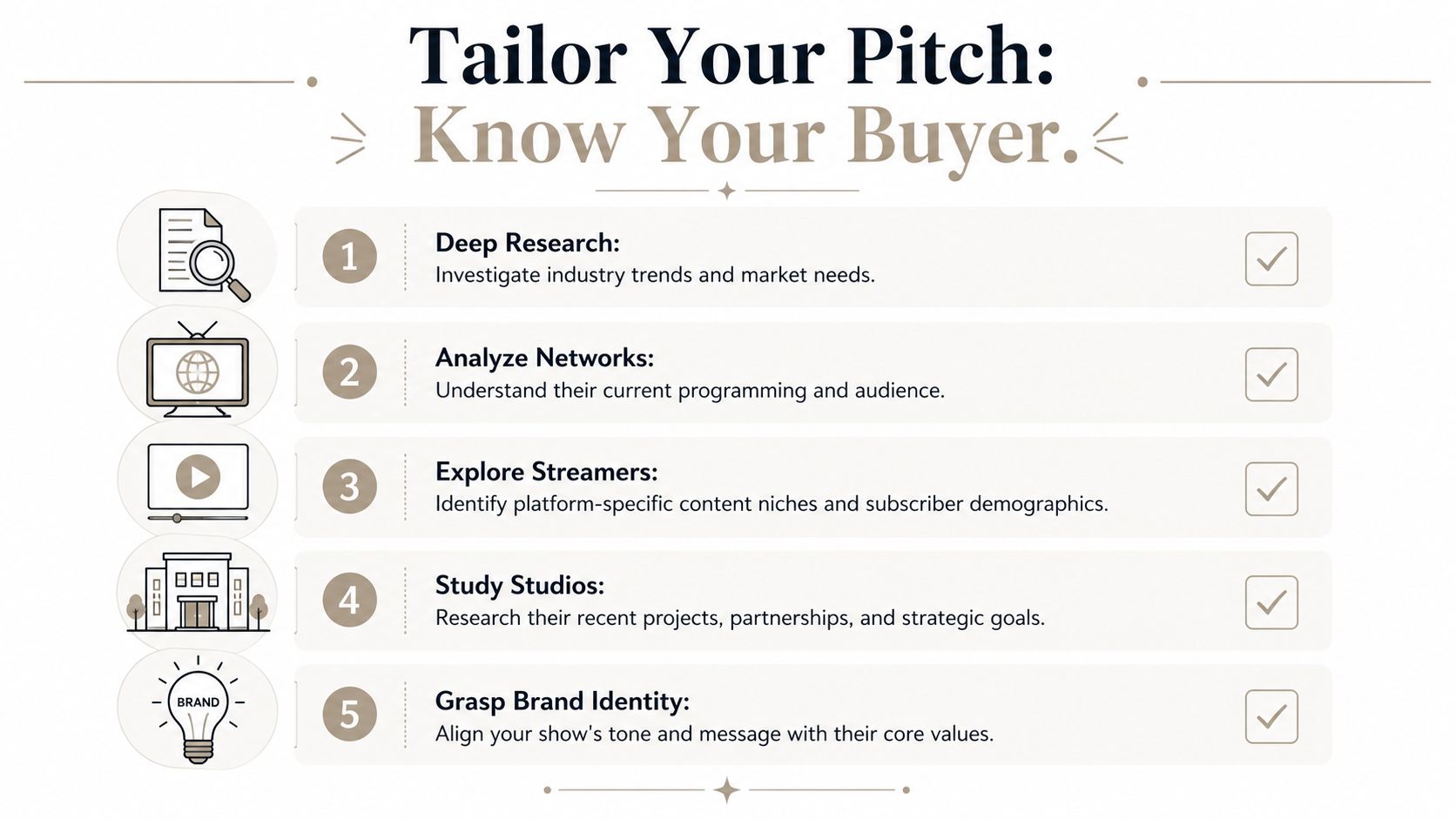
So research the production company, network, or studio the way a salesperson prepares for a major account. What tone do they return to? What kinds of protagonists do they back? What worlds do they avoid? Are they filling a slate gap or doubling down on a category they already understand?
Budget is where many promising pitches collapse. Buyers are not only reacting to concept; they are calculating burden. A pilot is a real capital risk, and most of the ones that get shot never become a series, so the person across the table is weighing your idea against the cost of finding out whether it works.
A useful buyer filter looks like this:
| Buyer question | What they are really asking |
|---|---|
| Does this fit us? | Will our audience recognize this as ours? |
| Can we make this? | Are the locations, cast, and scope manageable? |
| Can we market it? | Is the hook easy to communicate? |
| Can it last? | Is there enough engine for multiple episodes or seasons? |
If your series depends on heavy VFX, sprawling locations, or a large ensemble, the pitch has to show equivalent production awareness. Limited locations, controlled cast count, and repeatable sets do not make a show less ambitious. They make it easier to buy.
Do not pitch a budget problem and hope the room will solve it for you.
Run the verbal pitch like a buyer conversation
At this stage, creators often overtalk. They unload mythology, backstory, and theme before establishing fit.
A better approach is to narrate the pitch in a sequence that keeps the buyer oriented. Open with the personal reason the story matters. Move quickly to the human hook. Introduce the central character in the form they will appear in episode one, not in childhood. Then tie the conflict to the kind of programming the buyer in front of you actually makes.
If you are pitching a contained thriller to a buyer known for character-driven prestige, spend less time on mechanics and more on moral pressure. If you are pitching a commercial broadcaster, the recurring engine and audience accessibility matter more than formal experimentation.
That adjustment does not dilute the show. It proves you know who is listening.
Master the Delivery
Materials get inspected before or after the meeting. Delivery is what lives in the room.
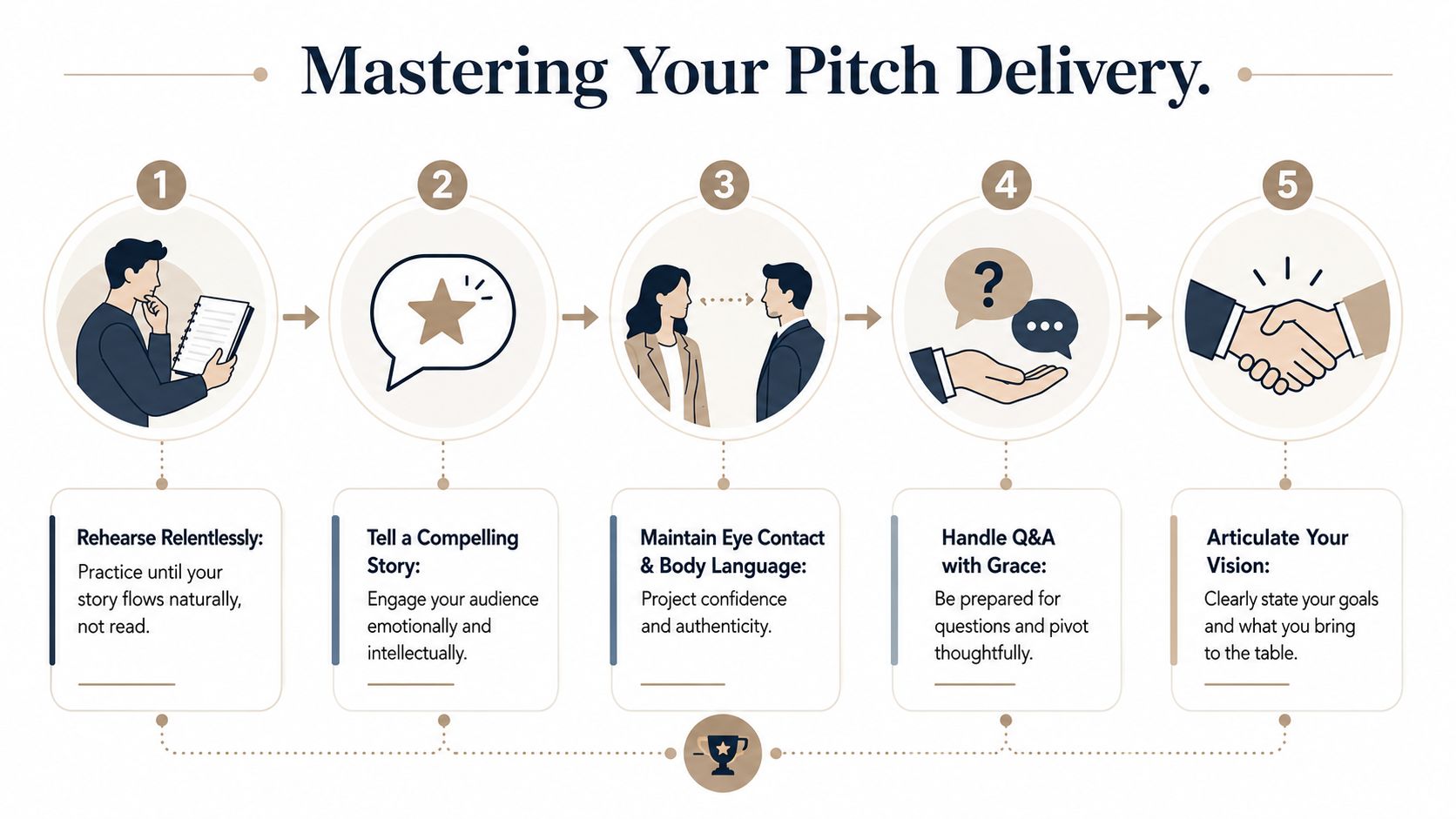
A lot of creators confuse passion with speed. They start talking fast, pile detail onto detail, and lose the buyer by minute four. Good pitch delivery feels natural but is highly built. It has structure, rhythm, and restraint.
A widely used seven-part flow
One of the more useful verbal templates comes from StudioBinder’s TV writing and development series, which breaks a pitch into seven parts: Origin, Human Hook, Characters, Desires, Obstacles, Highlights, and The Open Road.
Worth naming the caveat: this is StudioBinder’s own formula, not a rule the industry enforces, and they present it as points to hit rather than an order to obey. Treat it as a checklist for whether your pitch has gaps, not a script to recite.
What each part is doing:
- Origin gives the story a reason to exist. Why this idea stayed with you.
- Human Hook turns concept into feeling. What universal tension sits underneath it.
- Characters introduces the people we are investing in.
- Desires clarifies what they want right now.
- Obstacles creates story pressure.
- Highlights proves the show will produce memorable moments.
- The Open Road shows the series has room to keep unfolding.
The most common mistake is front-loading setup and saving the good material for the end. Buyers decide early whether they are leaning in. Get to the emotional engine fast.
Pacing should feel conversational. Pause after key sentences. Let people react. Leave space for questions. If you need help calibrating length, this guide to a 10-minute presentation and slide count is useful, because timing discipline matters in pitch rooms too.
The full StudioBinder episode is worth watching for how the seven parts sound in sequence:
Delivery is also follow-through
The meeting does not end when you stop talking. Your question-and-answer exchange is part of the pitch.
When an executive asks about budget, comps, audience, or future seasons, they are not derailing you. They are testing whether the project survives contact with reality. A defensive answer weakens trust. A calm, specific answer makes the pitch feel buildable.
The best answer in a pitch room is often shorter than the question that prompted it.
Prepare for objections in advance. Why this buyer. Why this scope. Why this lead. Why now. Why you. If you can answer those without spinning, the room starts to picture working with you, not just buying from you.
Follow-Up and Negotiation
Most creators handle follow-up emotionally. They either chase too quickly because silence makes them anxious, or they disappear because they do not want to seem needy. Neither helps.
Follow up with signals, not anxiety
The cleanest follow-up starts with a short thank-you note, then a measured check-in tied to something useful. A revised deck. A script draft. A clarified positioning note. A fresh comp. Give the buyer a reason to reopen the conversation.
If you sent a link-based deck, the analytics described earlier give you something better than guesswork. If the deck gets reopened several times or forwarded internally, follow up while the conversation is warm. If it gets no engagement at all, the next move is probably sharper positioning rather than another polite nudge.
A practical cadence:
- After the meeting: send thanks and the agreed materials.
- On the next check-in: reference the conversation, not just the calendar.
- If there is movement: offer clarity on open questions.
- If there is silence: reframe briefly, then let the room breathe.
Negotiate from clarity
If the buyer bites, the early negotiation phase usually reveals whether everyone heard the same show.
Get clarity on your role, the development path, the scope of rewrites, and what materials are being requested next. Stay specific. If they want changes, ask what problem they are trying to solve. If they want to reposition the audience, ask how that affects tone and episode engine. Do not negotiate from fear of losing the deal.
A creator who has pitched with business realism is harder to push off center, because the show’s identity, feasibility, and audience logic were already clear in the room.
Buying interest feels flattering. Do not let that flatten your judgment. The goal is not just a yes. It is the right yes, from the right buyer, under terms that preserve the show’s chance of becoming the version worth making.
Your Story Is Also a Business
Learning how to pitch a show means accepting something early: a great concept is only the opening bid. The buyer still needs a clear lead, a durable engine, professional materials, market logic, and a version of the show they can actually produce.
That does not cheapen the art. It protects it.
The creators who get traction tend to do the same few things well. They build around character. They package the idea in tangible form. They pitch buyers with real fit, which often means a production company before a streamer. And they treat delivery and follow-up as part of the sale. They do not ask the room to do interpretive labor. They reduce uncertainty.
Do that, and your pitch stops sounding like a dream and starts sounding like a project people can move on.
If you want a faster way to turn research, notes, and pitch materials into a shareable, web-native deck, Encelade is built for that job. It generates interactive presentations you send as a single link instead of a versioned attachment, with live data and interactive widgets when the material calls for them.