You’re probably trying to turn a messy discovery idea into something the team can actually use, staring at a half-finished doc. The topic and the method are probably there, but the plan still feels brittle because nobody has pinned down the participants, the approvals, the update cadence, or what happens if scope shifts after kickoff. That’s where a research planning template earns its keep, not as paperwork to fill in, but as the thing that keeps good research from getting stuck in review, logistics, or stakeholder confusion.
A good template forces the right conversations early. It turns a vague study idea into a fleshed-out plan people can align on, reuse, and challenge before anyone recruits a single participant or books a session.
Table of Contents
- Why Most Research Plans Stall Before They Start
- The Core Sections of a Research Planning Template
- Worked Examples for UX, Market, and Sales Discovery Research
- The Underweighted Sections That Decide Whether Research Ships
- Turning Your Plan Into an Interactive Research Deck
- Making the Template a Living Operating Document
Why Most Research Plans Stall Before They Start

The plan looked fine in the kickoff meeting. A few objectives went into the doc, someone suggested interviews, and the group agreed to figure out the rest after the first round of recruiting. Two weeks later, the project was stuck, because no one had decided who the primary audience was, what counted as success, or who could approve a change in scope.
That pattern shows up constantly. Modern planning guidance breaks research into planning, data collection, analysis, and reporting, and it tells you to estimate the time each phase needs, because a plan without timing is just a wish list, according to Asana’s research plan template guidance. The University of Sydney adds a useful second step. Once the full plan exists, write a 1 to 2 page summary of it, which is what you actually hand to prospective collaborators and partners, or use as an initial pitch to investors when the project needs funding from somewhere other than a grant, per the University of Sydney Researcher Development Hub. That’s a good reminder that the document has to travel across teams, not just sit with the researcher.
The four gaps that break the plan
The first failure mode is vague objectives. If the goal is written as understanding the experience, no one can tell whether the study should uncover usability friction, buying triggers, or message clarity.
The second is underspecified participants and sample size. A plan that just says to talk to customers isn’t enough: the team needs to know which segment matters, how many sessions are feasible, and what trade-offs are acceptable if recruitment turns out harder than expected.
A good research plan makes decisions before the calendar starts filling up.
The third gap is missing ethics and risk review. Even lightweight work needs a judgment call on privacy, consent, incentives, and whatever could go wrong during recruiting or fieldwork. The fourth is no defined cadence for updates. A plan that never names the owner of revisions, or the point where scope changes get logged, drifts fast, especially once analytics, CRM inputs, and multiple approvers are involved.
That’s why a research planning template isn’t just a form to fill in. It’s a governance tool that spells out what gets decided, who decides it, and when the team revisits it.
The Core Sections of a Research Planning Template
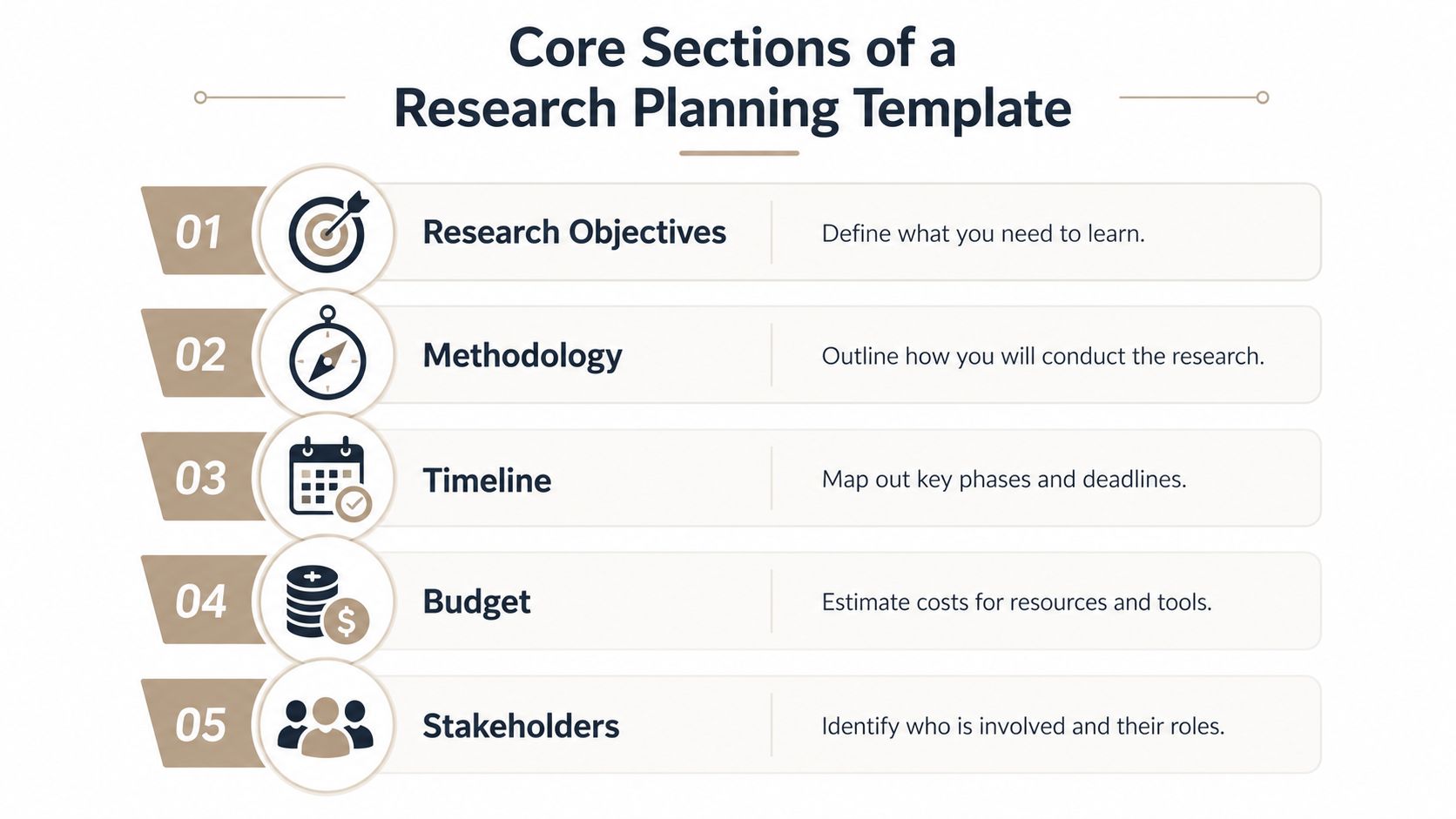
A usable template works because it narrows judgment into a sequence. The structure below follows the way strong plans are actually written, from the basic project framing out to the logistics that make the work possible. The order matters, because you can’t estimate feasibility until the question is clear, and you can’t finalize methods until you know who needs to be involved.
The diagram below condenses all of that into a five-part view you can put in front of a stakeholder. Treat it as the executive summary of the structure rather than the complete checklist. The sections that follow break each piece down further, and as you’ll see later, the parts teams skip most often are buried inside that detail.
Start with the problem and the reason it matters
Write a project summary and rationale that answers what’s being studied and why anyone should care. A clean prompt: this study examines a topic because of a business, product, or customer reason, and the finding will inform a specific decision.
The quick check is simple: if a colleague outside the team can’t tell why the research exists, the rationale isn’t done. The real-world version of this section should read like the opening of a funding conversation, not a diary note.
Turn objectives into verbs
A strong objective starts with a verb, something like understand, compare, test, map, or validate. That keeps the goal active and stops the plan from turning into a vague theme.
The prompt I use: we need to understand a behavior, barrier, or opportunity so we can take a specific decision or action. If the objective can’t be read aloud without sounding abstract, tighten it until it names the action.
Separate questions from hypotheses or success criteria
Research questions need to be focused and answerable. A good test is whether each one would actually produce a specific answer from the chosen method.
If the study is quantitative or decision-oriented, add hypotheses or success metrics so the team knows what evidence will matter. The clean check is whether the plan makes clear what result would change the next move.
Describe the method before you describe the schedule
The methods and study design section describes how the work will happen, whether that’s moderated sessions, a survey, interviews, secondary research, or mixed methods. The point isn’t to impress anyone, it’s to show that the method fits the question.
Use a prompt that names the method, the phases or rounds it runs across, and the question it answers. If the method doesn’t connect directly to the objective, then one or the other has to change.
Define who can participate and how many people are realistic
The participant criteria and sample size section is where many plans get sloppy, because the criteria are the most flexible part. Put in the target segment, the inclusion and exclusion logic, and a realistic limit on sessions or responses.
The completion check is blunt: can someone else recruit from this section alone, without pinging the researcher for clarification? If not, it’s not specific enough.
Name the instruments and the analysis plan
The data collection instruments section lists what the team will use, such as a discussion guide, survey, task script, or note-taking sheet. The analysis plan says how notes, tags, themes, or quantitative outputs get summarized, and what outputs the study will produce.
One methodological template guide lists 11 core components for a strong quantitative plan, including title, background, research question, hypothesis or objectives, variables, study design, sampling plan and sample size, instruments, analysis plan, ethics and risk management, and timeline or deliverables, according to the Documind research plan template guide. That level of specificity is what separates a plan from a rough outline.
Finish with the parts that make the work real
Add ethics and risk management, then finish with a timeline, milestones, deliverables, and budget. The prompt needs to cover approvals, logistics, and the handoff, not just dates.
A solid check is whether the plan tells the team when key decisions happen and what they produce at each stage. For formal grant work, NIAID recommends drafting in a specific order, a provisional title, then a draft of the Specific Aims, then the Research Strategy starting with Significance and Innovation before the Approach section, per NIAID’s guidance on writing your research plan. On the money side, it advises that most new investigators stick to a modular budget of $250,000 or less in annual direct costs, partly because reviewers tend to recommend deeper cuts to larger budgets, according to NIAID on creating a budget.
Practical rule: if one section can’t be used by a partner, recruiter, or stakeholder without a follow-up call, the template still needs work.
For a simple reference on how teams frame plan content in practice, the structure used in the business case template shows the same discipline, clear inputs, clear decisions, and clear output expectations.
Worked Examples for UX, Market, and Sales Discovery Research
The same scaffold behaves differently depending on the decision you’re trying to support. That’s the point of a good template, it shouldn’t force every study into the same shape, but it should keep every version honest about scope, participants, and outputs.
| Template Section | UX Research | Market Research | Sales Discovery |
|---|---|---|---|
| Project summary and rationale | Evaluate a new onboarding flow before release | Assess demand for a new category before launch | Understand buying roles and objections in a target account type |
| Objectives | Reduce friction in task completion | Estimate demand signals and category fit | Map how revenue conversations move through the buying committee |
| Research questions | Where do users hesitate during onboarding? | What language and needs signal interest? | Who influences the sale, and what surfaces late? |
| Hypotheses or success metrics | Fewer observed task breakdowns and clearer comprehension | Clearer category interest and consistent demand patterns | Repeatable buying roles and discovery themes identified |
| Methods and study design | Moderated usability tests plus a small unmoderated survey | Secondary research, quantitative survey, and qualitative interviews | Stakeholder interviews plus CRM pattern analysis |
| Participant criteria and sample size | New users who match the onboarding audience | Buyers and prospects from relevant segments | Sales reps, managers, and stakeholders tied to the funnel |
| Data collection instruments | Task script, moderator guide, survey | Interview guide, survey instrument, desk research notes | Interview guide, CRM review template |
| Analysis plan | Tag friction points and summarize task issues | Compare segment themes and quantify demand patterns | Group role patterns, objections, and account signals |
| Ethics and risk management | Make consent and recording rules explicit | Be clear about respondent privacy and incentive handling | Protect internal account data and approval boundaries |
| Timeline, deliverables, budget | Session schedule, findings readout, recruitment costs | Milestones for fieldwork, analysis, and category summary | Phased interviews, CRM review, stakeholder-ready briefing |
What changes across the three use cases
UX work leans hard on participant criteria and observable task behavior. If those aren’t precise, the team ends up testing the wrong people, or drawing conclusions from the wrong moments in the flow.
Market research, on the other hand, leans more on the sampling plan and analysis plan. The study has to balance broad signal with enough structure to make the results useful for product, marketing, or pricing decisions.
Sales discovery is different again. It needs audience segmentation and a deliverable that sales managers, enablement, or ops can actually work with, especially when the research is meant to feed CRM language or account planning.
Plenty of teams reuse the same template across all three, as long as the prompts stay disciplined. The details change, but the questions don’t.
The Underweighted Sections That Decide Whether Research Ships
Teams love the visible parts of the plan because they’re easy to discuss. Objectives sound strategic. Methods sound rigorous. A timeline slides into a meeting deck without much friction. The trouble usually starts in the sections people rush through because they feel administrative.
Ethics and risk review need real decisions
A serious ethics and risk management section doesn’t just say the research will be respectful. It names consent, privacy, data handling, recording, and any edge cases that could create confusion or harm.
That matters even in commercial work. If the plan doesn’t spell out how participant data will be used, or who can see it, someone eventually pauses the study to ask, and by then the momentum is already gone.
Feasibility lives in the budget, the calendar, and the recruitment plan
A plan that ignores budget realism usually gets derailed by small things, not one giant mistake. Incentives are the obvious line item, and they aren’t optional, participants should be compensated for their time one way or another. Where the plan can flex is format, since running sessions remotely means spending less on incentives, office setups, and parking validation, which is often the difference between a study that fits the budget and one that doesn’t, according to the User Interviews field guide on research plans.
That same source also recommends collecting the existing insights already available through stakeholder interviews, secondary research, analytics, and customer feedback before the study starts. That’s a useful discipline because it stops teams from paying to rediscover what they already know.
A plan is feasible when the recruiting, tooling, and approval steps fit the calendar you actually have, not the one you wish you had.
Governance is the part most templates leave vague
The gap that does the most damage is stakeholder governance. Most templates ask who the stakeholders are and how findings will be shared, but they stop short of naming the decision owner, the review cadence, or what happens when scope changes. That omission turns the plan into a static file instead of a live artifact.
Mainstream templates have caught up on part of this. Asana’s, for example, prompts you to plan how you’ll share findings and to define both the audiences and the deliverable formats. What it still doesn’t ask is who owns the document after kickoff, or what triggers a revision. The practical takeaway is simple: if nobody owns updates, the plan drifts the moment the project meets reality.
The best teams treat the document as a governance artifact. They define who approves changes, who sees the findings first, and when the plan gets revised after a scope shift. That’s what keeps research from ending up in a shared drive full of careful notes and no path to action.
Turning Your Plan Into an Interactive Research Deck
A planning doc gets opened, skimmed, and forgotten. A deck with live data, clear structure, and shared ownership gets used in meetings. That difference matters when the plan needs buy-in from sales, marketing, revenue ops, or product leaders who won’t spend time hunting through a long file.
Move the template into a slide structure people can review quickly
The cleanest approach is to turn each major template section into its own slide cluster. The opening slide carries the project summary and rationale, the next set covers objectives, questions, and methods, and later slides hold participant criteria, analysis, ethics, and timeline.
That structure matches how people actually read a plan. Stakeholders want the summary first, then the decision points, then the operational details that show whether the study can run.
Use interactive widgets where static slides break down
A tool like Encelade can fit naturally into this process, since it turns research, CRM notes, spreadsheets, and documents into interactive decks. It ships 50+ interactive layers, live connections through Google Sheets, Notion, Salesforce, Stripe, HubSpot, Google Analytics, and Amplitude, custom branding on Pro and higher plans, and PDF and PPTX export on every plan for offline sharing or archives. In practice, that means the plan can show participant segments, schedule milestones, or live metrics without needing a separate spreadsheet attachment.
Interactive widgets earn their keep in three places.
- Participant views: Use charts, maps, or device mockups to show who is in scope and how the sample is distributed.
- Timeline views: Use a phased schedule or Gantt-style slide so stakeholders can see when recruiting, fieldwork, and readout happen.
- Decision views: Use live tables or linked metrics so the plan reflects the latest inputs instead of a stale snapshot.
Keep branding and sharing simple
A research plan usually gets forwarded through several teams, so the deck needs to look official without becoming hard to edit. Themes, custom branding, and a consistent layout help the document feel like part of the company’s operating system rather than a one-off artifact.
The sharing model matters too. A link-based deck is easier to circulate than a file that gets duplicated and renamed three times over. If someone still needs a static copy for review, export to PDF or PPTX keeps the content portable.
For the mechanics of building that format, the interactive slides guide is a useful companion when you’re turning a planning doc into something people can click through.
Making the Template a Living Operating Document
A research plan only works if someone owns it after kickoff. In practice, that means the template needs a named editor, a clear threshold for revision, and a distribution method that keeps every stakeholder on the same version. Without those controls, the document turns into a record of what was decided, not a guide for what happens next.
The operating model has to stay simple enough to use under pressure. The template captures research intent, the deck carries it to the people who need it, and the team revisits both when scope, timing, evidence quality, or stakeholders change. That cadence matters, because plans break in the middle of a study, not only at the start.
Shipping checklist: name the owner, define the update trigger, set the review cadence, and share the live deck link with every approver who needs visibility.
A stronger template also needs a revision log, not just a set of static fields. I use a short table with four columns, date, change made, reason for change, and approved by. That format makes it obvious why a plan shifted and who accepted the change, which is usually what gets lost when teams only store the latest copy.
Ownership should be explicit as well. A simple RACI matrix works better than vague accountability. The research lead should own the content, the project manager should track timing, the subject-matter expert should review methodological risk, and the stakeholder group should approve changes that affect scope or interpretation. For a deeper look at how teams manage document versions, see our guide on version control for documents.
Update triggers should be specific enough to avoid debate. Revise the plan when the target audience shifts, when recruiting starts missing the agreed profile, when the discussion guide changes the research question, or when a stakeholder asks for a new decision the study wasn’t set up to answer. Those are the moments that affect validity or alignment, so they belong in the operating rules instead of being left to memory.
Every study should end with a short postmortem on the template itself. Note where the participant section was too loose, where the analysis prompt didn’t force a decision, and where the approval path slowed the work down. Then rewrite the template so the next project starts with fewer gaps and less cleanup.
A research planning template earns its place when it shapes how a team edits, approves, and learns from research, not just how it launches it.
Ready to turn your research plan into something stakeholders actually review? Explore Encelade to build an interactive research deck in minutes, or book 30 minutes here for a walkthrough with the team.